
Esther Chiang has an unusual CV even by the standards of legal tech founders. She read electrical engineering and English literature at Stanford, spent time at Qualcomm, then went to law school. Fifteen years of private funds practice followed, first at Sidley Austin, then as a partner at Kirkland & Ellis and Paul Hastings. In 2025 she left private practice to co-found SmartEsq, a New York-based platform built specifically for the legal work that goes into raising and running private funds.
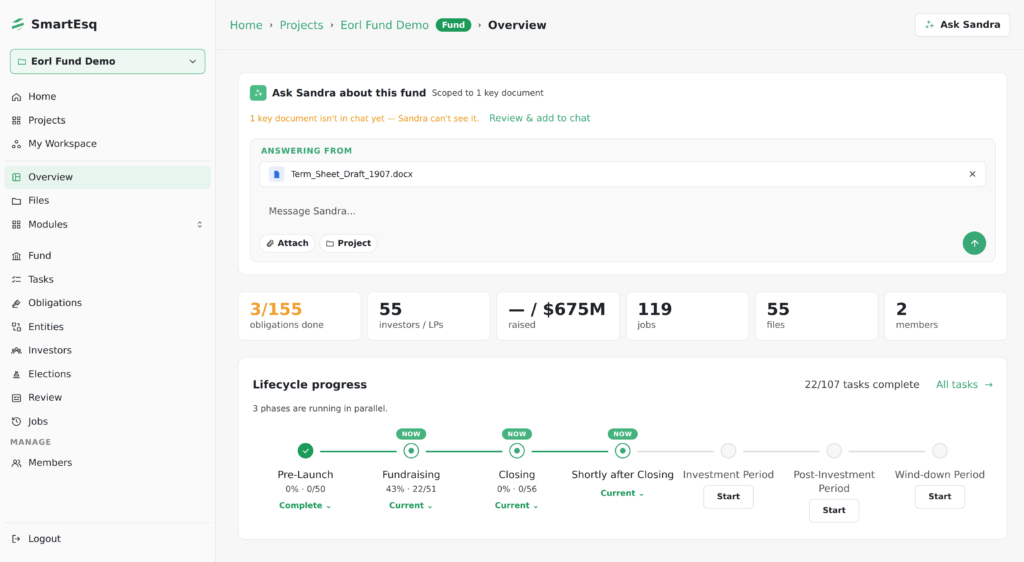
The platform is designed to sit across the whole fund lifecycle rather than solve a single document at a time. Its Summer 2026 release added a Fund Lifecycle and Task Tracker, an Obligations and Compliance Register that pulls ongoing commitments out of side letters and fund documents, and an expansion of Sandra, the company’s legal assistant, which now works across an entire fund and cites its answers back to source pages.
In paraphrasing Esther’s words regarding the arithmetic: forming a large private equity fund can take around 2,000 hours of legal work, and her ambition is to bring that closer to 400.
From Kirkland partner to pseudocode
The origin of SmartEsq is older than the company. Esther traces it back to 2015, the year she made partner at Kirkland & Ellis. The firm was experimenting with legal technology at the time, mostly conditional-logic document platforms. To Esther, whose engineering background ran deeper than most partners’, the technology was too rudimentary. She could imagine what a more sophisticated system might look like, but what she could not do in 2015 was build one. “I did not have the resources or the time to run neural network analysis myself. I remember thinking that perhaps one day, when the technology became more accessible, we could do it.”
That day arrived in late 2022, when ChatGPT’s launch began making large language models widely accessible. By the end of 2023 and going into 2024, she had enough concepts and pseudocode written down to bring the project forward, and she made the decision to leave private practice in 2025 to build it.
Esther described the transition from law firm partner to founder as less of a pivot than one would expect. To her, it feels more like a self-realisation arriving a bit later in life. “I have always had this tendency to move between technology and the humanities. What I am doing now in legal tech feels like a very natural step for me. I think this is probably my dream job, although I did not know that a long time ago. Of course, 20 years ago, this profession did not really exist” she says.
TLW: You are selling software into a market where you were until recently a partner. What does that access give you that someone outside the funds bar might struggle to replicate, and is there any aspect where being a former insider make the sale harder?
Esther: “The biggest advantage is that I don’t need a translator. When a funds partner describes the week before a final close, with side letter requests arriving at midnight and MFN election related negotiations running across dozens of investors, I have lived that exact week many times. That shapes the product: we build around the real workflow of a fund formation, not a generic idea of legal work. It also means I can talk candidly with partners and general counsel about where the hours actually go, and they know I am not guessing. In a market built on trust and reputation, that credibility matters. Where it cuts the other way is that some firms see a former partner from a peer firm and wonder whether I am a competitor rather than a vendor. I understand that instinct. The answer is that SmartEsq is not a law firm and does not want to be one. Our job is to make lawyers more effective, and our data architecture is designed around confidentiality from the ground up. The other challenge is internal: I have to remind myself that the way I ran deals is only one way. Our customers teach us constantly, and the product is better because we listen.”
Not agentic. Multi-agentic.
In August this year, SmartEsq announced what it called the “largest product release in its history”, introducing more than 260 enhancements and 7 major capabilities in an effort to take SmartEsq to what Esther describes as the genuinely end-to-end product she originally envisaged. For her, the enhancement list is not the most interesting part about SmartEsq. “The most advanced part is the intelligence we have built to connect the dots across different functions. Our goal has always been to simulate many of the processes that a real lawyer goes through.”
The examples she makes will likely resonate closely with funds lawyers: an LPA gets amended, and now several other documents may need to be amended to reflect the change, or an investor drops out of a deal, and half a dozen instruments need updating in response. Recognising those knock-on effects, and doing something about them without a human having to think of it, is what the frontier looks like in Esther’s vision.
She is faintly amused by how the industry talks about this. “People ask me questions such as, is your system agentic? The answer is that we are not only agentic; we are multi-agentic.” In practice, that means SmartEsq combines LLM calls with pre-processing and post-processing using more traditional techniques, including vectorisation and classical machine learning, and fine-tunes models for specific tasks. Substantial internal effort has gone into what she calls “textbook-style content”, written material produced by SmartEsq’s own lawyers to refine the context available to the system. And where a task benefits from deliberation, different agents vote against one another to reach a decision.
Autonomy is configurable per customer. The platform can act on its own, or only after human approval, and it flags conflicts between pieces of information for confirmation rather than resolving them silently. Each customer runs in its own instance.
TLW: You mentioned that different agents vote with one another to simulate deliberation. Can you walk readers through one concrete example of what that looks like in practice, and what kinds of decisions are worth deliberating on vs running through a single model?
Esther: “MFN analysis is a good example. When an investor makes its elections under a most favoured nation clause, the system has to decide, provision by provision, whether that investor is actually entitled to what another investor negotiated. That turns on several questions at once. Is the provision personal to a particular investor, for example because it is tied to its regulatory or tax status? Is it carved out of the MFN altogether? Does the electing investor’s commitment meet the relevant size threshold? Those are judgement calls where reasonable readings can differ. So rather than asking one model once, several agents analyse the provision independently, from different angles, and their conclusions are compared. Where they agree, confidence is high. Where they disagree, the disagreement is itself useful information, and the system surfaces it to a lawyer instead of quietly picking an answer. By contrast, pulling a closing date or a signatory’s name from a document does not need a committee. My rule of thumb is simple: if two experienced funds lawyers could plausibly disagree, it is worth deliberating. If they couldn’t, a single well-contextualised model, checked by traditional techniques, is faster and just as reliable.”
The lawyer, the chatbot and the… bicycle theory?
A theme we touched on repeatedly when discussing the market SmartEsq operates in is that lawyers are still treating AI as a chatbot. She thinks this is largely attributable to a gap in training. “Lawyers don’t have sufficient access to genuinely AI-focused training. Their information may be slightly outdated. Perhaps it’s because law firms have traditionally concentrated on continuing legal education.” Her standard recommendation to lawyers who ask what to do is to take actual AI courses, of the kind Andrew Ng’s DeepLearning.AI offers.
The metaphor she uses to explain the misunderstanding is that “it is very beguiling when you are interacting with a chatbot, because the interaction takes place in English. We assume that because we understand the language, we understand the technology. But that is not necessarily true. AI is an algorithm. It is not human. We need to understand the underlying mechanics driving it and what we are supposed to do when using it. It is a little like learning how to drive or ride a bicycle.”
She describes two failure modes among the lawyers she talks to. At one end, a practitioner throws a complex documentation task at a general-purpose model with no context, no fine-tuning, no background material. The output is poor and the practitioner concludes the technology does not work. At the other end, a practitioner asks a question, accepts the reply without checking, and loses the chance to build any judgement about what the tool is good at. “The misconception is that AI somehow operates differently from every other tool. Just like any other tool, you have to learn how to use it properly.”
Esther’s view of which customer group is furthest ahead on this curve is unflattering to the one she sells most software to. Law firms, in her observation, are behind the general partners and limited partners she also serves.
TLW: You said that, in your view, law firms are further behind on AI than the GPs and LPs. What are the GPs and LPs doing differently, and what is the specific behaviour a law firm would need to change to use AI as effectively as GPs and LPs?
Esther: “The GPs and LPs I work with tend to approach AI as operators rather than evaluators. They run businesses with finance, operations and data teams, and they are used to asking a very practical question: which process is costing us the most time, and can we redesign it? So they start with a specific workflow, such as tracking side letter obligations across a fund family, put the technology into that workflow, and measure the result. Many of their investment professionals have used data and analytics tools for years, so an algorithm does not feel foreign to them. Law firms often start from the other end. A tool is procured after a long evaluation, handed to associates and used as a chatbot for ad hoc questions, while the underlying workflow stays exactly the same. The billable hour does not help, because the incentive to redesign a process that bills well is weaker. The specific change I would suggest is for partners to take ownership. Pick one workflow the firm repeats on every fund, rebuild it around the technology rather than bolting the technology on, and have senior lawyers use it themselves. When partners understand what the tool can and cannot do, the whole team follows.”
On client data and anonymisation
The line between lawyer training to client-data governance is a thin one, and during our call, Esther draws it herself. Earlier this year she published a piece critiquing the Kirkland & Ellis and Palantir partnership, in which the two are reportedly building a proprietary fund formation AI platform for Kirkland’s exclusive use. Her critique is not that the technology is misguided. She thinks the underlying thesis is correct. It is that the platform is walled, that Palantir is an unusual partner for an industry built on discretion, and that concentrating this capability inside a single mega-firm is not where the market should end up.
Her scepticism about how law firms plan to use client data goes further than the Kirkland deal. “Traditionally, law firms have argued that they can anonymise that information. But I would challenge that assumption. Simply removing names does not necessarily prevent AI from identifying which client the information belongs to. It may still be relatively easy to work that out.”
What has indeed changed, she thinks, is scale. Previously client information sat in individual lawyers’ heads and was shared, if at all, in a generalised way. An industrialised system that processes large volumes of client information and retains that knowledge indefinitely is a different animal.
SmartEsq’s design responded to this early. “We designed the platform from the outset so that we never train models using our clients’ data unless they have expressly consented to it. In fact, we always assumed that everyone would say no. So we planned accordingly.” Most of the training data, Esther says, is written by SmartEsq’s own team.
What still surprises her is what does not come up during vendor procurement at law firms. Firms ask about cybersecurity and security certifications, but they don’t yet (at least, in her discussions with them) ask what data the system is trained on, nor how the firm’s own obligations to its clients are being met when it uses the platform. She’s seen relatively few firms revise their engagement letters to obtain express consent from clients for AI training rather than a general disclosure.
TLW: SmartEsq positions itself as the independent alternative to walled-garden platforms. But independent venture-backed AI companies have historically been bought, wrapped or partnered into the same ecosystems they were meant to challenge. What structural commitments is SmartEsq making so that its independence remains?
Esther: “It is a fair question, and I would rather answer it with architecture than with promises. Independence has to be built into the product so that it holds regardless of what happens around us. First, the data belongs to the customer. Every customer runs in its own instance, we do not train on client data without express consent, and customers can take their data with them. A platform that does not hoard its customers’ information has far less to offer a walled garden. Second, we build for the whole market rather than a single firm. The same platform serves law firms of every size as well as GPs and LPs, and it is designed to connect with the systems they already use rather than lock them in. Third, the company is led by funds lawyers, who understand that confidentiality is the product, not a feature. Ultimately, our customers are the strongest safeguard. If we ever stopped being neutral, the firms and sponsors who rely on us would leave, and they would be right to.”
A possible golden age for smaller firms
Esther’s prediction for what happens to private funds if SmartEsq’s thesis is right is this: fund formation could become at least five times more efficient, both on cost and on time.
She also draws consequences from that number. “One possible consequence is that we will see more smaller general partners and, hopefully, more small and midsize law firms participating in this market.” The reason funds work has concentrated in a handful of very large firms straightforward to Esther: it takes bodies. Servicing a hundred LPs’ repeated obligations is an issue with headcount (at least, more than it is with judgment), and only the largest firms had enough headcount to bid for the work. Take the headcount problem away, and what is left is judgement, which smaller firms already have. “We could enter a golden age for midsize and perhaps even smaller law firms working in private funds.”
The other shift she is watching for is digitisation. Private funds remain a paper-and-PDF market compared with public equity or cryptocurrency, where transactions are highly digitised and participants exchange data rather than documents. Whether AI turns out to be the mechanism that finally moves private capital in that direction is, she concedes, to be seen. It is one of the outcomes she says she would most like to see.
Pluto, and the future of the profession
Esther closes on a note that would not be anyone’s first guess. Her message to readers, when asked, is that lawyers should be more creative about imagining what the future of law could look like. Her reference, very Esther-esque, is to a Netflix anime called Pluto, in which an AI robot judge is murdered and AI detectives are deployed to investigate. “Obviously that is a rather extreme example. I do not necessarily think that is where we are heading. But it is a good metaphor for imagining what the future could look like.”
She then says “I have always felt that my identity has a certain duality because of my different interests and backgrounds. But fundamentally, I think of myself as a lawyer. And I want to participate in building this future of law. I hope other lawyers feel the same way. We should all be part of that conversation.”
TLW: You describe yourself as a lawyer first and a technologist second. Is there one thing today’s funds lawyers should be doing to make themselves useful to the future of the profession, rather than watching it happen around them?
Esther: “Learn how the technology actually works, and then write down what you know. The most valuable thing a funds lawyer has is judgement: knowing why a clause is drafted the way it is, which investor requests are market and which are not, and what tends to go wrong at a final close. Today most of that knowledge lives in people’s heads and is passed on informally, one associate at a time. AI systems are only as good as the context they are given, and the lawyers who can articulate their expertise clearly, in a form a system can use, will shape what these tools become. That is exactly what our own lawyers do when they write the textbook-style content behind SmartEsq. So take a proper AI course, not a CLE session about AI, so that you understand the mechanics rather than just the chat window. Then pick one area of your practice and explain it as if you were teaching a very capable new colleague who has never seen a fund document. It will sharpen your own thinking, and you will be ready to help design the future of the profession rather than simply inherit it.”