

Almost every legal AI product currently on the market shares a design assumption most users don’t even notice anymore: the intelligence sits behind a prompt.
You navigate to it, ask it a question, and evaluate what it returns. That model has become so pervasive across the category that it is easy to forget it is a choice, and one with consequences. The prompt-and-response pattern requires the user to notice a problem, articulate it well, and remember to open the tool in the first place. In a practice where a lawyer moves between six clients in a day, some of that memory attention inevitably fails.
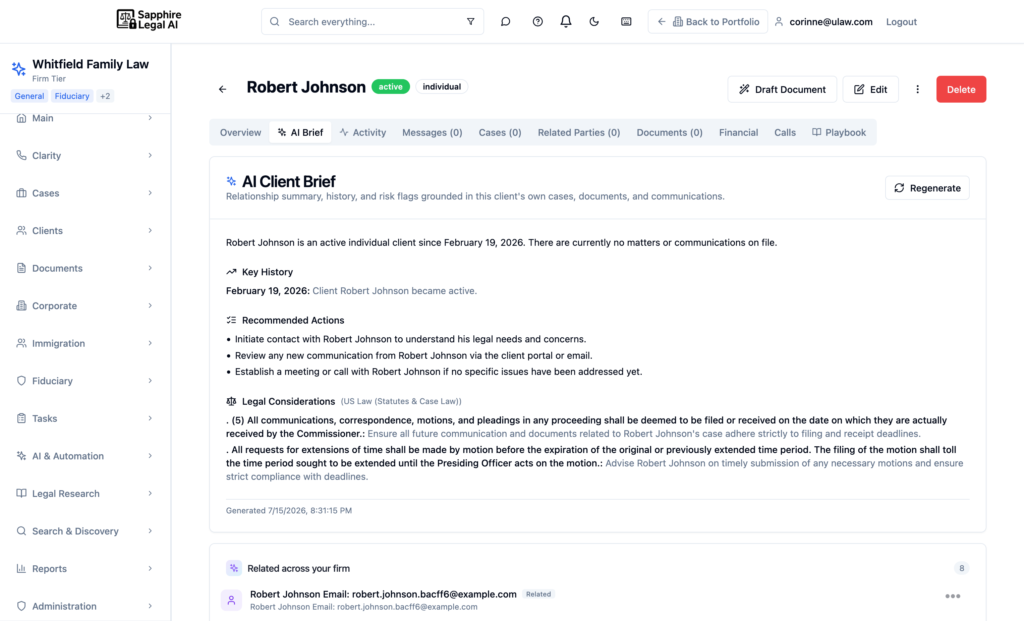
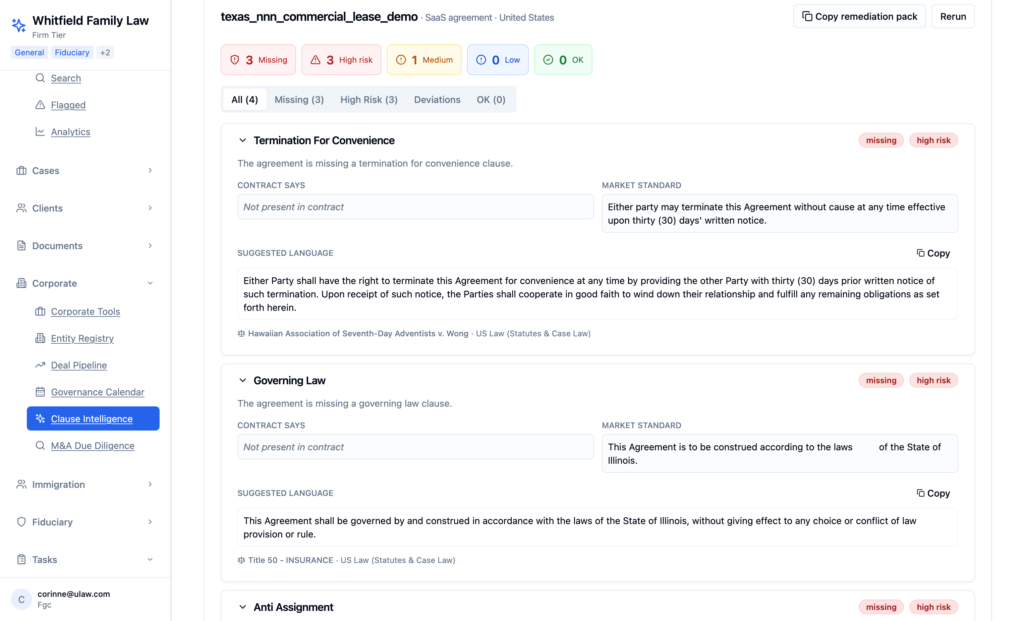
Sapphire Legal is a platform building against that assumption. It calls the alternative Ambient Intelligence, and the argument is that the AI should already be running when the user opens the matter, not waiting for the user to summon it. Upload a document and it is classified, filed and cross-referenced automatically. Open a matter and the brief surfaces before the user has read a word. A contract lands in a client’s inbox and a risk score is already attached, ranked against that client’s own negotiation playbook. The trigger is the event, not the click.
Sapphire Legal is built specifically for fractional general counsels, or fGCs, a category of legal professional the wider legal technology market has, by Brett Wilson‘s account, structurally overlooked.
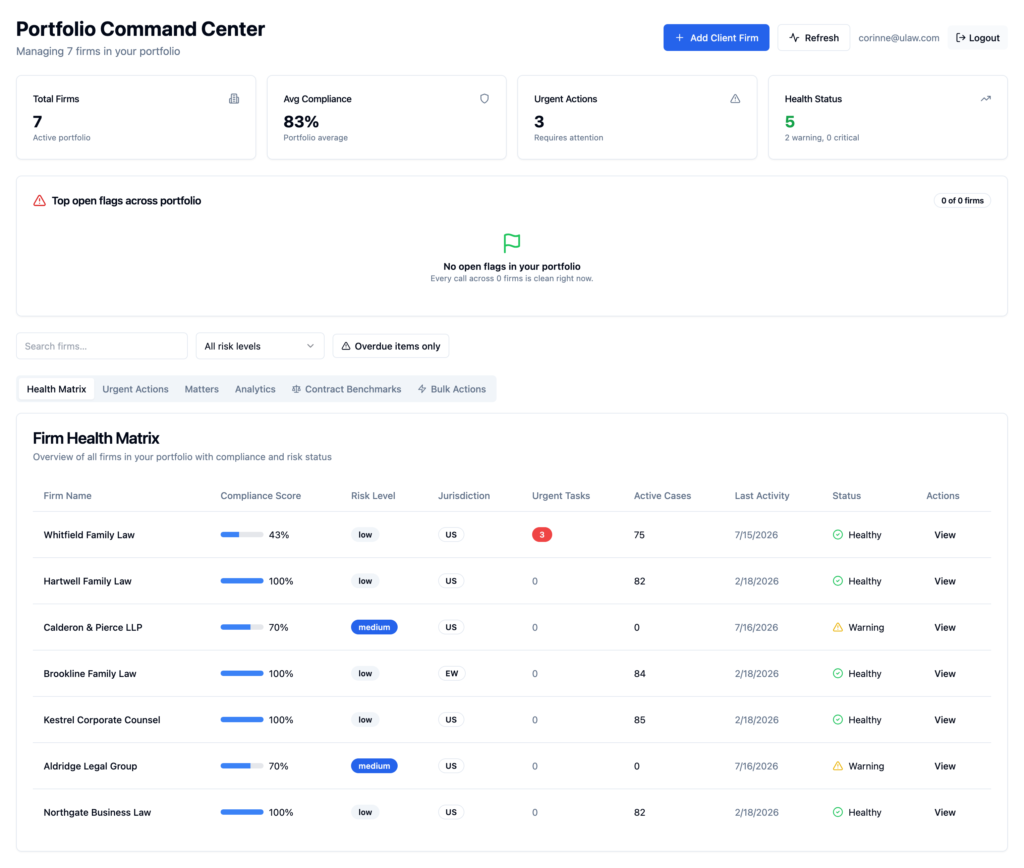
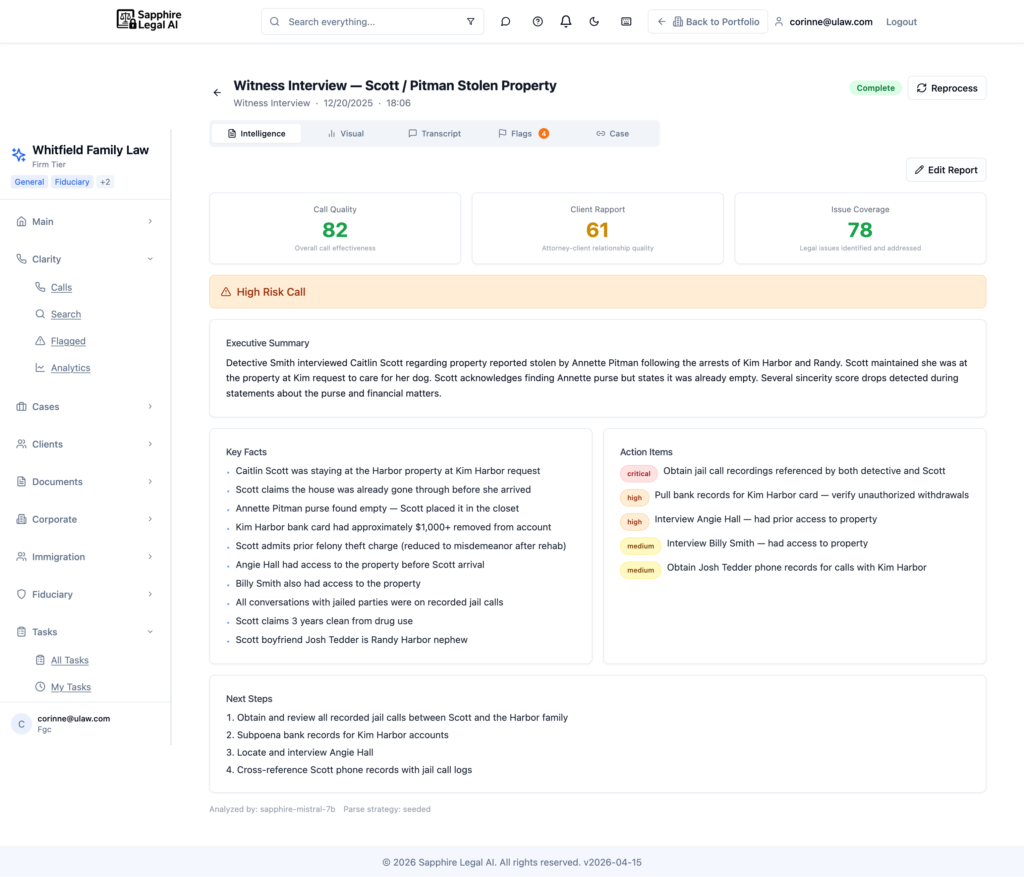
The platform’s Portfolio Command Center gives the fractional GC a single dashboard for every client company they serve, with per-client compliance scores, urgent-action queues, a Kanban board for active matters, and a health matrix showing risk levels at a glance. Underneath, per-client playbooks encode each client’s negotiating posture and non-negotiables; a locally-hosted seven-billion-parameter legal model trained on twelve million cases handles drafting; and Sapphire Clarity, the platform’s call-intelligence engine, turns uploaded recordings of client conversations, depositions and interviews into structured legal intelligence with severity-ranked risk flags. The system supports thirteen practice areas, each with its own workflow. Every client company runs inside a separately provisioned database and storage environment, which matters more than it sounds because a fractional GC’s clients frequently compete with one another.
This week, The Legal Wire sat down with Brett, Sapphire Legal‘s founder. Brett is not a lawyer. He is a fractional Chief Technology Officer and Chief AI Officer whose consulting work brought him into repeated contact with legal teams across the past several years, and who ultimately decided that the product his clients kept describing had not been built and needed to be.
Ambient versus bolt-on
The distinction Brett draws between his product and what he calls the bolt-on incumbents is worth taking seriously, because it is not a marketing frame. It describes an actual architectural choice with downstream consequences. A bolt-on legal AI is a product the user has to remember to use. It sits in a browser tab, or a Word add-in, or a chat interface, and it answers questions when asked. The failure mode of that model is not the answer quality, which is often perfectly good; it is that the tool is not consulted in a large proportion of situations where it would be useful. A busy fractional GC opens the tab less often than they should, and the value the platform could have delivered is lost to inattention.
Ambient intelligence, in Brett’s framing, is a different design.
The AI runs on the events, not on the requests. When a document is uploaded, the system classifies it, assigns it to the right matter, runs anomaly detection, and files it into the smart collections it belongs in. When a matter is opened, the relevant brief is already surfaced, the client’s playbook is already loaded into the drafting model, and the retrieval layer is already scoped to that client’s prior contracts. The user does not click through to the AI. The AI has already worked. Brett’s own line for it, in a recent note to this publication, is that Sapphire Legal is legal AI that works while the lawyer is in the meeting, which is closer to a description of an outcome than a slogan.
The reason this is possible, according to Brett, is precisely the architecture that makes Sapphire Legal a harder product to build than a wrapper. Because each client company runs inside its own private data environment, the platform can maintain per-client context continuously, without the risk of that context leaking sideways into another client’s workspace. A shared multi-tenant system can, in theory, do many of the same things; the risk of doing so is that a contract intelligence signal derived from Client A’s playbook appears, however briefly, in Client B’s drafting suggestions.
For a fractional GC whose clients compete, that is not a risk to be managed with policy; it is a risk to be eliminated with architecture.
TLW: You’ve framed the distinction between ambient and bolt-on as an architectural choice, not just a UX one. For a fractional GC or in-house counsel currently deciding between Sapphire Legal and a more familiar competitor, what would they feel differently in the day-to-day of a working week and where does the ambient model create friction of its own that a bolt-on tool would not?
Brett: “The honest day-to-day difference is that you stop making a decision. With a bolt-on tool, every time you get value from it, you had to remember to open it, frame the right question, and evaluate the output. Multiply that by five clients and you start to see the cognitive tax — most of the friction isn’t in the answer, it’s in the ask. With Sapphire, when you open a matter, the brief is already there. When a contract lands, the risk score is already attached to it against that client’s own playbook. You didn’t ask for either of those things. The event triggered the work.
Where ambient creates friction of its own is trust-building. If the system is supposed to be running in the background, you need to believe it’s running correctly — that the classification is right, that the right playbook was loaded, that the brief is scoped to the right client. Early on, practitioners do verify more than they would with a tool they explicitly invoked, because the invisible action feels less certain than the visible one. That friction reduces as confidence in the system builds. But it’s real, and I’d rather name it than pretend the model is frictionless.”
A category built for a market almost no one else serves
The market Sapphire Legal has chosen to build for is, on Brett’s account, considerably larger than the wider legal technology industry treats it as.
Fractional GC’s serve three to ten client companies simultaneously, each with a distinct commercial context, a distinct risk profile, and a distinct set of preferences that live, in current practice, mostly in the fractional GC’s own head. The workflow tools available to them were, almost without exception, built for a different customer. Clio was built for a single firm billing hours. NetDocuments was built for a small firm managing its own documents. Neither imagines a practitioner running the equivalent of five in-house legal departments out of a single brain.
The natural question is why the incumbents have not moved into that space, and Brett is direct about it. Fractional GCs, in his description, are not a large enough addressable market on their own to compete with the enterprise contracts that occupy Harvey and Thomson Reuters, and are not a coherent product category to a horizontal legal SaaS company chasing solo practitioners and BigLaw at once. They fall between the cracks of how the industry segments its buyers, and the tools they end up assembling are a stack of five subscriptions that were built for someone else and do not talk to one another. The design space he is working in, in his view, was left open by disinterest rather than by difficulty.
What is interesting about the choice, and worth noting for a legal technology audience, is that the fractional GC model is growing on both sides of the Atlantic. It is one of the routes lawyers now leave BigLaw for, on the grounds that it offers the professional scope of an in-house role without the single-client dependency and with meaningfully more autonomy. Sapphire Legal’s positioning is, in that light, a bet on where a specific part of the profession is heading rather than a bet on where it currently sits.
TLW: You’ve made a deliberate choice to build for fractional GCs first, with adjacent expansion into fiduciary firms, trust centres and other regulated practices you say share the same underlying architecture needs. What does refusing to broaden into law firms or in-house teams cost you in the short term, and what would have to change about the fractional GC market for you to genuinely reconsider that discipline?
Brett: “Short-term, it costs revenue we could probably close. There are law firms and in-house teams who could use pieces of what we’ve built, and some of them have asked. The discipline is to say no, because the moment you start building for a single-firm billing workflow or a single in-house team, you start optimising for the wrong problem. The fractional GC runs five companies simultaneously. That multi-portfolio context isn’t a feature we added — it’s what the architecture was designed around from day one. Diluting that to win adjacent deals would mean building a product that does everything adequately rather than one thing correctly.
What would change it? If the fractional GC model itself changed — if the way fGCs structure their practices started to look more like a small firm, or if a regulatory shift collapsed the multi-client model — we’d need to revisit. But the direction I actually see is the opposite: more lawyers leaving traditional structures to work this way, and more companies choosing fractional over full-time counsel as a default rather than a cost-saving measure. The market is moving toward us, not away from us. I’d rather be early and disciplined than broad and average.”
Private Legal Intelligence, and why the category name matters
Sapphire Legal has coined the term Private Legal Intelligence to describe what it is building. Naming a category is a founder move that often reads as ambitious to the point of pretension, but Brett’s rationale is more grounded than that.
Legal AI as a phrase has become so broad that it covers everything from contract-review products to system-prompted general-purpose chatbots, and stops meaning very much. Private Legal Intelligence is his attempt to describe a set of three properties he thinks the label ought to require: the data is architecturally private, the model is genuinely trained on legal materials rather than prompted toward them, and the platform delivers intelligence at the portfolio level rather than at the level of a single document.
The distinction between a legally-trained model and a general-purpose model with a legal prompt is one Brett is careful about. His own model is a seven-billion-parameter open-source system, fine-tuned on twelve million legal cases, running on Sapphire’s own infrastructure within AWS. It has not been the largest available model, and Brett is comfortable with that; the domain-specific training is, in his view, more consequential for legal work than raw parameter count. The platform has indexed legislation across all fifty US states, the British and Irish Legal Information Institute, and has Australia and Canada in progress, which gives the drafting layer jurisdiction-aware citation grounding that most general-purpose models will simply confabulate.
There is a candid observation Brett offers about the wider market that is worth flagging. He is openly hopeful that other builders will adopt the Private Legal Intelligence category, which is not the position most founders take toward their own coinages. His argument is that if the profession comes to expect private data isolation, legally-specific model training, and portfolio-level context as the baseline, the profession is safer, clients are better protected, and the category as a whole improves. That is a slightly unusual public position from a founder bootstrapping a company, and it is difficult to read as anything other than sincere.
TLW: You’ve said openly that you would like other builders to adopt the Private Legal Intelligence category, which is an unusual position for a founder to take toward their own coinage. What does Sapphire Legal retain as its edge if the category name becomes the industry baseline, and where do you worry the term could be co-opted by products that meet the label but not the underlying architecture it is meant to signal?
Brett: “If the category name becomes the baseline, Sapphire retains the architecture that earned it the right to name the category in the first place. Anyone can print “Private Legal Intelligence” on a marketing page. What they can’t easily replicate is per-tenant data isolation at the infrastructure level, a model trained on twelve million legal cases running on our own infrastructure, and a portfolio command layer built specifically for practitioners who serve multiple clients simultaneously. The label describes an outcome; the architecture produces it. We have a head start on the architecture.
Where I worry is exactly what you’d expect: larger companies adopting the terminology because it resonates, while continuing to run shared-model, shared-index architectures underneath. The risk isn’t that the category name fails; it’s that it succeeds as a marketing claim before the profession has the tools to evaluate what’s actually behind it. That’s why I’ve been direct about what the three properties need to be: architectural data isolation, domain-specific model training, and portfolio-level intelligence. If the profession starts asking those three questions as a matter of course, the co-option problem largely solves itself. The label only holds if the substance is expected to match it.”
Where Sapphire Legal fits
Sapphire Legal enters a category that has, in recent months, drawn enormous investor attention and quite a buzz in the legal tech space.
Brett’s view of the next three to five years is measured. He expects meaningful consolidation, on the reasoning that a large number of companies have entered the space and not all will find product-market fit or continued funding. He notes with some interest that Harvey has announced it will train proprietary models, and that DLA Piper and other large firms have committed significant investment to their own AI capabilities, both of which he reads as signals about where the market is moving on questions of privacy, verifiability and governance. The regulatory environment, particularly in Europe and the United Kingdom, is likely to reinforce those directions rather than relax them.
What makes Sapphire Legal worth watching is less its size, which is early-stage and bootstrapped, than the coherence of the choices it has made. Building an ambient-intelligence model requires per-client data isolation, which requires a hosted architecture rather than a wrapper, which requires ownership of the model rather than an OpenAI dependency, which in turn allows the platform to ship features in weekends that competitors would take quarters to ship.
Focusing on fractional GCs is not a niche play but a discipline that keeps the product genuinely useful for a specific practitioner rather than generically useful for everyone. And insisting on a category name, and openly wishing other companies would adopt it, is the sort of gesture only a founder confident about the underlying architecture makes.
Whether the wider market comes to view the fractional GC as a first-class customer, and Private Legal Intelligence as the expected baseline rather than a differentiator, the next several years will begin to clarify. Brett’s bet is that both are inevitable, and that being early to serve a market the incumbents have overlooked is a more durable position than being late to serve a market they already own. It is a considered bet, and one made by someone who came to legal technology with the enterprise instincts to know why architecture eventually decides these things.