
Legal and compliance teams across Europe live in a peculiar paradox. On paper, they are responsible for navigating some of the most sophisticated regulatory frameworks in the world. In practice, many still rely on tools that would look familiar twenty years ago: spreadsheets, fragmented alerts, inboxes full of regulatory newsletters, and tedious manual searches across scattered databases.
With time, the gap between the complexity of regulation and the tools available to manage it has continued to widen.
That gap is precisely where Cleo Labs has positioned itself.
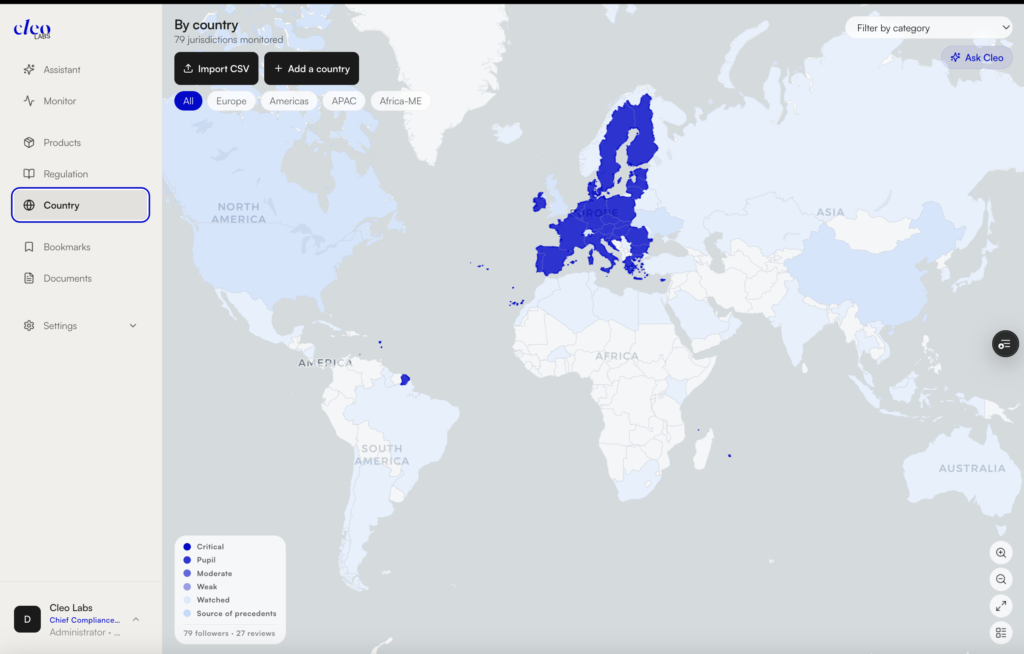
The Paris-based legal technology company has built an AI-powered regulatory intelligence platform designed for legal and compliance teams operating across Europe’s increasingly dense regulatory landscape. The platform continuously monitors more than 500 regulatory sources across jurisdictions and languages, evaluates their relevance and business impact, and generates structured assessments designed to help teams determine what’s truly important.
What makes Cleo Labs stand out, over and above its capacity as a legal database, is what the Cleo team describes as a “regulatory radar.” Instead of asking lawyers to monitor every signal themselves, the platform surfaces the ones that deserve attention.
And if you have ever worked in regulatory law, that distinction matters more than it might first appear.
A platform born from lived experience
Cleo Labs did not begin as a legal technology company.
The founders, Naomie Halioua and Anaelle Guez, originally met through Women in Web3, a community they built to bring together women working at the intersection of technology, AI, and blockchain. Their first venture focused on AI education.
But after a year working closely with companies adopting new technologies, they began noticing a recurring issue. Regulation was becoming harder and harder to track. European companies were grappling with frameworks such as GDPR, the AI Act, DORA, CSRD, and a growing list of national regulatory regimes layered on top. Yet even large organisations often lacked a clear picture of which rules genuinely applied to them.
The founders realised the problem was not a lack of expertise. The problem was infrastructure.
Anaelle had seen the issue firsthand during her career as Legal Director and later Chief Transformation Officer at Havas, where regulatory monitoring often meant piecing together insights from multiple sources and manually mapping obligations to business activities.
Naomie brought a different perspective: AI research from École Polytechnique and experience working with emerging technologies.
Together, they began exploring whether the problem could be approached differently.
The result was Cleo Labs.
On 29 April, Cleo Labs announced a €1.5 million funding round, signalling growing investor confidence in its approach to regulatory intelligence. Since then, the company has expanded rapidly: its platform now tracks 106 countries and more than 25,000 regulations, it has open-sourced a 45-skill compliance library used inside Claude Code and other AI agents, launched a public API and an MCP integration making Cleo accessible directly from Claude, Cursor and ChatGPT, and was named winner of the Scaleway Startup Challenge at VivaTech 2026.
Mapping the regulatory perimeter
At the heart of the platform is a deceptively simple question: How many regulations truly apply to your company?
For most organisations, that question is difficult to definitively answer, and this is what Cleo attempts to solve, in three steps.
First, a company enters its domain or basic organisational information. The platform’s AI analyses the company’s products, markets, and activities to identify its regulatory perimeter. Second, Cleo maps the relevant regulatory frameworks across jurisdictions. Applicable rules are identified, risk-scored, and linked to the company’s business context. Third, the platform produces a structured action plan, highlighting obligations, enforcement timelines, and the specific regulatory authorities involved.
The results are more than a list of laws. They are organised and filterable by factors such as jurisdiction, regulation, and authority, and automatically prioritised according to deadline, allowing teams to work more effectively, rather than simply cataloging information.
When I saw the platform during a demo with Naomie, the most striking aspect was the structure of the output. As someone who previously worked in regulatory law, I am used to the slow process of assembling regulatory landscapes manually: scanning guidance documents, cross-checking and comparing updates, and mapping obligations in spreadsheets that become outdated almost as soon as they’re complete.
Cleo compresses much of that process into minutes.
One cannot help but imagine the alternative: a team of regulatory lawyers simultaneously monitoring hundreds of sources across dozens of jurisdictions, in multiple languages, around the clock. Cleo’s multi-agent architecture essentially does exactly that.
A multi-agent approach to regulatory intelligence
Much of Cleo’s technical differentiation lies in how it gathers and processes information.
Rather than relying on a single model, the platform uses a multi-agent pipeline, with each agent trained to monitor a specific region in its own language and using the search structures that best capture regulatory developments in that jurisdiction. In practice, this means the system can analyse Chinese regulatory sources in Chinese, French updates in French, or European supervisory guidance in multiple EU languages all at the same time, continuously, rather than at scheduled intervals.
For legal teams that have historically had to choose which jurisdictions to watch closely and which to monitor only periodically, that coverage removes the trade-off entirely
TLW to Naomie: The Cleo platform uses region-specific AI agents that operate in the native language of each jurisdiction to monitor regulatory developments. From a technical perspective, what were the biggest challenges in building a system that can reliably interpret regulatory signals across different languages, legal systems, and publication formats?
Naomie: “Honestly, the hard part was never language (a good model reads a German or Japanese notice fine), but the real challenge is telling real signal from noise: flag too much and you bury the client, miss one rule and they’re exposed. And the ones that matter most are the weak signals, for example a draft, a consultation, one line in a gazette which are the hardest to catch. On top of that the sources are messy: some texts are binding and some are just guidance, one regulator gives you clean data and the next a scanned PDF, many sit behind private APIs or block bots, and the same rule shows up five times across countries. So it was never about foreign languages, it was catching the weak signals without inventing anything, while the format and the legal system change every time.”
Due diligence at regulatory scale
Cleo’s platform currently focuses on two areas where compliance teams face particularly heavy monitoring burdens.
The first is third-party due diligence: Enter the name of a company or entity, and the system generates a 37-category risk report within minutes, covering sanctions exposure, politically exposed persons (PEPs), adverse media, regulatory enforcement, and court records across more than 106 countries.
The contrast with traditional workflows is striking. Manual due diligence often requires several days of work, multiple databases, and a largely narrative report assembled in Word. Cleo aggregates information from more than 19,000 regulatory authorities, generates structured reports with risk scoring, and maintains a continuous monitoring feed.
Each entity receives a composite risk score from 0 to 100, supported by links to the underlying sources. Every action is also logged through an immutable audit trail, allowing organisations to demonstrate compliance processes to regulators if needed.
In short, the system transforms a fragmented investigation into something closer to a structured regulatory dataset.
Understanding product-level compliance
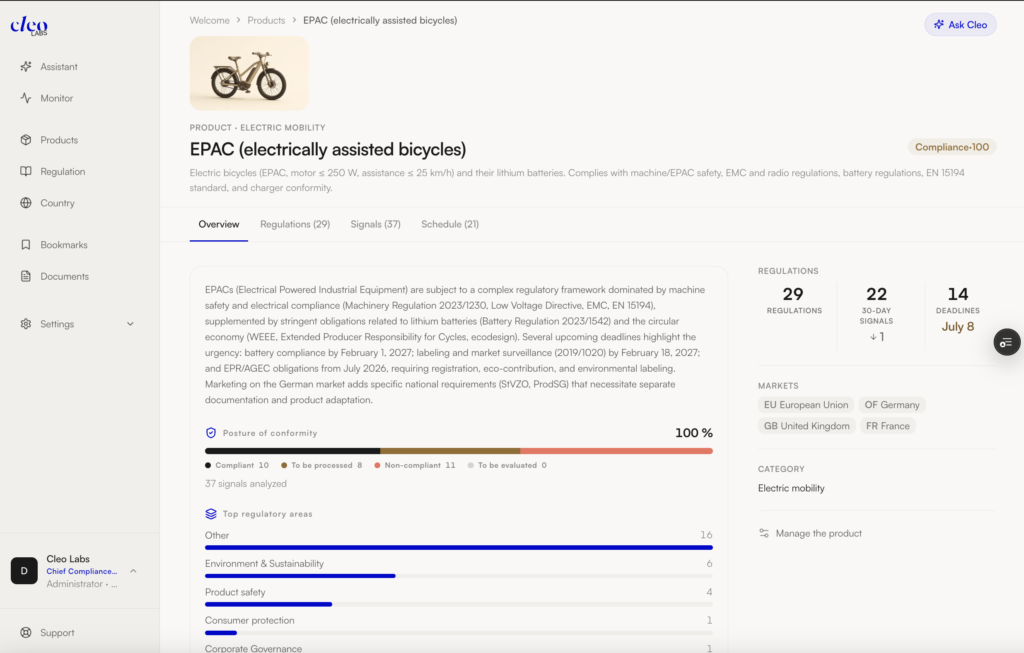
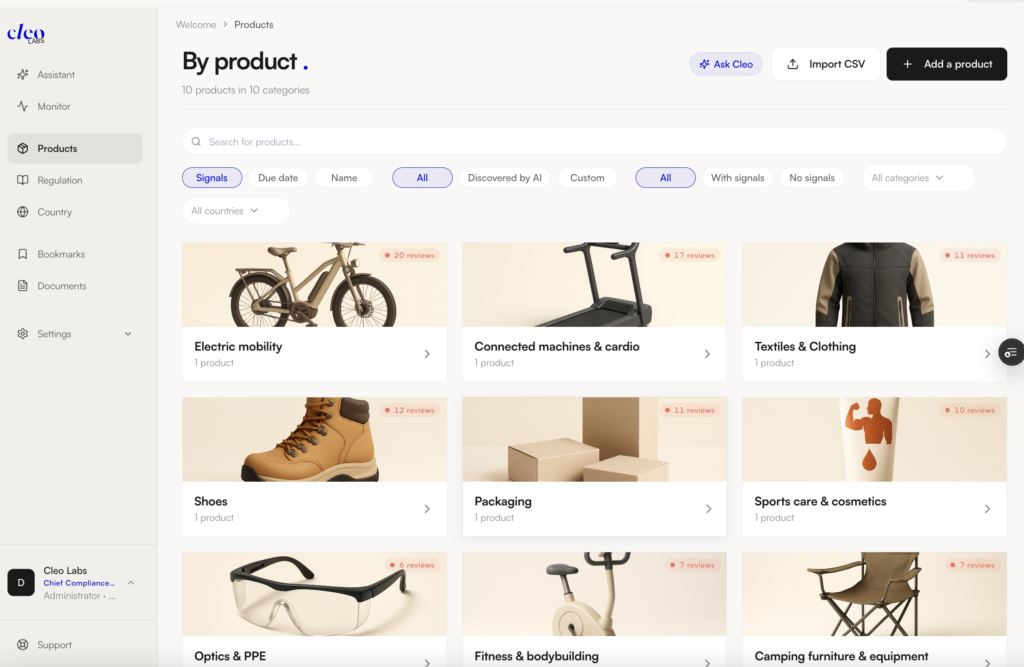
The second major use case focuses on product compliance and market access: Enter a product category and type, from cosmetics, electronics, and toys, to textiles, and select the target markets. The platform generates a matrix showing every relevant regulation, certification requirement, safety standard, and labeling rule across more than 106 countries.
For companies expanding into new markets, the difference can be significant. Market-entry compliance work that might traditionally take weeks of regulatory research can be mapped in minutes, allowing legal teams to identify requirements early in the product development cycle.
The platform currently tracks more than 25,000 regulations across 106 countries, enabling organisations to analyse compliance obligations before entering new markets.
Tools for the teams carrying the compliance burden
Throughout the platform’s design, Cleo’s founders appear to have been guided by a simple principle: compliance professionals are not the problem. Their tools are.
Legal and compliance teams already possess the expertise required to interpret regulation. What they often lack is a reliable infrastructure for finding, organising, and prioritising regulatory signals. Cleo’s role, therefore, is not to replace lawyers but to remove the clutter surrounding their work. Or, as the founders describe it, to give compliance professionals “uncompromising clarity.”
Building legal technology that lawyers trust
Designing regulatory technology that lawyers will really trust is not trivial. Regulatory professionals tend to be skeptical of tools that promise automation but fail to provide transparency about their sources. Cleo Labs takes that challenge seriously. The platform consistently links outputs back to underlying regulatory sources and maintains detailed audit trails.
From a legal perspective, that design choice is deliberate.
TLW to Anaelle: As someone who previously worked in-house navigating complex regulatory frameworks, what aspects of traditional compliance workflows did you find most frustrating and how did those experiences shape the design choices behind Cleo’s platform?
Anaelle: “What frustrated me most wasn’t the difficulty of any single rule, it was the sheer ocean of them. Thousands of regulations across dozens of countries, and they constantly contradict each other: what’s required in one market is banned in the next, a claim that’s fine here is illegal there. That’s what shaped Cleo: we start from your product, not the law; we monitor continuously from official sources so contradictions and changes surface early; and instead of handing you the whole ocean, we tell you exactly what you need to do one clear decision, every answer traceable back to a real source.”
The long-term ambition
For Cleo’s founders, their ambition extends beyond building just another compliance monitoring tool.
Their broader goal is to create a structured interface between regulation and business activity. A software capable of reading laws, understanding what a company does, and mapping the relationship between the two.
That is a significant ambition, and the founders do not shy away from it. But the direction makes sense. Regulatory complexity is increasing, not decreasing, particularly in Europe. The pertinent question is whether the infrastructure supporting compliance will evolve at the same pace.
TLW to Naomie: Cleo’s system attempts to connect regulatory texts directly with a company’s operational reality. How do you see regulatory intelligence evolving over the next five years, particularly as AI becomes more capable of understanding legal and business context simultaneously?
Naomie: “As AI gets better at holding legal and business context at the same time, regulatory intelligence stops being a search problem and becomes a decision problem: not “here are the rules,” but “here’s what applies to your product, here’s where two markets contradict each other, here’s the one thing to do, and here’s the source that proves it.” It shifts from reactive to anticipatory – the system flags a change before it hits you, not after a shipment is stopped. But the more capable AI becomes, the more traceability matters, not less. In compliance you can’t act on a confident guess, so the winners will be the systems that connect rule to product automatically and show their sources every step of the way. That’s exactly the bet we’re making with Cleo.”
A platform designed for judgment, not replacement
Ultimately, Cleo’s design reflects a pragmatic view of how legal work functions in practice.
Compliance professionals rarely struggle with interpreting regulation once they know which rules apply. The real difficulty lies in identifying the relevant signals among thousands of ever-changing regulatory updates. Cleo addresses that discovery problem.
By continuously monitoring regulatory sources, mapping obligations, and structuring the results, the platform aims to give legal teams back something increasingly scarce: time. Time to analyse, to advise, and to exercise professional judgment.
Which, in the end, remains the part of legal work that technology is least likely to replace.
TLW to Anaelle: Cleo positions itself as a “regulatory radar” rather than a replacement for legal expertise. In your view, how should compliance teams think about the relationship between AI-driven monitoring tools and human legal judgment?
Anaelle: “The way I see it, AI and legal judgment aren’t competing, they work at different altitudes. A radar’s job is coverage. No human team can watch that much surface area continuously, and that’s exactly where AI belongs. But detecting a signal is not the same as deciding what to do about it. Interpretation, weighing risk, judgment calls in the grey zones, that stays human. That’s why Cleo is built with humans in the loop at its core: legal and regulatory experts interpret, adjust and correct the AI, and that feedback continuously trains the system. The AI narrows the ocean down to what actually matters; the human decides. So compliance teams shouldn’t think of it as “AI replacing the lawyer” it’s AI giving the lawyer a radar, so their judgment is spent on the decisions that need it, not on manually hunting for the rule. And because every signal stays traceable to its source, the human always keeps the final word.”