
By Pete Feinberg’s recollection, a reporter at Legalweek in New York recently counted the term “AI” being used two hundred and seventy times in a single day. That, more or less, is the texture of the legal technology conversation at the moment. Casepoint, the unified platform for eDiscovery, legal hold, FOIA, investigations and compliance work, where Pete now serves as Chief Product Officer, has been operating in that market for some time, with a customer base that includes both major federal agencies and large enterprise legal teams.
Pete joined Casepoint in March 2026 from Consilio, where he was Chief Product Officer for thirteen years. Three months into the new role, we discussed Casepoint’s product direction and his views on where legal technology as a whole presently stands.
A platform built for two worlds at once
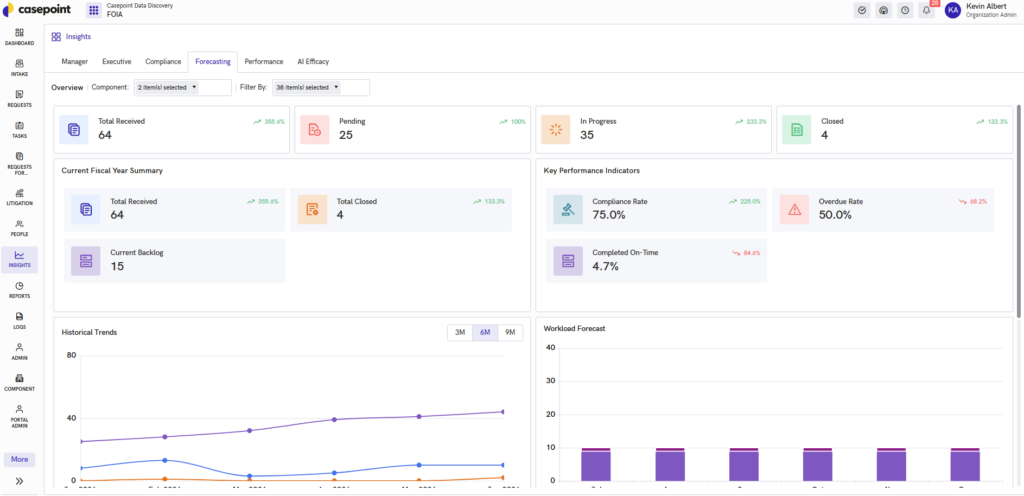
The Casepoint platform spans the full lifecycle: legal hold notifications, data preservation and collection; data discovery use cases, such as early case assessment, eDiscovery for litigation or investigations, and FOIA and public records management for government teams; secure storage of sensitive case data through its Casepoint Filestore™ product. Across all of it sits a layer of AI capabilities: natural language search, document summarisation, and automated classification of mixed document types, designed to enhance human review rather than replace it. The unifying claim is that all of these workflows belong inside one secure, defensible environment rather than stitched together from separate tools, with a continuous chain of custody from preservation through review and response.
Two structural choices distinguish the company. The first is its customer mix. Casepoint serves both government agencies and large enterprises, which is uncommon; most legal technology companies sit on one side of that line or the other, and the demands of each are different enough that supporting both well is not a small commitment. The second is its security posture. FedRAMP High, DoD Impact Level 5 (IL5) and Impact Level 6 (IL6) authorisations are credentials very few legal technology providers hold; Casepoint is one of only six SaaS companies globally with IL6 authorisation, which is what allows federal customers, including the Department of War, to deploy the platform at all. Those authorisations are slow and expensive to obtain, and they function as a real moat in a category where federal customers require them.
It is the second of those choices that helps explain why Casepoint reads as a different sort of company to some of the names it competes with. A platform business of this kind builds its commercial relationships, and its product priorities, around software directly: the customer is buying the system and operating it themselves, rather than buying a managed service in which the software sits behind a team of people. Pete is consistent on what drew him: the focus that comes with a software-first organisation, and the customer relationships built around a deep technology platform.
TLW: You’ve described the move as a deliberate choice for the “purity of focus” of a software-first organisation, after thirteen years inside a company that combined services and technology. From that vantage point, what is the most important thing software-first companies do differently in how they design, sell, and support, which a hybrid services-and-software model finds difficult to replicate?
Pete: “It’s a very simple proposition for software companies – build the best software available in the market to win, or perish. For pure software companies, there’s no fall back on services as there is in a combined services and technology company. We are only as successful as the product we build fits with the needs of those that we sell to and serve. I find that purity of focus electrifying. It sharpens all our senses, makes us question and reaffirm everything we think we know, and dedicates us to bringing only our best to market.”
The futurist dilemma
The frame Pete returns to most readily is one he calls the futurist dilemma. The futurist understands what the technology can do, sees the opportunities, and sees the inefficiencies that have historically existed in human work. What the futurist sometimes forgets is the human condition: the stress a lawyer carries when they suspect they may have missed a critical document, the fact that a career and a reputation are bound up with the quality of a document review or document production. The futurist’s intentions are usually good, but the focus on the technology can run too far ahead of the people it is meant to help.
This is, he argues, the central pressure on a product leader in legal technology right now. The temptation to stand on a conference stage and talk about how remarkable a system is, is large and constant; the temptation to ship before something is ready is also large. But lawyers, Pete notes, are not evaluating these tools as technologists. They are evaluating them as professionals whose reputation is directly tied to the quality of what they sign off on. For a lawyer to trust an autonomous system, they must be willing to accept its output as reliable enough to stake all of that on, which, he says plainly, is an extraordinarily high bar.
TLW: The “futurist dilemma” frames the product leader’s job as sitting between what the technology can do and what professionals can actually trust it with. In practice, how do you tell, inside a product team, when the futurists have run too far ahead, and what does the corrective look like when they have?
Pete: “When I evaluate a software concept, I try to have in my mind’s eye a person I’ve met, spoken with, gotten to know. More ideally, I’ll have a collection of people that I’ve met and gotten to know in my mind’s eye. And I imagine them seeing that concept for the first time. Then I ask myself, “Will they get it?” “Will they want to use this?” “Will they trust it?” “Will they be free of objection when using it?” “Will they call their lawyer friends and say, ‘hey, you’ve got to see this!’?” “Will this work for me given the wildness of the data I deal with and workflows I need to support?” If my belief is that those questions aren’t all answered in the affirmative – then the concept needs more work.
I know it sounds like a simple bar, but it demands a deep understanding of the software buyer personas and user personas alike. It demands an understanding of their workflows and of historical alternatives those persons have used – potentially since the dawn of time – to do their work. It demands an understanding of what competitors are featuring as their wares. It demands an understanding of the wild nature of data and human behavior. It demands an understanding of how software systems operate. This complexity is why I think many of my peers struggle or fail.
Steve Jobs once said, according to lore, “It takes a lot of hard work to make something look simple, to really understand the underlying challenges and come up with elegant solutions.” This is precisely why product leaders exist; to meet that bar every single time.”
Assistive AI, autonomous AI, and the audit trail that must follow
Pete divides AI in legal work into two categories he is careful to keep distinct.
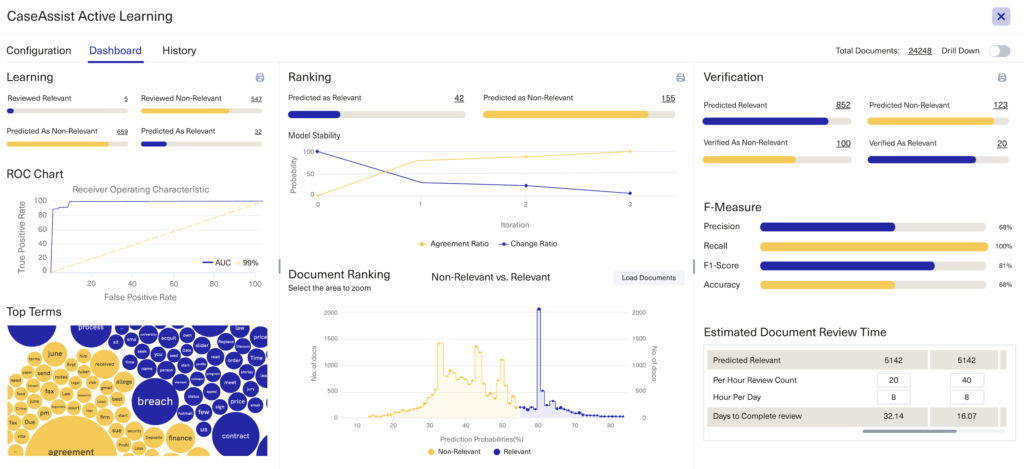
The first is assistive AI, where the human remains in control and the tool sits alongside them. Document summarisation is the useful example: AI is generally good at summarising, a lawyer can compare a summary against the source and quickly judge whether it is useful, and the risk profile is low because the human is still in the process.
AI-generated privilege log descriptions are another: work that historically required thousands of near-identical entries drafted by hand, now largely automated. None of this is especially controversial.
The challenge is what happens when systems move into the autonomous range, where the AI reasons, decides, and acts independently. Pete likes to compare it to autonomous vehicles. Most people are, by now, comfortable with lane departure warnings or adaptive cruise control. Once the vehicle is steering, braking and accelerating on its own, people become less comfortable, because they start asking what happens when conditions change, when visibility drops, when something unexpected occurs. The same questions apply to fully agentic legal systems, and they are the right questions to ask.
Casepoint’s own position today sits closer to the assistive end. The platform’s AI capabilities, natural language search, document summarisation, and automated classification, are framed as built to enhance human judgement rather than replace it, and Pete’s view is consistent with that. His preferred path is what he calls progressive adoption: not a leap from manual review to a fully autonomous independent agent-driven workflow, but a sequence in which the AI runs in parallel to the workflows that humans are familiar with, surfacing its reasoning, and earning the humans’ confidence over time. The people using these tools are not yet ready to bet their reputations on more, and the path to that readiness has to be designed.
Auditability is the connecting concern, and Pete is unusually specific about what the word needs to cover. It is not enough to know that an agent performed a task and when. A serious audit trail has to record who initiated the action, which model version was used, which prompt version was active, which skill set was in play, which workflow version was running, and which agent executed the step. None of those components are static, and any change can move outcomes. If the industry is going to ask legal professionals to trust AI systems, the transparency has to be complete.
A connected point follows regarding validation. Running multiple human review teams against the same data set used to be prohibitively expensive; running multiple models, or comparing prompts, or having one model review another’s output, costs far less. Over time, that should make it possible to demonstrate with statistical confidence that a particular workflow performs better than a human-only approach, which would change the conversation with opposing counsel, regulators, and courts. The condition is patience: you reach that position by moving gradually, not by claiming it before the evidence is in.
TLW: You’ve described auditability that captures every layer from model version and prompt version to skill set, workflow version, agent, and initiator, as the foundation for trust. That is a much heavier bar than most vendors are currently delivering. What does building to that standard cost a product team, and where do you see the rest of the industry cutting corners on it?
Pete: “I think innovators in the legal technology space are at risk of missing the key point of auditability as we push into the agentic AI age. When customers can tweak the underlying skills of an agent, or directly control the prompts/inputs, or pick from different fine-tuned models – recording these particular object versions with each transaction will be essential. Otherwise, our software systems will not stand up to scrutiny – the same scrutiny we’ve faced for over 10 years with our search tools or our predictive learning tools.”
On overpromising, and the cost of being first
Pete is willing to be undiplomatic about how some of his peers currently talk about their products. He worries about overpromising, and that marketers and sometimes sellers become so focused on being associated with AI that they start looking for a silver bullet. There are companies, he says, he will not do business with because their claims significantly outran their capabilities. AI has dramatically lowered the barriers to building software, and those would-be innovators are aggressively rushing their products to market to capitalize on a return. That leads innovators to bringing products to market without doing the necessary testing, with wild data, in different conditions with different testing data sets, and market them aggressively anyway.
His view of being first is the corollary. Innovation matters, and a company not perceived as an innovator will not survive, but he is not persuaded that first is the same thing as trusted. In a risk-averse environment, trust matters more than speed. Being second is fine. Being third is fine. What matters is the ability to demonstrate that the technology works under real conditions, because without it, the confidence you need for adoption never accrues. There are products in the legal market now, he notes, that rushed to market before they were ready, and the reputations left on the line are the customers’.
TLW: You’ve said the industry overvalues being first, and that trust is the harder thing. Which capabilities currently being marketed in legal AI do you think most deserve skepticism right now, and conversely, where is there a less ‘obvious’ category of work that is genuinely earning trust without making much noise about it?
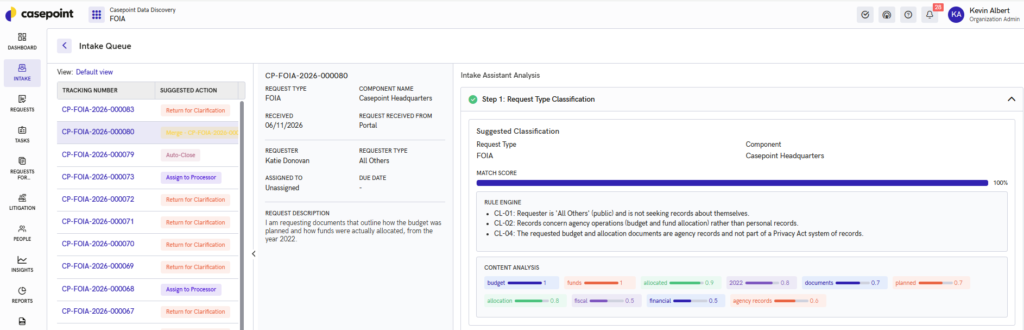
Pete: “Healthy skepticism comes with the territory in legal tech. This is an industry that is defined by its risk aversion and inquisitive, probing nature. Given that these LLMs are a “black box” to all of us, the industry is right to approach these AI-powered tools with a dose of critique and skepticism. But when we see AI-powered assistive tools like document summarization, or sentiment analysis, or categorization, and we see outputs from these LLMs that includes the LLMs reasoning, lawyers have the opportunity to draw our own conclusions about the goodness of the output and can build trust that the software – however it is doing its magic – is delivering quality results.”
Bringing the customer along
One question, Pete says, drives him daily: how to bring customers along for the ride.
Building the software is only part of the job; the more important part, in his telling, is helping customers understand it, trust it, and become comfortable adopting it. That demands a different relationship than software companies needed a decade ago: customers engaged earlier and more frequently, brought in during design and testing rather than at the point of first log-in. Trust cannot be assumed; it has to be earned, and the work of earning it begins long before a product ships.
TLW: You’ve described bringing customers along as the central challenge facing legal technology right now, and that’s the trust-building. Concretely, what does that look like inside Casepoint? When does a customer first hear from product, and how do you make sure their engagement impacts what gets built, rather than ending up as a courtesy that smooths the sale?
Pete: “I want customer engagement around our products to be the hallmark of my legacy here at Casepoint.
First, that means a complete reimagining, revamp and rebuild of our Customer Advisory Boad Programs – which is underway now. Second, that means that our customers who chose to engage with us (and I hope all of them do), can expect our Product Leads to reach out during the concepting and prototyping phase, before we’ve even committed to building a product or enhancement, to show, discuss and listen to feedback on that concept. I also expect my Product Leads to continue to connect with customers, voice to voice, while the product is being built, to continue to listen for inputs and feedback that might be timely to allow us to make adjustments during development. Even after a product is developed and tested, I expect my Product Leads to showcase that new product/capability pre-sale to listen for objections, inquire about its potential use, explore areas of potential enhancement, and deeply understand the workflows the product supports.
That’s all, of course, in addition to analyzing usage, adoption and support metrics to inform the full picture of the product market fit. In addition, I want us to connect with customers no less frequently than quarterly to share our Roadmap and get inputs to those Roadmaps. As customer advocates in the innovation process, there’s no such thing as listening too much or connecting too much with our customers.”
On being second, and being trusted
Casepoint is, on the evidence of a discussion with Pete, a company whose new product leader does not particularly want to be on a conference stage with others shouting about AI, doing the same. The platform itself is broad: eDiscovery, legal hold, FOIA/public records management, investigations at its core, secure data storage through Casepoint Filestore™, and a layer of AI capabilities built to surface relevant material, classify documents and summarise content, and at some point, as trust is built, to make autonomous judgements. The security posture is a real moat, and it limits how quickly anything can be deployed, which is part of the point.
Pete’s view of what the company should be is consistent with that picture, and slightly out of step with the louder, uber aggressive parts of the market. The job, in his framing, is to build serious software for high-stakes work, make the AI inside it seamless to use, and auditable enough to be trusted; and to take the cycles needed to bring customers along.
It is what the people whose careers depend on the output have been asking for. The question that will follow him through his first year is whether a thirteen-year argument made inside one large company can be turned, at a different one, into a roadmap that delivers on it.