

Around the second century BCE, by the company’s own retelling, Roman law of civil procedure was held inside a temple and accessible only to a priestly class who could read it. A clerk named Gnaeus Flavius eventually copied the texts and made them public, which is when ordinary citizens could begin to act on the rights they already had. The story is the origin myth Bayshore has chosen for itself, and it carries more weight in the company’s self-description than founder-led origin stories usually do. The argument is that complexity has put the law behind a different kind of temple wall, and that the unintended priests are no longer judges but compliance and legal teams.
Bayshore, a Munich-based company co-founded by Paul F. Welter, Philipp Wiegand and Erik Krauter, is building what it calls an AI front door for legal and compliance operations inside large enterprises. With specialist lawyers working alongside the customer, the company encodes regulations, internal policies and compliance frameworks into deterministic, machine-readable logic, a rules program that captures how that particular organisation interprets its own obligations.
AI agents then run the journey from intake to decision: routine requests resolve automatically, complex ones reach a human reviewer with the context already gathered, and every step is recorded in a full audit trail. The platform is ISO 27001 certified, hosted within the EU, and can be deployed on-premise.
The company closed an eight-million-dollar seed in March 2026, led by Earlybird Venture Capital with Lucid, Booom and Heliad participating, and is already deployed at large listed enterprises across pharma, finance and defence.
The deterministic-over-probabilistic bet, encoding legal logic as something closer to code than to prose, is the central technical claim that distinguishes Bayshore from most of the rest of the market. Paul, who is both an admitted German lawyer and a software engineer, is the person making it. He spent time researching at Stanford’s CodeX Center for Legal Informatics, and the architecture he is now building commercially is a direct extension of that research.
This week, The Legal Wire had the opportunity to speak with Paul about his journey and that of Bayshore. As a former legal philosophy major, Paul lets a call expand outward, toward what regulation is truly for and what happens when it stops doing its job.

Why deterministic, and why now
To understand what Paul is building, it helps to understand what he is consciously not building.
Most legal AI right now is built on top of large language models, which are, by his description, fundamentally probabilistic systems that rely on pattern recognition. There will always be some degree of uncertainty in their outputs. He gives the example of a retrieval system feeding a model a chunk of a document containing a monetary threshold, while a passage two sections earlier specified the threshold only applies in Africa. If the context is missing, the model may quietly apply the rule to a European scenario instead. These kinds of issues, he says plainly, will always exist.
They are also disqualifying for the work Bayshore is built to do. Compliance is not a domain in which the same question may yield different answers on different days, and not one in which a reasoning process can be opaque to the people who have to defend it. Paul is frank about a related limit: large language models are not explainable. You can evaluate whether an output appears reasonable, but you cannot truly observe the internal reasoning, which means you cannot know whether a flawed assumption was introduced. For an auditor or a regulator, that is the wrong answer to the wrong question.
Bayshore’s response is to use AI where it genuinely earns its place and not elsewhere. Language models do the translation work, turning natural-language policies and regulations into the deterministic logic that then runs.
Once the logic is in place, execution itself is not probabilistic: the same case follows the same path through the decision graph every time. AI agents are called for narrowly defined tasks within that structure, investigating a third party against sanctions lists, gathering information from particular databases, asking targeted follow-up questions. Only, the agents do not decide the compliance outcome, the logic program does.
TLW: You’ve drawn a clear line between language models, which are fundamentally probabilistic, and the deterministic logic programs Bayshore runs on top of them. For someone evaluating that distinction concretely, where does the deterministic layer end and the language-model layer begin inside a typical compliance workflow and how do you handle the regulations that are themselves genuinely ambiguous, where there isn’t a clean rule to encode?
Paul: “There’s a well-worn example at Stanford’s CodeX: a sign at a park reading ‘No vehicles in the park.’ Try to decompose ‘vehicle’ into rules and you never finish. Does it turn on the number of wheels, whether there’s a motor, whether electric counts, top speed, noise, exemptions for an ambulance or an ice-cream cart? Below a certain level of abstraction, terms stop dividing cleanly into sub-rules, and you can no longer anticipate the atypical cases life produces.
That is exactly where the handover happens. The deterministic logic carries the structure; the language model does the work it is actually good at, recognising patterns and classifying messy facts. In a gifts-and-hospitality policy, the logic decides which rules apply once you know the benefit category, but classifying whether something is a cash gift or a lunch invitation is a job for a model, guided by category descriptions, positive and negative examples, and the purpose the rule is meant to serve. As for genuinely ambiguous regulation, we don’t give legal advice or push an interpretation. The customer holds a strong view of what is customary and how risk-averse they are, and two organisations read the same rule the same way. Our forward-deployed legal engineers find out how the customer wants a rule interpreted and encode exactly that.”
On agents, with appropriate caution
The current legal AI conversation focuses considerably on agents. Weighing in on this, Paul notes that agents are extremely powerful when you are dealing with open-ended problems where you do not know in advance what information you will encounter. In those situations, an agent can formulate a plan, spawn sub-agents, collect information and coordinate activities.
The cost is predictability: agentic systems become genuinely difficult to control and to audit, which is why Bayshore uses logic programs as guardrails around them rather than the other way round.
In Bayshore‘s architecture, the logic program decides what happens next. Language models are called at specific points and given clearly defined tasks; they are not asked to determine, on their own, how an entire compliance process should be executed.
Agents, on the other hand, are appropriate when collecting third-party information across many sources, where the system may need to investigate a finding further or search more places. Those are tasks that cannot be mapped deterministically. But Paul is unambiguous that agents are not allowed to make final compliance decisions, because that would be neither predictable nor auditable enough (at this stage). You cannot explain a regulatory decision to an auditor, Paul mentioned as an example, by saying the agent told you it was fine.
TLW: Several founders in the legal AI space appear genuinely more comfortable giving AI autonomy than their customers are. You‘ve taken the opposite position: agents within strict guardrails, deterministic logic above. Is this a permanent design principle for Bayshore, or a function of where the technology currently is and what would have to change about the underlying models, or about regulators, for you to genuinely consider letting an agent make a final compliance call?
Paul: “I’d push back on the framing slightly, because we already let software make the final compliance call today, precisely because it is deterministic, predictable, controllable and transparent. I can sit down, configure it, and answer for how it behaves.
What I cannot do is rely on a language model or an agent that decides for itself what happens. Under the hood a model is an enormous set of matrices; the output is non-deterministic by design, because we want these systems to be creative rather than repeat themselves. There is randomness baked in and a path dependency in how tokens are generated, so the same input rarely yields the same output. The providers don’t disclose their training data or their architectures either. Standards like the IDW’s PS 861 expect AI systems to be auditable and explainable down to the data and the process steps behind a decision, and I don’t see how a 90-billion-parameter black box satisfies that. So this isn’t a ‘not yet.’ I don’t believe there’s a future where compliance runs on probability alone. If the model providers ever bolt on the deterministic components that would change my answer, they will have stopped selling models and started building hybrid systems, which is to say they will have rebuilt our tool.”
The encoding process, and what it forces
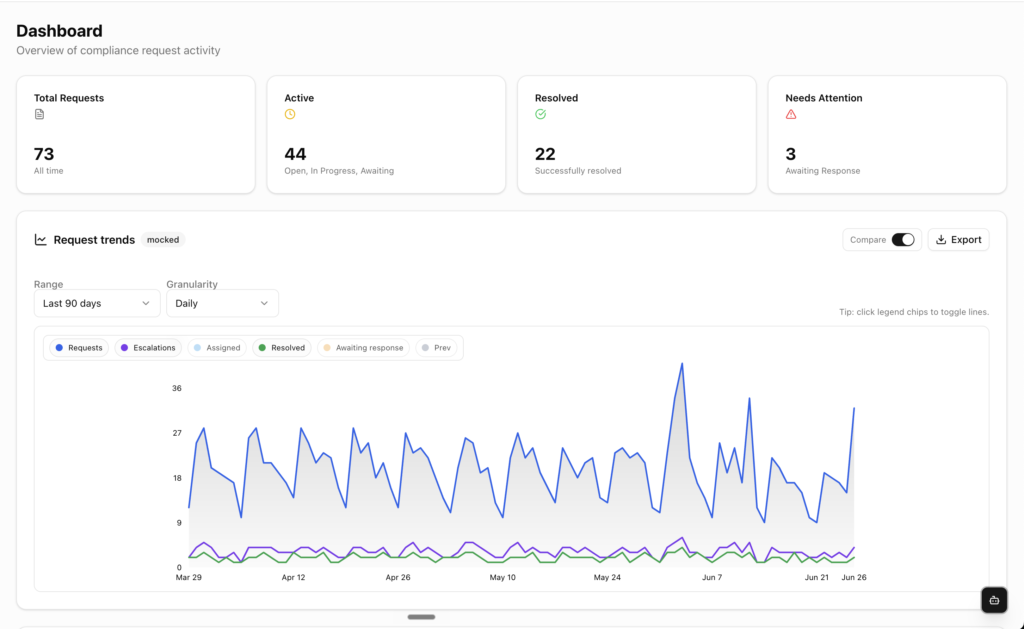
Encoding legal logic is not a purely technical exercise. Before a rule can run deterministically, someone has to resolve what the rule means for that organisation: which interpretations it adopts, which edge cases it has decided to handle in a particular way, and where it has chosen to draw lines that the regulation itself leaves open.
That process, which Bayshore works through with customers using its own specialist lawyers, often surfaces disagreements and assumptions that were never previously explicit. The act of making logic machine-executable forces a kind of institutional clarity that most compliance programmes have never had to achieve.
What emerges from that process is not a rigid workflow but something closer to a codified institutional position. The same case follows the same path every time because the organisation has already decided, in advance, how it interprets the rules that govern it. That is a different kind of output from what most compliance technology produces.
TLW: Building the process by which an organisation’s legal logic gets encoded into deterministic rules, what has that revealed to you about how compliance decisions are being made inside large enterprises today, and how has it shaped the way Bayshore is designed?
Paul: “The thing it made unavoidable is that law and compliance have always been resource-constrained. For most of history, legal judgement was something only humans could do, so every compliance system has run on scarce human experts, and everything you see today is a compromise around it. Push the work into the second line and you get backlogs that throttle the business. Push it into the first line and you accept misjudgements, patched over with endless training that goes stale the moment something changes or someone new arrives. Or you do assurance afterwards and inspect samples, by which point the damage may already be done and the blind spots are large. Compliance decisions today are pragmatic: you focus on the highest risk and knowingly accept the rest. So we asked what a compliance system would look like if that constraint were gone, if legal reasoning were available in abundance, at any time, in any place, with all the relevant knowledge. That is embedded law. When a new supplier is created, an agent is triggered automatically, runs the review schema, gathers what it needs, documents everything, and only surfaces a genuine red flag. You build the obstacle before the breach can occur, and when something truly complex arises, a human is free to handle it instead of drowning in routine.”
The bottleneck, and what Paul thinks regulation is for
The closing third of a call with Paul widens out, in the way conversations with people who have studied legal philosophy sometimes do, into the question of what regulation is for in the first place.
He does not think regulation is the problem. Well-designed regulation, he says, serves purposes worth keeping: it protects consumers, the environment, fair competition, public safety. The problem is inefficiency, and the solution is not to eliminate regulation but to help people work with it more effectively.
The failure mode he keeps returning to is access. Legal expertise has become a bottleneck. Experts are overwhelmed, backlogs are vast, and legal services have become expensive and difficult to reach. In Germany, consumers will often not pursue claims below roughly EUR 3,000, because the process is too expensive and inconvenient to be worth it. The same problem exists inside businesses, where contracts can sit unfinished for years while specialists across multiple functions are pulled into review. There is an old jurisprudential observation, associated with Lon Fuller and others, that a law not effectively communicated is no law at all; Paul’s concern is something close to its modern form. If people cannot understand the rules that apply to them, the rules cannot do the work they were written for.
That is, in his own framing, why Bayshore exists. The company’s stated ambition is to become “the Gnaeus Flavius of the digital age,” which is the sort of phrase that risks reading as marketing if the founders mean it lightly and as serious if they do not.
Paul, on the evidence of a call, means it seriously. The company is currently focused on helping businesses comply with legal requirements more efficiently, but the underlying technology, he argues, could eventually be applied to courts, public authorities and other institutions where the same expert-as-bottleneck problem exists. Whether that is plausible at scale is a fair open question; the conviction that it is worth attempting is what gets him out of bed.
TLW: You’ve described the deeper problem as the law being legible only to a small expert class, with everyone else effectively locked out of rights that exist for them in theory. That is a strong claim, and it is also the claim Bayshore has chosen as its origin myth. What does that mission constrain in how you build the company, including the customers you take, the features you prioritise, the things you decline, to ensure Bayshore does not drift from it?
Paul: “It constrains us mostly by what we refuse to build. We don’t build an answer machine or a general Q&A bot. A customer once asked whether they could upload guidance on dress code or how to book an order correctly and have us advise on it; we don’t do that. We stay on legal questions. We also don’t do advisory or drafting work, no help formulating a statement of claim, structuring a contract cleverly, drafting a will or running a transaction.
The question we always come back to is ‘Am I allowed to do this?’ At the end of it a legislator has written a law, and we either help people comply with that law or with the policies meant to implement it internally. We deliberately don’t do the work big law makes serious money on, like M&A, litigation, IP, etc. There is an enormous amount of capital chasing that vision, and it doesn’t interest us. What interests us are the laws themselves, the value judgements a society, and especially a democracy, has set for itself, and helping those laws become real. That’s also why we actively seek dialogue with legislators and standard-setters: if they work with us, they can indirectly shape how companies actually adhere to the rules they write.”
Where Bayshore fits
Bayshore is an unusual company in its corner of the legal AI market. The technical bet, deterministic logic on top of probabilistic models, is a coherent answer to a specific category of problem, and the customer profile, large regulated enterprises in pharma, finance and defence, is one in which the bet is most likely to pay.
The eight-million-dollar seed and named institutional customers suggest a market willing to engage with the architecture rather than dismiss it as theoretically interesting but commercially niche.
Harder to dismiss is the founder’s intellectual seriousness about what he is doing. The Gnaeus Flavius framing reads as posturing when stripped from the conversation; in context, when he is talking about consumers who will not pursue EUR 3,000 claims and businesses that wait years to finalise contracts, it reads as something closer to a description of what he truly thinks the technology is for.
The bet is specific. Either deterministic legal logic on top of language models will turn out to be the architecture regulated enterprises were waiting for, in which case Bayshore is unusually well positioned, or the rest of the market will close the explainability question from a different direction. Paul does not seem to find either possibility especially threatening.