
Trade compliance is no longer a niche legal concern. As sanctions regimes expand, export controls become more complex, and geopolitical tensions continue to reshape global commerce, legal and compliance leaders are being asked to manage growing regulatory risk while enabling business growth.
For Dr. Konrad Walter, Chief Legal Counsel at SAP, the organisations that will succeed in this environment are those that stop viewing trade compliance as a defensive function and start treating it as a strategic capability.
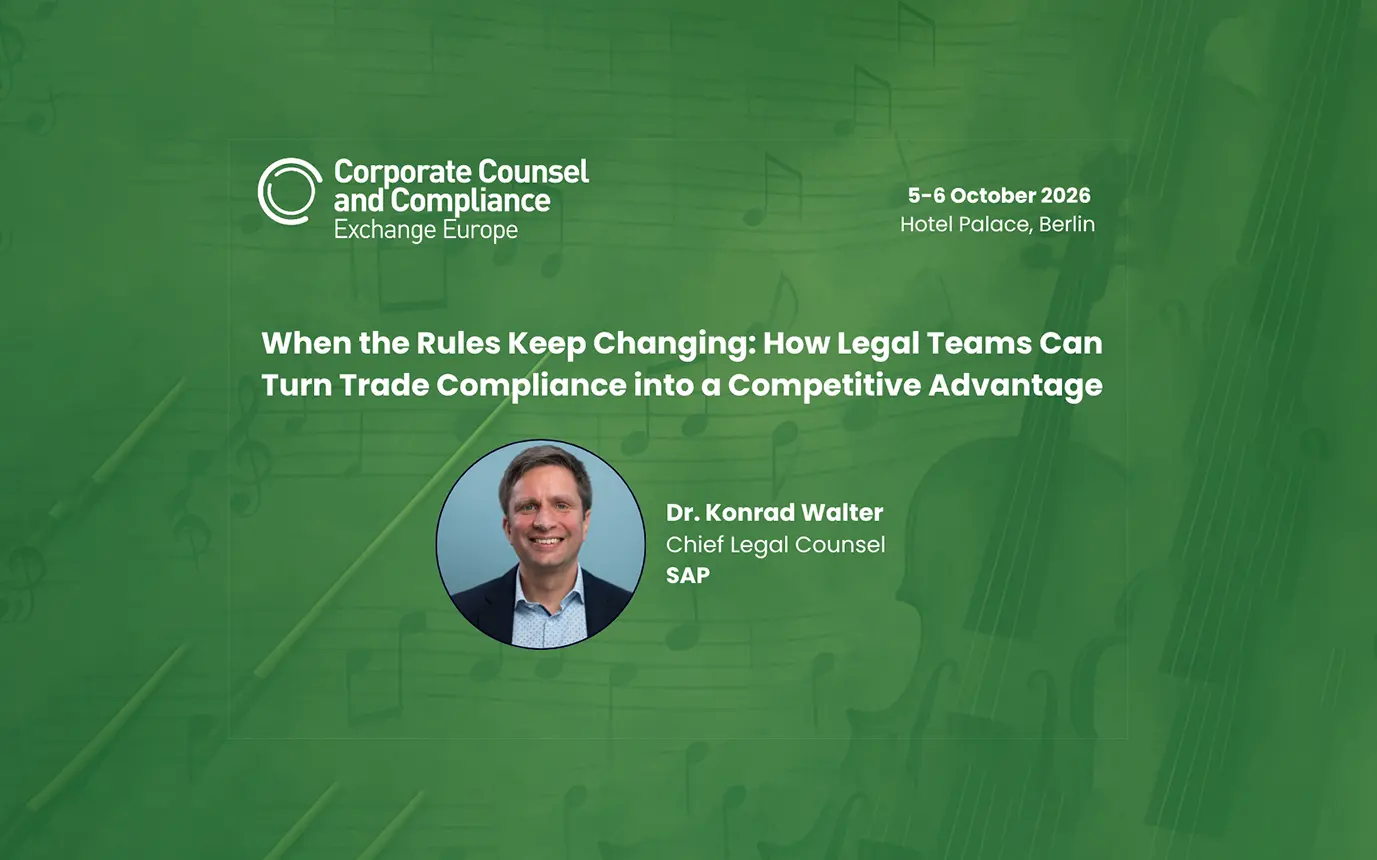
Ahead of his Think Tank, ‘Between a Wrong Note and a Missed Cue: Applying Trade Compliance in a Fragmented World’, at the Corporate Counsel & Compliance Exchange Europe 2026, Walter shared his perspective on the forces reshaping trade compliance and what legal leaders can do to stay ahead of change.
Trade Compliance Has Become a Geopolitical Risk Function
Over the last several years, trade compliance has rapidly moved up the corporate agenda. According to Walter, one event in particular accelerated that shift.
“The biggest shift happened with Russia’s full-scale invasion of Ukraine.”
What was once viewed as a specialist area of compliance is now directly connected to sanctions, export controls, tariffs and supply chain risk management. At the same time, businesses are grappling with an unprecedented pace of regulatory change and increasingly assertive enforcement activity.
For multinational organisations operating across multiple jurisdictions, staying compliant has become significantly more challenging. Different countries often apply different sanctions frameworks, export restrictions and supply chain requirements, creating a fragmented regulatory landscape that can expose companies to conflicting obligations.
Walter believes the starting point is understanding an organisation’s risk profile.
“You need to define your risk profile. For companies acting globally, it can make sense to set some universal standards such as compliance with EU and US laws.”
While there is no perfect solution for navigating conflicting legal requirements across jurisdictions, consistent controls, strong visibility and clear governance structures help organisations manage complexity more effectively.
Why Compliance Can Accelerate Growth
One of the biggest misconceptions surrounding trade compliance is that it slows business down.
Walter sees the opposite happening in organisations with mature compliance programmes. Rather than acting as a barrier, effective compliance frameworks create predictability, reduce disruption and support better commercial decision-making.
“A common misconception is that it only slows business down. In practice, well-designed controls create predictability, reduce disruption, and support better commercial decisions.”
The challenge for legal and compliance leaders is therefore not simply enforcing rules but demonstrating business value. Increasingly, this means speaking the language of risk, resilience and commercial outcomes rather than focusing solely on regulatory obligations.
Technology is also playing a growing role. Automation can help organisations identify issues earlier, streamline decision-making and prevent compliance concerns from becoming obstacles to business objectives.Supporting Innovation in an Era of Export Controls
Can Innovation Keep Pace with Regulation?
The rapid development of artificial intelligence, quantum computing and other emerging technologies is creating new challenges for both businesses and regulators.
Walter argues that future export controls must remain targeted and proportionate.
“Any new export controls should be carefully targeted towards technologies with clear national security implications and potential military applications.”
While some emerging technologies may require additional oversight, Walter cautions against broad restrictions that risk limiting innovation without delivering meaningful security benefits. In his view, the majority of AI applications do not fall into the category of technologies that require export control measures.
For legal teams, this places a premium on early engagement with the business. Monitoring regulatory developments, participating in strategic discussions around emerging technologies and helping shape governance frameworks can prevent innovation projects from being stalled later in the process.
Walter also highlights the importance of international coordination, noting that businesses benefit from regulatory approaches that remain aligned across jurisdictions, creating a more level playing field while supporting broader non-proliferation goals.
Preparing for the Next Regulatory Shock
In today’s environment, regulatory change often arrives with little warning. Organisations that respond effectively are usually those that have invested in strong foundations long before disruption occurs.
According to Walter, preparedness starts with continuous monitoring of regulatory developments, reliable master data and automated processes that can be adjusted quickly when sanctions or export control requirements change.
“The key lesson is preparedness.”
Companies that build these capabilities are far better positioned to adapt when new restrictions emerge. Equally important is executive support and close collaboration with the business. Compliance functions that are viewed as trusted internal partners can respond more quickly and confidently when new risks arise.
Legal teams can further improve organisational agility by establishing clear decision-making frameworks, escalation procedures and governance structures.
“The aim is to make compliant decisions faster, not to create more friction.”
Embedding compliance directly into workflows and supporting those workflows with technology enables organisations to maintain control without sacrificing speed.
Building Compliance as a Strategic Capability
Walter’s core message is a simple one: growing regulatory fragmentation is not a reason for businesses to retreat from global markets.
Instead, it should encourage organisations to build stronger compliance architectures supported by governance, quality data, technology and cross-functional ownership. Those that invest now will be better positioned to navigate uncertainty, adapt to future regulatory change and seize opportunities in an increasingly complex global environment.
As geopolitical tensions continue to influence trade policy and regulatory expectations, trade compliance is becoming far more than a legal requirement. For leading organisations, it is emerging as a source of resilience, agility and competitive advantage.
Download the Complete Interview
This article captures only a selection of Dr. Konrad Walter’s insights.
In the full interview, he discusses:
- Defining a global trade compliance risk profile
- Managing conflicting obligations across jurisdictions
- Preparing for rapidly changing sanctions regimes
- The future of AI and export controls
- Embedding compliance into business decision-making
- Building resilient compliance operations that support growth
Download the full interview to discover how leading organisations are transforming trade compliance from a regulatory requirement into a strategic business capability.
Where the Conversation Continues: Corporate Counsel & Compliance Exchange Europe
Dr. Konrad Walter will be exploring these themes in more depth at the Corporate Counsel & Compliance Exchange Europe (5-6 October 2026 | Hotel Palace, Berlin), an invitation-only forum bringing together Chief Legal Officers, General Counsel, Chief Compliance Officers and senior legal leaders for candid, peer-led discussion.
If you’re looking to:
- Future-proof your trade compliance framework
- Navigate sanctions and export control risk with confidence
- Balance innovation and regulatory obligations
- Improve collaboration between legal, compliance and business teams
- Build resilience in an increasingly fragmented geopolitical environment
The Exchange offers practical case studies, peer-to-peer discussion, insight into evolving regulatory frameworks, and strategies for building resilient compliance functions that support long-term business growth.
Request your complimentary invitation* or get in touch to learn more about attending the Corporate Counsel & Compliance Exchange Europe.
*Subject to seniority and suitability.