
There’s a saying Terry Dohrmann returns to more than once, borrowed from an old sales leader of his at Salesforce. If a client needs a spoon, do not try sell them the whole knife set.
Sounds obvious, right? Until you try to apply it in a legal AI market that decided the correct answer to every problem is roughly the entire cutlery drawer. Terry is building Lexafide, his second serious run at plaintiff legal technology, around the belief that the market is going to correct on this sooner rather than later.
Terry is not new here. He was at Salesforce when Morgan & Morgan, one of the largest plaintiff firms in the United States, decided it wanted to rebuild its entire architecture on Salesforce and picked Terry to work on it. That collaboration eventually became Litify, the case management platform which Terry co-founded and grew from zero until Bessemer Venture Partners acquired a majority stake. He describes the exit briefly and honestly. He was exhausted; it was a good outcome. He lasted about a month at home before his wife told him, in his own paraphrasing, to please go and do something else.
That something else turned out to be Lexafide, which Terry co-founded with Rab Govil, a technology entrepreneur whose team had already built an agentic AI platform for a portfolio of businesses in banking and call centre operations. Rab showed Terry the platform and asked what he would do with it. Terry’s vision was to run the Litify playbook again, this time in AI, going directly to the plaintiff firms he was now acquainted with. He would be the subject-matter expert on the workflows. Rab’s team of engineers would build the technology around what Terry knew those firms did on a day-to-day basis.
This week, The Legal Wire sat down with Terry, who is one of the more candid interviewees you can hope for on the plaintiff-firm side of legal AI. What follows is his account of what Lexafide is, why he decided to build it the way he has, and where he thinks the ‘trending’ parts of the AI conversation are largely mistaken.
Three agents, one shared brain, and eight months of plumbing
Lexafide is a set of AI voice and orchestration agents built for plaintiff law firm workflows, wired natively into the existing case management systems and telephony platforms of those firms.
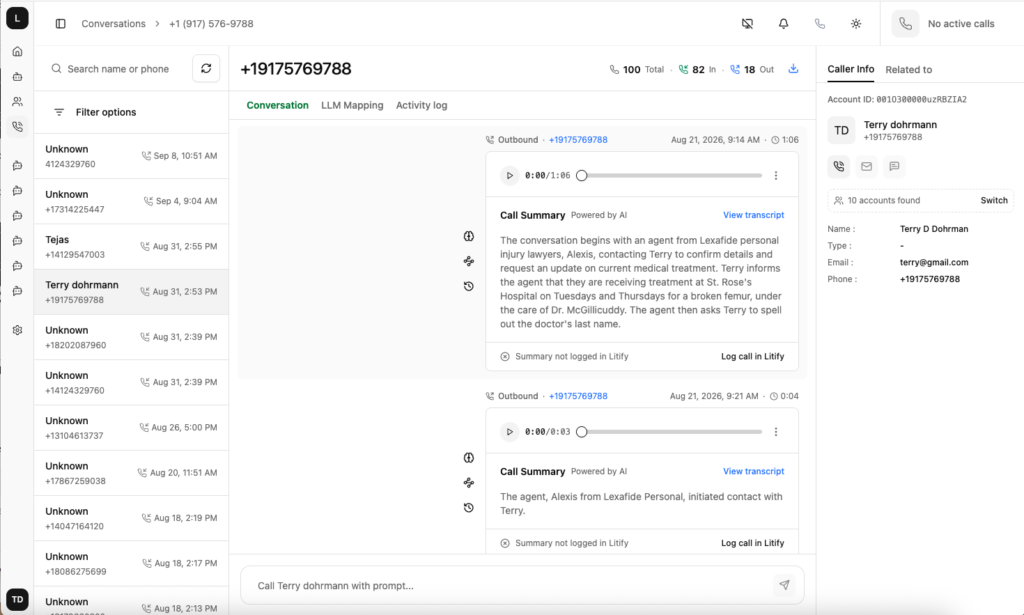
Three agents ship today. A Reception Agent answers calls, extracts intake data, summarises what happened and updates the CMS in real time. An Outbound Agent runs batch and chaser calls, verifies data, fills gaps and schedules appointments. A Human Assist Agent surfaces live suggestions during a human’s own call and logs the summary afterwards. All three feed into what Lexafide calls its shared case context: a running record of what each conversation on a matter has produced, available to every subsequent agent conversation on the same case.
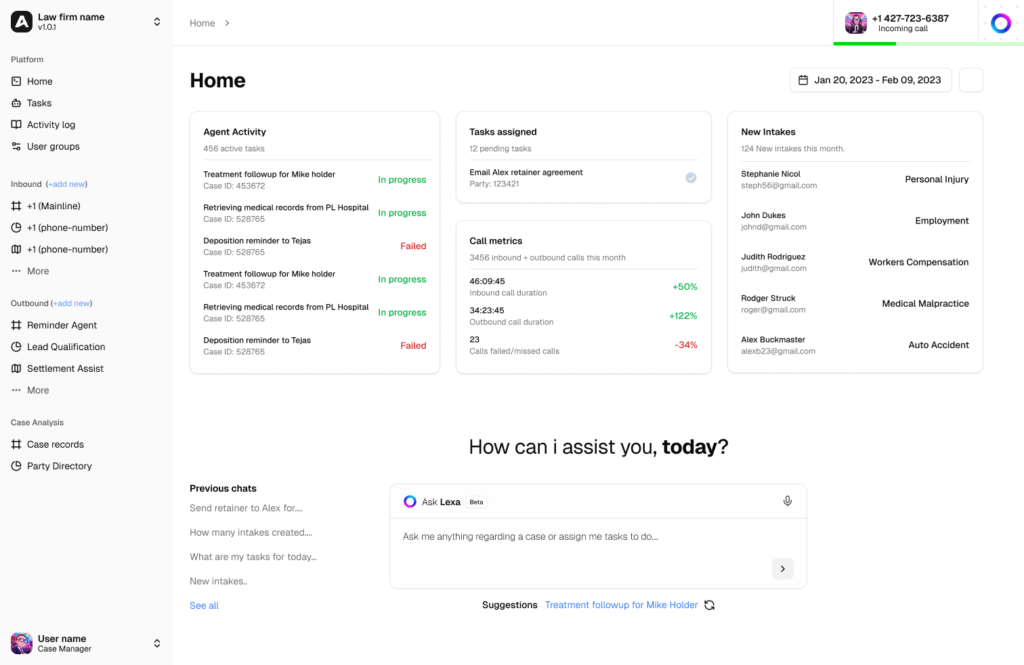
With integrations making headline news in the legal tech space, this article wouldn’t be complete without noting Lexafide’s rather impressive list. Native connections include hooks into Litify, Filevine, SmartAdvocate, Lawmatics and Salesforce on the case management side. RingCentral, Twilio, Five9, Dialpad and Zoom on the telephony side. In practice, that translates to, roughly, the following sequence: a call answered by the Reception Agent updates the firm’s CMS as the caller is speaking, without anyone re-keying details afterwards, all while the firm’s existing infrastructure does not have to be changed. Terry spent about 8 months of focused work getting that plumbing right, which he describes as easily the least glamorous part of building the company, and, in his view, the part most competing products have not done properly.
Terry’s thinking on how the platform got built sounds best in his own register. The starting question, he says, was not what AI could technically achieve inside a plaintiff firm, but what the firm needs on a Tuesday afternoon when everyone is already overloaded. Rab’s team had built a general-purpose agentic AI platform serving banks and call centres and Terry brought the workflow knowledge: what a plaintiff intake captures, why an adjuster call is different from a client call, how a Monday-morning voicemail backlog turns into lost cases by Wednesday. The company was built by mapping the workflow first and wiring the agents into it, as opposed to shipping a generic AI product and asking firms to adapt.
The aim is not to replace anyone at the firm. It is to give plaintiff firms the operational capacity to run the work they take on, without the phone going unanswered or the adjuster call being routed to the wrong attorney.
What Lexafide is trying to sell, in other words, is not intelligence. It is time.
TLW: You spent about 8 months on integrations and telephony work before pushing the product into the market at any real pace. That’s a lot of restraint for a legal AI company. What specifically in that infrastructure work turned out to be harder than you expected, and what is the mistake most competing voice-agent products are making by not doing it?
Terry: “Part of my answer is personal – I spent years forming relationships with lawyers and firm runners by delivering a product that works. Many of them are my friends and we were not going to bring a product to market that isn’t properly vetted and functional. Going a level deeper, what ate up the eight months was everything underneath the calls, the integrations to Case Management and Telephony systems. Seeing how test environments behaved differently than production, Salesforce and Calendly failures that only showed up under real call volume, a Lawmatics integration where we genuinely weren’t sure for weeks whether we had write access or not. None of that shows up in a demo, it only shows up once you’re live with a firm’s actual data and their case managers are depending on it.
The mistake I see other voice-agent products making is treating these integrations as a checkbox — ‘yes, we connect to your CMS’ — instead of treating it as the product itself. If a write-back fails silently, or a call summary lands in the wrong matter, that’s not a minor bug, that’s the firm’s trust in the whole system gone in one afternoon. We spent our time getting the boring things right: webhooks, field mapping, handoffs between agents. It’s not glamorous, and it’s not what gets a company on stage at a conference, but it’s the difference between a demo that impresses and a system a firm actually keeps running.”
Why a client referred to Lexafide as the Jerry Maguire of AI providers
One of Terry’s clients recently described Lexafide as the Jerry Maguire of AI providers. What the client seems to have been reaching for, and what Terry keeps circling in his own language, is a specific contrast with the larger, better-funded parts of the legal AI market. Getting close to a small number of clients. Understanding what makes each firm tick. Being reachable when something breaks. Refusing to be the kind of vendor whose founder is only in the room when the annual conference sponsorship needs approving.
In Terry’s own words, he’s “look[ing] at parts of the legal AI market today and see[ing] a red ocean. There are sharks attacking sharks. They’re all going to beat the hell out of each other.” His approach is intentionally different. “I’m going to stand on the boat and build a sustainable, value-driven business.” The sign that the approach is landing, in his view, is that people from some of the larger legal AI companies are beginning to call him looking for jobs.
There is a strong commercial argument in the framing, too. When a legal AI company raises a very large round at a very high valuation, expectations immediately change. The company needs to grow into the valuation, which means flooding the market with salespeople and pursuing growth at a rate the market doesn’t naturally support. Terry has watched that model unfold more than once, from the inside. The resulting sales motion (six-figure contracts sold on the promise of an all-encompassing platform, followed by adoption of 10% of what was purchased) is producing a kind of client fatigue that is starting to show up in the market.
TLW: The Jerry Maguire framing is a client’s description of what it feels like to work with you. If you had to translate that feeling into 2 or 3 concrete things a firm should look for in an AI vendor before they sign the contract, things that would properly distinguish a Jerry Maguire from the rest, what would they be?
Terry: “I’d tell a firm to ask three things before they sign.
First: did this vendor spend real time learning how your staff actually works before they showed you a product, or does the demo look identical to what they showed the firm down the street? And did they identify the areas of friction that you’d actually like to solve for?
Second: are they selling you outcomes, or a price per AI minute? The minute conversation is a trap, it invites you to compare us to a human wage, which misses the point entirely— ask instead what changes for your staff when they can handle more cases at the same quality.
Third, and this is the one people skip: ask what happens after the pilot. Not the roadmap slide, ask for real production metrics, real references, and a support model that survives the sales team leaving the room. A lot of this market is discounting hard to win logos right now, which tells you something about what happens to service once the ink is dry. A Jerry Maguire vendor is still returning your call in month eleven. Most of the market isn’t built to do that, because most of the market was never built to stick around that long in the first place.”
The discovery-based sales motion, and the spoon
The way Lexafide sells is directly downstream of the way Terry thinks about the market. His sales process starts with discovery (not a demo). What are you doing today? How does your staff operate? Where are the real friction points? Then, and only then, pick one thing and solve it. Maybe it is opening claims. Maybe it is scheduling calls with clients. Maybe it is the front desk being overwhelmed on Monday mornings and every voicemail arriving three hours late. Solve that one thing. Charge for solving it. Prove the value. Iterate to the next thing.
That sales motion is quite different from the standard legal AI playbook, which Terry describes as involving walking into a firm with a large platform, signing a six-figure contract, and then watching the firm use 10% of the product.
Lexafide’s motion is smaller, cheaper, faster to prove and more likely to lead to a second engagement. But it is also the motion Terry can afford to run because Lexafide is not carrying the weight of an over-capitalised balance sheet.
The counterpoint is also rather interesting. A spoon-first sales motion has structural limits. The average deal size is smaller. The sales cycle depends on a discovery-driven relationship rather than a features-driven pitch. And the ambition to grow inside a client account depends on the firm choosing to buy the next thing, which they may not decide to do, after all. Terry doesn’t shy away from this. He views these limits as the price of a more durable client relationship, and in a market where every serious competitor is racing to sell as much as possible as fast as possible, a slower motion looks pretty different by the time the market corrects.
TLW: Your discovery-based sales motion is one you can afford partly because Lexafide is not carrying a large venture round. If a founder came to you tomorrow wanting to build a plaintiff-focused legal AI company with $50 million in the bank, what would you tell them to do differently, and where would the pressure from the capital eventually break their approach?
Terry: “I’d tell them to be careful what they wish for. Fifty million sounds like freedom, but it’s really a clock. Companies can be Investor driven, employee driven or customer driven. Investor focused businesses can be effective – the drive to create return for those investors can lead to a good product. Likewise employee driven companies can work where people like to work where they are creating value for other humans. Lexafide has deliberately chosen to be customer driven – our belief is that by getting close to our clients, building alongside of them, listening to them – we will be a valuable company in the years to come.
Back to your specific question – the board wants growth in a straight line, which means you hire salespeople fast, and salespeople need something to sell, so you widen the platform to give them more to pitch. Before long you’re not solving one problem well for a firm, you’re selling the whole knife set on day one because the model demands it, not because the firm asked for it. Where it breaks is discipline. Our motion works because we can afford to spend weeks in discovery before we propose anything, and losing a deal that isn’t a fit doesn’t blow up our quarter. A well-funded team can’t say no to a badly-fitting deal, not when they’ve got a burn rate and a board update coming. I’d tell them: keep the sales cycle short and the trust cycle long. Solve one real thing, prove it, then expand. If your cap table is forcing you to sell faster than a firm can actually absorb the product, you’ll win the battle and lose the war.”
Onboarding, staff impact, and the KPI question
Onboarding a new firm currently takes about 30 days, though Terry says the company is working to get that to two weeks. Simpler use cases (a reception agent handling after-hours calls) can be running in about a week. In every case, Terry says part of his job is to rein in over-excited clients who want everything at once. Start with one thing. Prove it works. Then expand.
The staff-impact question is where Terry says something against the grain of the current AI conversation. Are firms reducing headcount? Across his 16 direct clients and the wholesale footprint, the honest answer is no. Existing staff are taking on more capacity per person rather than being replaced. The exception is outsourced call centres: if a firm pays an external centre to cover nights and weekends, that spend can be replaced. Actual employees inside the firm are not being cut.
What does change, is the definition of what those employees are expected to do. Richmond Vona had to change the KPIs for its staff after implementing Lexafide, because what a competent staff member could accomplish in a working day had roughly doubled. The firm’s expectations and performance measures all had to adjust. This is the part of AI adoption Terry says the industry consistently under-covers. The technology arrives. The people stay. But the shape of what those people do is measurably different, and if the firm does not update its management practices to match, the value the AI generates gets absorbed into confusion rather than converted into growth.
TLW: Beyond changing the numbers on a performance review, what does a firm need to do to make sure the doubled capacity turns into growth instead of confusion, and where have you seen firms get it wrong?
Terry: “Objectives and ratings on the performance review is the easy part to change. The hard part is ensuring the entire team is bought into the vision of sustained growth benefiting the firm and better results benefiting their clients. This needs to be ingrained. What’s also important, is that a manager who’s used to running a twenty-call day now has staff doing thirty-five, and if that manager’s own job hasn’t been redefined, they don’t actually know what good looks like anymore. Richmond Vona had to work through exactly that — new KPIs were only step one, the real work was deciding what to do with the freed-up time: redirect it into more claims opened, or more client check-ins, on purpose, as a target. If you don’t, staff will quietly find their own equilibrium, and it usually isn’t the ambitious one. Where I’ve seen firms get it wrong is treating the AI as a headcount story instead of a capacity story, and then never actually deciding what the extra capacity is for. The technology did its job. Nobody translated that into a new definition of a good week. That’s a management decision, more than it is a technology decision, and it’s usually the part firms are least prepared to make.
Half lawyer, half entrepreneur, half maniac
The plaintiff firm owners Lexafide serves are, in Terry’s memorable framing, half lawyer, half entrepreneur, half maniac. He is aware that is three halves. He is also, having spent most of his working life inside their offices, someone who has earned the right to say it. The firms are entrepreneurial and always looking for an edge. They don’t have the patience for a twelve-month platform implementation, and they do not have the tolerance for a vendor who is only in the room at contract renewal.
What they respond to, on Terry’s evidence, is somebody who understands the workflow, solves one problem well, and comes back to solve the next one.
Whether Lexafide’s spoon-first, integration-heavy, deliberately under-capitalised approach turns out to be the winning shape of legal AI in this segment is an open question in the market. What sparks our interest now, is that the founder placing the bet built the case management platform much of the segment currently runs on, has watched what worked and what did not from the inside, and is willing to be honest about which parts of the current legal AI conversation have run ahead of the evidence.