

If you’ve spent any time in the legal tech corner of LinkedIn over the past several years, you’ll already know Colin Levy. Which in itself is a pretty impressive thing to be able to say about a GC, given that GC’s aren’t usually the most public members of a team.
But Colin, in fairness, is not really the average GC. In the course of a normal week, Colin acts as GC at Malbek, an author, a professor teaching the next generation of lawyers how a working AI stack can function in practice, an advisor to legal tech companies, and a curator of voices in the ongoing industry conversation about where all of this is heading (see his website).
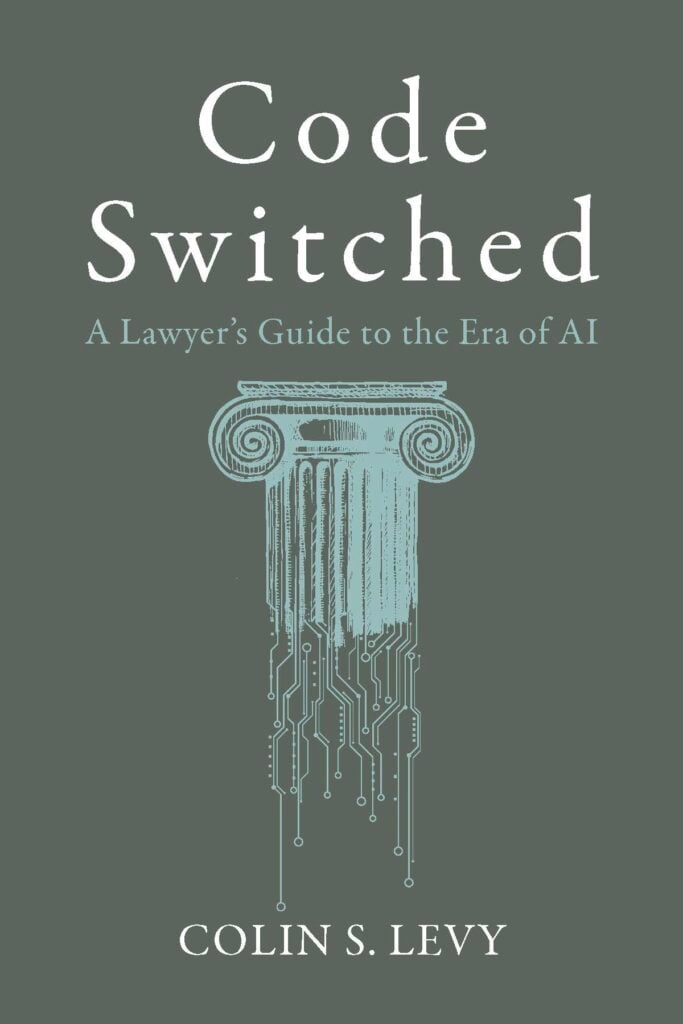
His new book, Code Switched, comes out on 6 October (click here to pre-order). The title is a small joke: legal work has always required lawyers to switch between registers (client mode, court mode, drafting mode, even the specific mode where you explain to your parents what you do for a living), and Colin argues that AI is now one more register lawyers need to code-switch into. His central argument, expanded across the book but repeated across our conversation, is not that AI will replace lawyers. It’s that AI, used properly, amplifies exactly the things that make a lawyer irreplaceable in the first place. Judgment. Resourcefulness. The client relationship. The strategic instinct that no model has yet learned to fake.
This week, The Legal Wire sat down with Colin for a conversation that started with the book and ended with the helpful acknowledgment that even someone with several different roles in the legal tech space doesn’t always know what’s going on, because things are constantly changing.
What follows is a piece about a legal tech commentator who is careful with language, generous with time, and clear about his message.
The ongoing misunderstanding in legal tech
After speaking with Colin, I considered his answer to the question of ‘what does legal tech still misunderstand about AI’ several times. He reminded me that AI isn’t inherently intelligent in the way we tend to think about intelligence (I, for one, definitely tend to forget this). It follows that the most powerful impact of a technology rarely comes from the technology itself. The most powerful impact comes from the person using the tool, knowing how to use it, and understanding the workflow it is being pointed at.
The problem he’s observed is that people want to jump straight to the fun stuff. The sexy stuff, as he calls it, is something you cannot get to without first thinking carefully about what you are trying to accomplish. Of course, we’ve all seen that if you skip that step, the opportunity cost is real. Yet it still happens often: misaligned expectations; disappointed users; missed opportunities to become significantly more productive.
Taking a metaphorical step back, Colin remarks that “One of the most underappreciated impacts of these tools is that they’re actually increasing the need for human judgment and discernment.” That gets lost, he adds, amid all the talk about AI taking over different parts of our lives.
Which brings us to Colin’s favourite complaint. Terms and phrases like “revolutionise,” “transform,” “replace”, and “AI-powered”, often used without attributing the real meaning, are all just distractions, part of the ongoing ‘hype cycle’, with none adding substance to the discussion or contributing meaningfully to the advancement of the space.
TLW: You’ve said AI increases the need for human judgment. As a GC who is accountable for what leaves your organisation, how has your own review discipline changed over the past year/two years of AI adoption and what would you want in-house teams reading this piece to change about their own review processes, if they have not yet?
Colin: “I’m more deliberate now about what happens after an AI-assisted contract summary reaches me. Did the lawyer open the agreement? Did they check the defined terms and the exceptions, or just the paragraph the system pointed them to? I don’t think every draft needs the same degree of scrutiny. If a note is helping the team get oriented, that’s one thing. If a business colleague is about to rely on it in a negotiation, I want a lawyer to trace the answer back to the document and say where any uncertainty remains. I’d ask an in-house team to agree on when that closer review is needed and who makes the final call. It’s easy to read a tidy summary, feel comfortable with it, and miss the provision that changes the answer.”
AI as a thought partner, not a knowledge engine
Colin’s framing of AI as a thought partner, not a knowledge engine, is the same framing you’ll find in his upcoming book. It’s not a search bar with better manners. It’s closer to a member of your team who is still learning as they go. It won’t know everything at the start, but it can become more useful as you give it better context and learn how to work with it. It can also, and this is an important caveat, get things wrong, and the responsibility lies with the more experienced partner in the relationship (that is, you, the user) to tell the difference.
The framing is explained by Colin as more than a mere metaphor. He warns that these tools are people pleasers, which we all know by now, provide confident-sounding answers that can seem awfully close to what you want to hear. But what you want to hear is not necessarily what you need to hear. Therefore, the lawyer who treats an LLM as an oracle instead of a slightly-too-eager junior associate is going to have a bad time.
His experience as a GC also evidently informs how he thinks about the relationship between AI and a good legal team. When prompted, he explains that for him, a good legal team consists of people who will disagree with you well. Colleagues who test your reasoning. Colleagues who ask you what you have not thought about. If the profession loses that extremely important muscle of interrogating a proposition properly because a chatbot has agreed with every version of it, a vital component of the practice of law gets weaker over time.
TLW: You’ve described AI as a “thought partner”. What is a practical habit or method of AI-use that you would want a lawyer to build into their day-to-day, so the partnership stays a partnership rather than turning into something that eventually goes unchecked?
Colin: “One habit I suggest is to ask the tool to argue against the advice you’re leaning toward. Say you’re thinking of pushing back on an indemnity clause. Before asking it to draft language, explain your concern in a few lines and ask what the counterparty is likely to say. Then go back to the agreement and what the business is trying to accomplish. Maybe its objection is useful; maybe it misses the point. You still have to decide. This can take five minutes. It doesn’t require a clever prompt or a new process for the whole team. I find it more useful than asking the tool whether my draft is good. And if I can’t explain why I kept or ignored an objection, I’d take another look before sending anything.”
On buying legal tech, and the courage to buy nothing
Given his vantage point (GC, teacher, advisor, buyer, seller-adjacent), Colin has useful advice on how to go about evaluating a legal tech vendor.
Start with the users, he says. Why is there a need for the tool at all? What is the exact, precise need? Can you define it specifically? Then, build the criteria you use to evaluate potential vendors. Don’t let the evaluation be controlled exclusively by the person who ultimately signs the cheque, regardless of what biases they may bring. Involve the people who will use the tool often. And, as uncomfortable as this may be in a procurement process: get familiar with the possibility that if you can’t find something you’re happy with, you don’t need to buy anything.
Don’t pick something just because it is there or because it seems to work for everyone else. Pick something because it’s going to have a material impact on your team or business. People buy things, Colin says, because they are available rather than because there is a genuine need and a proven use case. This sounds quite simple, I’ll admit, but having heard of various legal AI vendors running massive discounts or offering other (sometimes eye-watering) incentives to sign up for their product, the discipline of buying nothing is meaningfully undervalued, and Colin is probably right that many decisions continue to be informed by the wrong considerations.
On the broader funding picture, Colin makes a distinction between investments that are well-grounded and material, and investments that are chasing something because it has already been successful. Too many people are focussing on the size of the round rather than the rationale behind it.
TLW: You buy legal tech, you build legal tech workflows, and you advise the companies selling it. In a first meeting with a vendor, what would you be listening/looking for in that meeting, that tells you their product could be deployed successfully? And are there any common vendor claims that lawyers get wowed by but that, in your experience, rarely translate into something meaningful once the tool is in use?
Colin: “In a first meeting, I’d ask for a demonstration using a routine commercial agreement with a few awkward provisions. That’s closer to the work than a clean sample. I want to see what the person using the product has to enter, where the output came from, and what happens when the system can’t give a clear answer. I’d also ask who on our side would have to maintain it after the vendor leaves. That can turn a promising demo into a job nobody has time to do. The claim I’d question is ‘we’ll cut review time in half’ without saying which part of the work goes away. If lawyers still have to fix the summary, check the clauses, and explain the judgment call, show me where the saving actually is.”
Lawyers as builders, and the education question
A related topic that Colin is keenly interested in is legal education. And through his education and other roles, he sees another capability entering the lawyer’s job: building. Not builders in the sense that they will all learn to code. More like builders in the sense that they will increasingly be expected to design workflows, assemble tools, and deliver custom solutions to clients. Lawyer as product manager, if you like, only with more Bluebook.
Colin’s observation is that law schools have not fully caught up. Many are still training students for the world that existed before, instead of the one they are about to practise in. In an effort to prepare his students for the impending legal world, Colin explains that his own courses lean hard into practical skills: how to use these tools, how to build with them, how to know when to ignore them. He is not the only person doing this, and he says the number of law schools moving in this direction is growing. But there is still meaningful distance to close, and the students entering the profession this year will feel it first.
One can’t help but wonder whether students with no technical inclination or desire to ‘build’ will still enroll in law school, or whether a whole new type of law student is about to emerge. Colin could relate to the observation, and noted that he was not always someone who loved technology. In fact, when he was younger, he thought technology was clunky and intrusive. Of course, he’s come a long way. The point being that if a GC who used to distrust the whole category can end up teaching the next generation how to use it well, the barrier for the rest of us is probably not as insurmountable as we think.
TLW: For a mid-career lawyer reading this piece who is nervous about the transition and does not know where to start, what is the one small practical thing you would ask them to build this month and is there anything they should resist reaching for while they are learning?
Colin: “I’d ask them to build a short briefing sheet for one kind of agreement they see regularly. Before anyone asks AI to review a customer contract, what does the lawyer need to know about the deal? What is the customer buying, which terms have already been discussed, how much time is there, and where does the business have room to negotiate? Those answers are often scattered across emails or sitting in someone’s head. Write the questions down, try them on a couple of real requests, and see which ones need a conversation rather than a form. Then use the tool on the document with that background in front of you. I’d resist dropping an agreement into a system and simply asking whether it’s acceptable. Without the context, it may spend time on a clause that does not matter here and miss one the business cares about.”
Learning to Code-Switch
Perhaps the most refreshing part of speaking with Colin is that he makes a subject that can feel complicated and heavy, surprisingly manageable and relatable. You don’t necessarily need to predict where AI will be in 5 years, become a software engineer turned lawyer (or the other way around), or test and adopt every new tool that appears on LinkedIn. Keep it simple: understand the work in front of you, be sufficiently curious about the technology options to help with it, retain enough judgment to know when the machine sounds intelligent, but is in fact missing the mark, and don’t beat yourself up if you’re not getting everything correct along the way.
That thinking also links to the Code Switched title. Lawyers often have the ability to act as chameleons, adapting their language and thinking to the person or problem in front of them. AI merely adds another context to navigate.
And if Colin, admittedly, once found technology clunky and intrusive, perhaps the rest of us can embark on a learning curve, too.