
A sports and entertainment lawyer can spend the same morning reviewing a sponsorship agreement, chasing comments on a licensing deal, redlining a vendor contract for an event, and summarising commercial terms for a business team that wants the answer ten minutes ago.
It is legal work, certainly, but it is also timing, brand protection, relationship management, and a fair amount of controlled chaos.
This context is important because tools built for generic contract work do not always travel well into environments like this. The documents may still be contracts, but the pressures around them are different. The drafting is more contextual. The turnaround is tighter. The commercial sensitivities are often sitting just below the surface.
ArenaDocs has been built with that setting in mind. Rather than trying to serve every kind of legal team, it focuses on counsel and legal support staff working in sports and entertainment, where the value of a tool often lies in how closely it reflects the actual texture of the work.
Kaelin Brittin’s background helps explain why the product takes that approach. Before co-founding ArenaDocs, she worked as Associate Counsel for the Washington Commanders, where legal work sat close to some of the organisation’s most visible moments: the sale of the franchise, the name change, major commercial agreements, and the constant negotiation of sponsorship, licensing, and vendor terms. ArenaDocs reads very much like a product built from that vantage point.
A tool shaped by the work itself
ArenaDocs did not emerge from a generalised view of legal workflows. Its design reflects a particular kind of in-house experience, where contracts are rarely isolated documents and more often sit within a broader commercial context.
That context shapes how agreements are drafted, negotiated, and ultimately understood by the business. A sponsorship agreement is not simply a set of clauses; it is tied to brand positioning, revenue expectations, and public-facing commitments. The same is true, in different ways, across licensing, broadcast, and vendor arrangements.
ArenaDocs narrows its focus accordingly. Instead of attempting to standardise across industries, it concentrates on the types of agreements and negotiation patterns common to sports and entertainment. That decision limits its breadth, but it also allows the platform to reflect the structures, fallback language, and deal dynamics that lawyers in this space encounter regularly.
This week, The Legal Wire connected with Kaelin Brittin and Kevin Robbins of ArenaDocs, to find out how a deliberately narrow focus on sports and entertainment is shaping a more personalised, practical approach to legal AI.
TLW to Kaelin: You’ve chosen to focus on a relatively narrow segment of the market. How deliberate was that decision, and where have you seen the biggest advantages of building for a specific industry rather than a general legal audience?
Kaelin: “We chose a narrow focus intentionally. The future of legal AI is personalized, and our depth in sports and entertainment is what makes that possible. My years in-house with the Jets and Commanders shaped how we think about the work and the pain points that come with it.
After hundreds of conversations with attorneys in this space, a clear pattern emerged: generic, one-size-fits-all tools demand long implementations, constant upkeep, and steep price tags — often without delivering material value to the day-to-day work. Our focus changes that. We understand why brand mark protection matters in a partnership agreement. We flag overly broad sponsorship categories. We’re built around the work sports and entertainment legal teams actually do.
Today, we’re working with the Jets, Sports Fishing Championship, Cavaliers, USA Track & Field, and a growing roster of emerging leagues, agencies, venues, teams, consultants, and solo practitioners.”
Personalisation as a practical requirement
That emphasis on personalisation is also reflected in the work of Kevin Robbins, ArenaDocs’ co-founder and CTO, who leads the platform’s technical development.
If the platform is shaped by a particular type of work, it follows that the outputs should reflect the way that work is actually done.
Legal drafting is rarely neutral. Over time, lawyers develop preferences around language, tone, and negotiation positions. These are often informed by prior deals, internal policies, and the expectations of the business teams they support. Generic outputs can be technically correct, but still require significant adjustment before they are usable in practice.
ArenaDocs addresses this through a combination of personalised profiles and clause libraries, allowing the system to generate outputs based on a team’s own precedent rather than external templates. Drafting, editing, and review functions all operate within that framework.
The result is less focused on generating new language from scratch, and more focused on surfacing the right version of language for a given situation. In that sense, personalisation is not a convenience feature. It is central to making the system usable in a live commercial environment.
TLW to Kevin: Personalisation sits at the core of ArenaDocs. From a technical perspective, how do you ensure that outputs remain consistent and reliable while adapting to individual user preferences and precedent?
Kevin: “Every aspect of ArenaDocs has been built with intention and that intention can be understood by the AI model. The beauty of having precedents is knowing that the right answer exists as long as the model can understand what you care about and knows how to find it. That is the technical hurdle that ArenaDocs clears for users. Personalization is a side effect of ensuring that the outputs remain consistent as well.
By giving users the ability to frame who they are and what their goals are, we ensure that the system gives them outputs that will suit them. That is why ArenaDocs supports deep user profiles as well as offering multiple, so the many sports and entertainment lawyers that wear multiple hats can switch hats seamlessly as they tackle their day-to-day volume.”
Working within the document, not around it
The platform’s integration into Microsoft Word reflects another practical decision.
Legal work in this space still happens, overwhelmingly, in documents. Drafting, reviewing, and negotiating agreements all take place within Word, even as other parts of the workflow become more digitised.
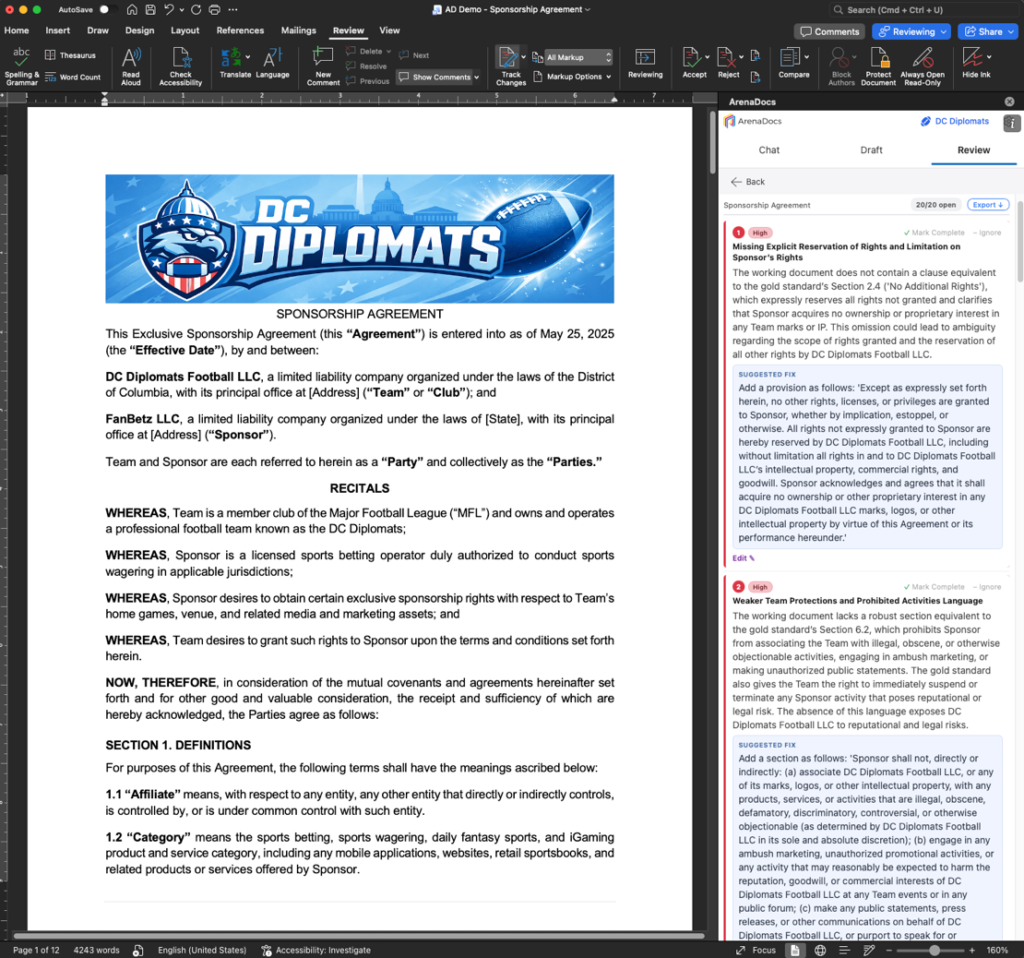
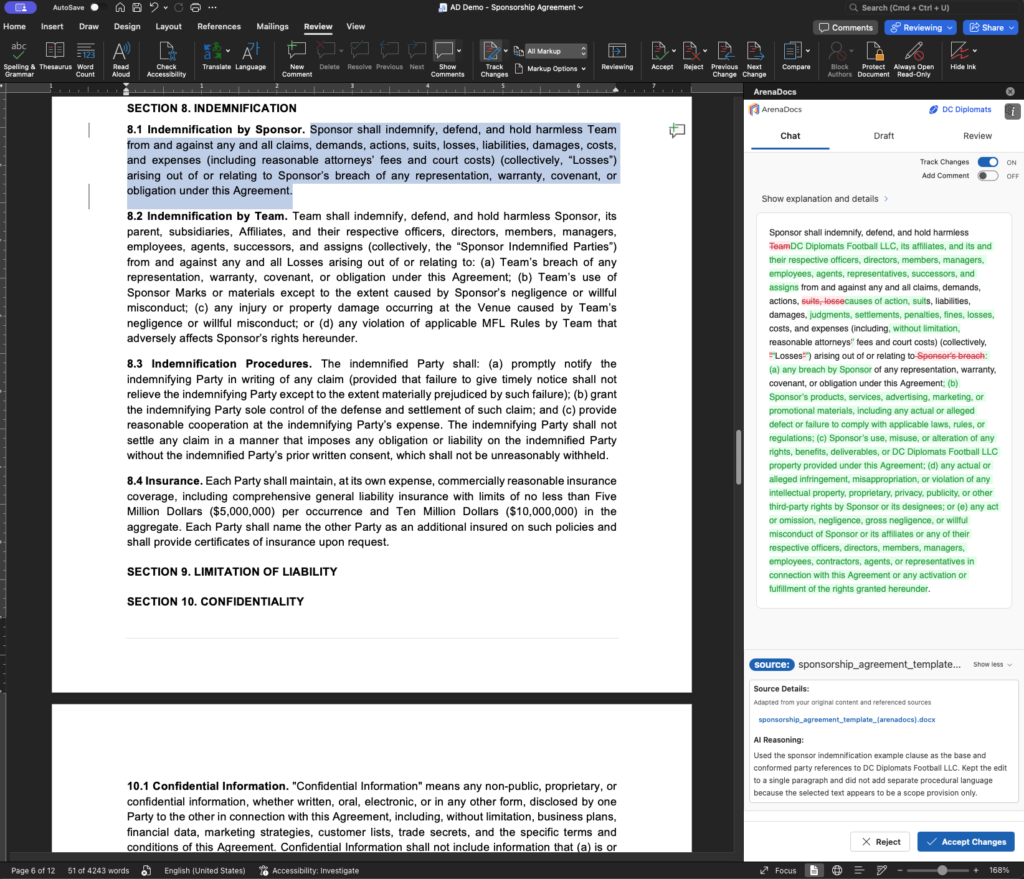
ArenaDocs operates directly within that environment. Drafting tools, redlining suggestions, clause generation, and document review all sit inside the document itself, rather than requiring users to move between platforms.
This reduces friction in a way that is easy to overlook. The question is not only what a tool can do, but how easily it fits into the flow of work that already exists. In this case, the emphasis appears to be on continuity rather than disruption.
Speed, but with structure
The platform’s value becomes more apparent when applied to repetitive but time-intensive tasks.
Drafting a new agreement can be reduced to a set of inputs like deal terms, prior templates, and instructions, with the system generating structured outputs in a matter of seconds. Clause generation follows a similar pattern, offering multiple variations aligned with different negotiation positions.
Review functions focus on identifying issues, comparing documents, and suggesting revisions through redlined outputs. Importantly, these changes are presented for approval rather than applied automatically, maintaining user control over the final document.
There is an emphasis here on acceleration rather than substitution. The system shortens the time between input and usable output, while leaving the underlying decision-making with the lawyer.
TLW to Kaelin: ArenaDocs appears to prioritise speed without removing the lawyer from the process. Was that balance a deliberate response to how legal teams in sports and entertainment actually operate?
Kaelin: “Yes, entirely deliberate. Sports and entertainment legal teams operate at a fast pace, deal windows tied to league calendars, media cycles, and game days. The work is also high-stakes and highly scrutinized, whether it’s a sponsorship deal, a player agreement, or a league compliance matter. No general counsel is going to let AI make the final call, and they shouldn’t.
ArenaDocs is built to keep the lawyer in control. The platform operates in Microsoft Word and adds value and time savings day one. No months long migration process and no lengthy training period. We give lawyers time back, cutting drafting and review times significantly so they can focus on the critical thinking and material judgement changes. The lawyer stays in the driver’s seat; we just make the car quicker!”
Communicating contracts beyond legal teams
Legal work does not end when a contract is finalised. In many cases, the next step is explaining that contract to the people who need to act on it.
This can involve translating detailed legal language into summaries that are useful for finance teams, executives, or operational staff. The process is often manual and time-consuming, particularly where multiple stakeholders require different levels of detail.
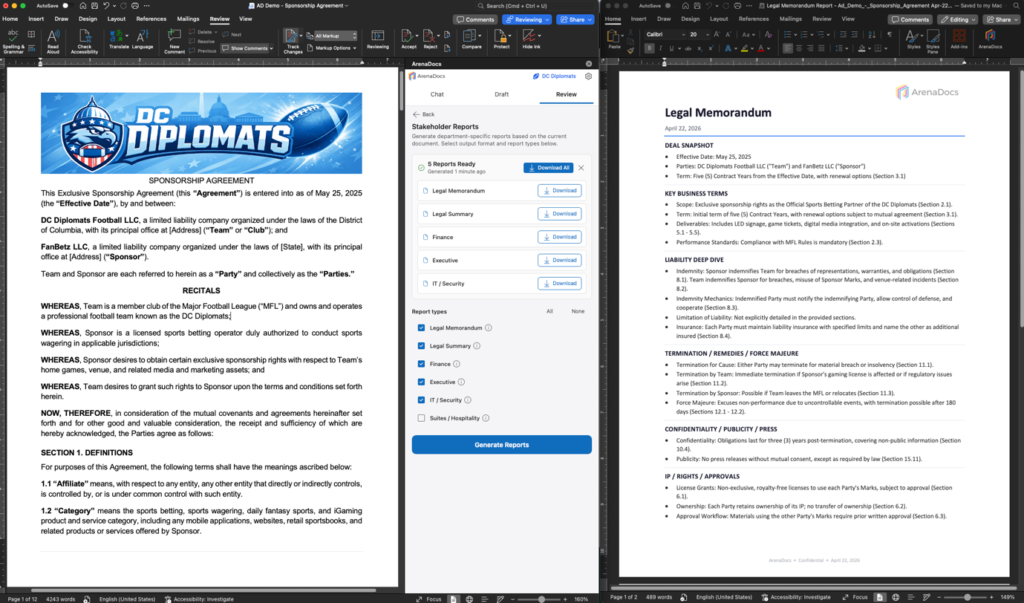
ArenaDocs addresses this through its reporting functionality, which generates summaries that highlight the terms most relevant to a given audience. It is a relatively small part of the platform, but one that reflects how legal teams operate within a broader organisational context.
TLW to Kevin: How do you see AI changing the way legal teams communicate key terms and risk internally, particularly in fast-moving environments like sports and entertainment?
Kevin: “Internal communication at the speed of AI is already happening within lots of legal teams and the sports industry is no exception. Features like our tailored Stakeholder Reports allow the legal team to automatically draft reports that translate the documents into correct language and context for a specific audience. The way we’ve seen this used in practice with our customers is to attach our executive summary or legal memorandum as a cover sheet when sending documents up the chain and using our department specific reports as an organized notification of the relevant details when informing internal departments of the implications on their department from the deal. With the legal process streamlined and the internal communication friction removed, we expect that teams will be able to navigate deals much more efficiently and, therefore, increase their volume of deals considerably.”
A different approach to adoption
The platform’s pricing structure also reflects a particular view of how legal technology should be adopted.
ArenaDocs offers both monthly (USD 200 per user) and annual (USD 150 per user) plans, giving teams the flexibility to go month-to-month or save with an annual commitment. This pricing transparency and optionality lowers the barrier to entry compared to many enterprise tools that require multi-year contracts and higher upfront costs. The approach also allows teams to test and implement the system more quickly, without the need for extended procurement cycles.
It is a practical decision, but also a strategic one. In environments where legal teams are closely tied to business operations, speed of adoption can matter as much as the underlying functionality.
Why specificity may be the real advantage
ArenaDocs is not designed to serve every legal team out there. Its scope is narrower, and deliberately so.
As the market matures, there is increasing room for tools that prioritise depth over breadth, and systems that are closely aligned with the realities of a particular industry, rather than attempting to generalise across many.
For sports and entertainment teams, where contracts are shaped by commercial context as much as legal structure, that alignment can be particularly valuable. A tool that understands how those agreements are actually negotiated may prove more useful than one that simply processes them efficiently.
There is no guarantee that this approach will scale across all areas of legal work. But within its intended context, ArenaDocs suggests that precision, applied deliberately, can be a meaningful advantage.
For more information, visit https://www.arenadocs.com/ or reach out to Kaelin at Kaelin.Brittin@arenadocs.com.