


Turbo Law is a San Mateo, California-based AI platform built for litigation. I recently spoke with co-founder and CEO Jay Sarmaz, who, together with Ozgur Bora Gevrek, started the company in 2025. Before Turbo Law, Jay and Bora already had something in common: both are PhD dropouts (Georgia Tech and UCLA respectively). Jay mentions this early on, and it quickly becomes evident during our discussion that leaving academia in no way stifled either career trajectory. On the contrary, Jay’s affinity for execution over theory forms the basis of his founder story.
In June 2026, Turbo Law closed a $3.8 million seed round led by Turkish investment firm Revo Capital, and is now managing more than 3,000 active matters and twenty million pages of legal documents across a handful of US law firms. The company reports a 60% reduction in non-billable hours per matter and a 10% drop in written-off fees among the firms using it.
Turbo Law is not another horizontal legal AI product. It’s a litigation platform, built one vertical at a time, starting with tort and insurance work, then expanded across six practice areas, and soon to support all practice areas. My conversation with Jay, shortly after the funding announcement, covered how he got here, why he thinks the era of point solutions is ending, and what he means when he calls the agents running underneath the platform “minions”.
From a research lab to a litigation operating system
Jay’s route into legal technology is not linear. Eight or nine years ago, before meeting his current co-founder, he and a friend started a research lab. The model, Jay explained, was: take ideas, incubate them, and try to scale whichever ones found a market big enough to scale. Three companies came out of that lab, and the last of them was his first venture into legal tech.
It focused on predicting case values for personal injury matters, a category he refers to as “a huge market” in the United States. That business grew into a data and AI platform for personal injury firms, which he ran for around two years. He then moved to lead data and AI at another legal tech company, where he repositioned a Series A business from a software product into an intelligence product, and helped raise $19.7 million in Series B in the process. Turbo Law was the next thing.
The pattern he saw in the market by then, and which he still uses as the framing for what Turbo Law is trying to fix, was ‘operator’ fatigue. “If you think about the legal profession over the past ten years, there have been a lot of individual tools doing individual things. You might be trying to build a medical chronology, so you use one tool. You might be trying to draft a document, so you use another tool. You want to do legal research, so you might use LexisNexis or Westlaw. Attorneys became more like controllers of ten different technologies, keeping all that context in their minds to derive a certain output or outcome. We think that’s not the future everyone dreamed of with AI.”
TLW: You led a repositioning of a Series A legal tech company from a software product into an intelligence product. What did that experience teach you about what the market wanted next and how much of Turbo Law’s current architecture comes directly out of what did or didn’t work there?
Jay: “What I learned is that firms don’t actually want more software. They want to understand their matters better. Most legal tech has been sold as a tool: a workflow, a dashboard, a feature. Firms adopt it, and someone still has to sit in the middle, pulling context from five different systems to work out what’s actually happening in a case. When you reposition around intelligence, around telling a firm something about its own work that it didn’t already know, the conversation with buyers changes. They stop asking what buttons the product has and start asking what it understands. Turbo Law is built on that from day one. The foundation isn’t an interface, it’s the Fact Graph, a live understanding of the matter that review, drafting, research and strategy all run on. That’s also why we started with the data layer rather than the screens. Intelligence is very hard to bolt on later.”
How the platform is built
The technical claim underlying Turbo Law is that on any given matter, the platform deploys “tens of thousands of little agents” that Jay calls minions. They read the file, look for things, talk to one another, and refine their outputs as they go. The output, ultimately, is what the company calls a Fact Graph: a live map of the parties, events, dates, admissions, defenses, contradictions, and relationships in a matter, each element linked back to the page and line of the source document that produced it.
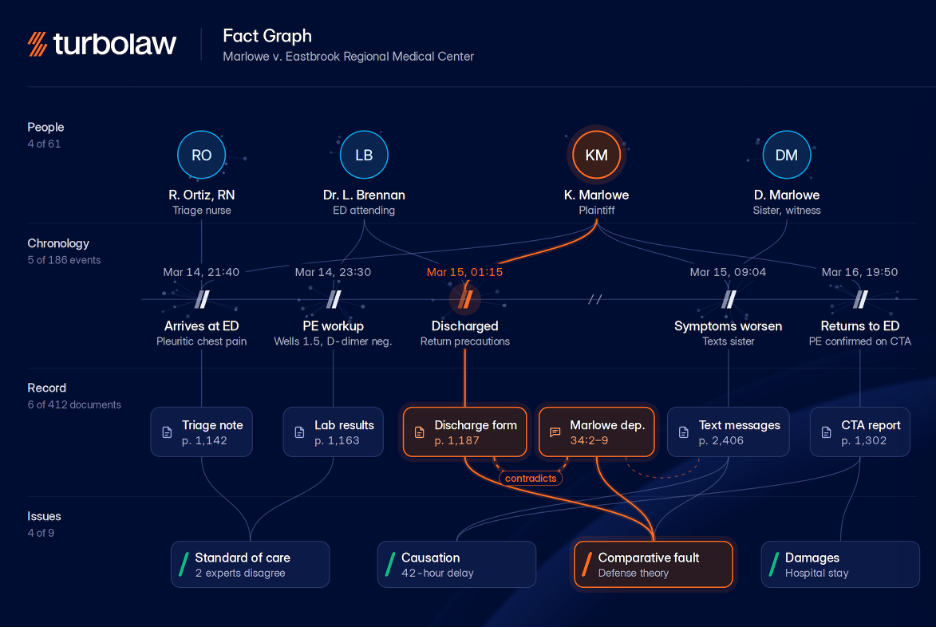
“You continuously have a live understanding of the matter,” Jay says. “Once you have that, you can drive the entire litigation lifecycle: building a strategy, reviewing documents, understanding what’s happening in them, drafting and doing research, all of that, end to end, in a single platform.”
That end-to-end architecture is organised, on the product side, into five pillars: Review (Fact Graph construction, chronology building, privilege flagging on intake), Drafting (motions, discovery responses and client reports written from a firm’s own prior work product rather than a generic template), Research (case law, deposition contradiction detection, and, in the pipeline, expert-witness intelligence), Strategy and Settlement (case evaluation at intake, settlement value modelling, mediation prep and monthly status reports), and an Assistant that takes multi-step assignments across those pillars and returns line-cited work product. Jay repeatedly makes the point that the value is not in any single one of these, but in the fact that they are all connected and run against the same live representation of the matter.
TLW: Can you explain the human oversight model that sits above your ‘minions’ and when a partner reviews the output of a Fact Graph, how do you demonstrate to them that the system caught the things they themselves would have caught?
Jay: “The model is simple: the platform proposes, the team verifies and the partner decides. Nothing in the Fact Graph exists without a citation. Every fact, date, admission and contradiction links back to the page and line it came from, so a reviewer never has to take the system’s word for anything. One click and they’re looking at the source. The minions do the reading and the cross-checking, and the people do the judging. As for proving it catches what a partner would have caught, the most convincing test is a matter the partner already knows cold. They see their own key facts come back, cited, and usually a few things they hadn’t connected, like a deposition answer that contradicts a record thousands of pages earlier. That’s when trust starts. Everything is auditable, and privilege controls and ethical walls are built in, so supervision works the way firms already supervise associates and paralegals.”
Judgment: “what lawyers should be doing instead”
Jay’s view on where the lawyer’s role goes as this kind of infrastructure spreads is not that lawyers are being replaced. Rather, he sits firmly in the camp that believes legal tech frees lawyers up to do more of what they were trained for.
“Lawyers study judgment at school,” he says. “This opens up the opportunity to use that judgment more.” His illustrative example is a large business dispute. In the past, given limited time, an attorney might spend most of the matter collecting evidence, building timelines, and focusing hard on two things they considered the most valuable. With something like Turbo Law, in Jay’s account, the attorney can focus on fifteen nuanced points instead, still spending roughly the same amount of time, but building a much deeper understanding of the case. “It unlocks more of what law is about, which is judgment, rather than doing all the legwork or carrying things around.”
He is also clear about what can’t be automated. “There’s obviously the human component of this, which you can’t replicate in a system. Understanding all the human factors, negotiation with the other party and whatnot becomes super valuable too. We definitely bet on lawyers and law firms for the long term.”
The vertical-first bet and an argument for connected infrastructure
A number of larger US plaintiffs’ firms have recently announced significant investment in their own internal AI infrastructure. Morgan & Morgan’s was the most recent, so it became the example Jay was asked about directly. His response is measured and he doesn’t try to talk anyone out of building. “If a firm wants to keep its data in-house, or if they’re scared that larger firms might do something with it, then I understand.” But Jay also makes a strong counterargument.
It rests on two ideas. The first is depth. Turbo Law goes into one litigation type at a time, working with a large number of practicing lawyers to build the vertical properly before expanding. The second is that the law itself is something that expands over time, and firms that isolate themselves from the wider practising ecosystem lose access to that expansion. “If you constrain yourself to just a specific law firm, you’re going to lose what another attorney can bring to the table in terms of pushing the law forward and expanding it. There’s value in having your own system too, but there’s also value in the collective knowledge and understanding of the law.”
His third point is less exciting, but in his view it makes the build path even harder to justify. “The product layer is getting super simplified. There are going to be products that dynamically give you whatever you need in terms of interface. You may not need to build something yourself today, something custom to you, because the product is going to be extremely customisable.”
TLW: You have talked about Turbo Law being part of a wider ecosystem, and about the value of collective legal knowledge across firms. In practice, what does that ecosystem look like? Are you pooling anonymised patterns across firms, sharing precedent structures, or is the ecosystem argument more about being the infrastructure that connects into what firms have rolled out already?
Jay: “Let me be clear on the first part: we don’t pool client data. Each firm’s environment is isolated, and we never use a client’s files, strategy or work product to train shared models. In this industry, that’s non-negotiable, and it should be. The ecosystem argument is about two other things. The first is knowledge of the law itself. We build each vertical with practising litigators from many different firms, so the platform understands how a medical malpractice or trucking case is actually worked: the records, the rules, the case law, the strategy patterns. A firm building alone only ever gets its own view of that. The second is connection. Turbo Law doesn’t replace a firm’s document management system or the tools it already runs. It connects to them, and the DMS stays the system of record. So the ecosystem is a platform that gets deeper with every litigator who helps shape it, while every firm’s data stays its own.”
Giving meaning to the numbers
The two headline numbers Turbo Law leans on in its funding coverage are a 60% reduction in non-billable hours per matter and a 10% drop in written-off fees. Both deserve a moment of explanation, and Jay is happy to break them down.
The non-billable reduction is not the result of a specific non-billable feature. It comes from removing the internal work that surrounds a billable matter: the pulling of context from different systems, the internal discussions about what the case is even about, the manual construction of chronologies before a partner can meaningfully bill for anything. “That downtime you would otherwise have, pulling context from a lot of different systems and people, you can eliminate with Turbo Law,” he says. The write-off reduction he attributes to the same underlying shift. “Write-offs are when your clients don’t pay you, because they think you should have been more efficient. That changes pretty drastically. The reduction was 10% to begin with. I think it’s going to go up.”
The other noteworthy numbers are the ones behind the growth. Turbo Law reports seven-figure annual contract value in year one, twenty million pages of documents processed, and more than 3,000 active matters running on the platform. The $3.8 million seed round was led by Revo Capital, alongside Treeo VC, BridgeX Ventures, Alchemist Accelerator, angel investor Gokul Rajaram, and a group of technology executives and litigation partners. The capital is going toward expansion of the go-to-market and engineering teams, deeper coverage of the verticals it serves, and sustained investment in security and compliance.
TLW: You said Turbo Law started in tort and insurance and has expanded across six practice areas. How do you decide which vertical to open next, and how do you know a vertical is deep enough that the team can move on to the next one without leaving existing customers behind?
Jay: “Three things decide the next vertical. The first is pull from customers. Firms that use Turbo Law in one practice group ask for it in the next, and that tells us where the pain is. The second is complexity. We go where the files are largest and the facts are hardest to hold together, because that’s where a live understanding of the matter is worth the most. The third is whether we have practising litigators in that area willing to build it with us, because we don’t ship a vertical we haven’t worked through with the people who actually try those cases. Knowing when a vertical is deep enough is less about feature counts and more about work product. When attorneys in that practice are using the drafts and evaluations on real matters with only light edits, it’s ready. And moving on never means leaving a vertical behind. Every practice area runs on the same Fact Graph, so improvements to the core reach every customer.”
The next wave
The single overarching message from Jay is reflected quite well in one of his final statements. “We’re the next wave of tech in the litigation space. We’re removing a lot of the need for lawyers to know how to prompt, move documents between systems, build playbooks, and manage context of the task at hand.”
Whether litigation teams are ready to hand that much of the workflow to a single platform is something Turbo Law will have to demonstrate, and we’ll be keeping an eye on its progress. It requires a level of delegated trust that many litigators are not yet ready to give any system, and Jay would probably be the first to say so.
What is clearer is that the vertical-first, one-platform thesis Turbo Law is built around is an intentional design choice premised on where Jay and Bora consider the litigation software market to be heading. If they are right that point solutions are giving way to unified platforms with deep verticals underneath them, Turbo Law is well placed. If they are wrong, it will not be for lack of a coherent argument or a serious product roadmap.