

In-house legal teams are, in theory, some of the most informed functions inside a business. They sit across contracts, compliance, disputes, strategy, and risk. They see everything. And yet, in practice, much of that knowledge remains frustratingly inaccessible.
It gets stuck in past agreements, email threads, playbooks that may or may not be up to date, and the heads of lawyers who happen to remember how something was handled three years ago. Ask a question: “Have we accepted this clause before?” or “What’s our position on this issue in California?”, and the answer often depends on who you ask, and how much time they have to dig.
Ruli AI is based on a simple premise: what if a legal team’s institutional knowledge could actually speak?
From tools to continuity
Ruli AI describes itself as a continuous intelligence platform for in-house legal teams. That phrase might seem simple, but it’s doing quite significant work.
Most legal tech tools operate episodically. You open them to complete a task: run research, review a contract, extract data. Then you close them. Ruli’s approach is different. It attempts to build a layer of intelligence that sits across the legal function, connecting research, contract analysis, monitoring, and drafting into a single system that continuously learns from the organisation’s own data.
Your contracts, your playbooks, your policies, your past decisions. All of it becomes part of the system’s context.
The result, at least in theory, is not just faster answers, but answers that reflect how your company actually operates. That distinction makes all the difference. A generic AI tool can tell you what the law says, but it is less useful when you need to know what your organisation has historically accepted, rejected, or negotiated.
Research that reflects the business
At the front end of the platform sits the Ruli Assistant, which combines legal research, document analysis, and internal knowledge retrieval. On the surface, this looks familiar. Many tools now offer AI-assisted research with citations.
Where Ruli becomes more interesting is how it grounds those outputs.
By connecting to internal systems such as cloud drives, contract repositories, and prior memos, the Assistant can draw on the company’s own history when generating answers. In practice, this extends beyond contracts: teams can specifically query board materials, internal policies, emails and prior advice, with the system surfacing relevant answers from across the organisation’s full legal footprint.
This becomes particularly valuable in moments of transition. When lawyers move on, what remains is often the outcome, not the reasoning behind it. By structuring that knowledge into something searchable and persistent, Ruli reduces that dependency on individual memory.
As a result, research is not just legally correct but aligned with internal risk tolerance and precedent. That shift can meaningfully change how advice is delivered. Instead of answering a question in abstract legal terms, the system can support answers that reflect how the organisation has approached similar issues before.
That shift, from general knowledge to contextualised judgment, is subtle, but vital.
A closer look at the platform, guided by Bryan Lee, Co-founder and CEO of Ruli AI, provides useful context for how these ideas translate into practice.
TLW: Many AI research tools focus on accuracy and citations. Ruli goes further by grounding outputs in a company’s internal playbooks and past decisions. How did you think about balancing external legal authority with internal institutional knowledge when designing the Assistant?
Bryan: “External legal authority tells you what the law permits. Internal institutional knowledge tells you what your company has decided to do within that space – and those two things are often very different. Every company has its own risk tolerance, playbooks, applicable regulations to its products/services – basically it’s own way of doing things.
When a GC asks whether they should accept a limitation of liability clause, they don’t just need to know what’s standard in the market. They need to know what their company has historically accepted, what their risk tolerance is, and what their playbook position is. We designed the Assistant to hold both of those layers simultaneously by giving tools like Playbook creation/mgmt., adding context from your historical files, and our contextual company profile that shapes your risk tolerance.
Ultimately, we want to make in-house legal teams smarter over time, to better manage their risk, and move them from individual counsels playing whack a mole, to orchestrators of agents and strategic partners.”
Seeing patterns across contracts
While the Assistant focuses on answering specific questions, DataGrid surfaces patterns across large datasets that help legal teams identify issues they might not have thought to look for. Upload hundreds, or even thousands of documents, and the platform extracts structured insights across them: clauses, obligations, risks, deviations from standard language.
And although extraction is useful, the true value is its comparison function.
Patterns begin to emerge. Outliers become visible. Non-standard terms surface without anyone having to manually read every document.
For in-house teams managing large contract portfolios, this kind of visibility is often missing. You might know what your “standard” position is supposed to be. You are less likely to know how consistently that position has been applied across hundreds of agreements, and Ruli makes that gap visible.
It also makes it actionable.
Each data point is linked back to its source, meaning lawyers can move from summary to underlying language instantly, which is an important detail for anyone who has had to justify conclusions internally.
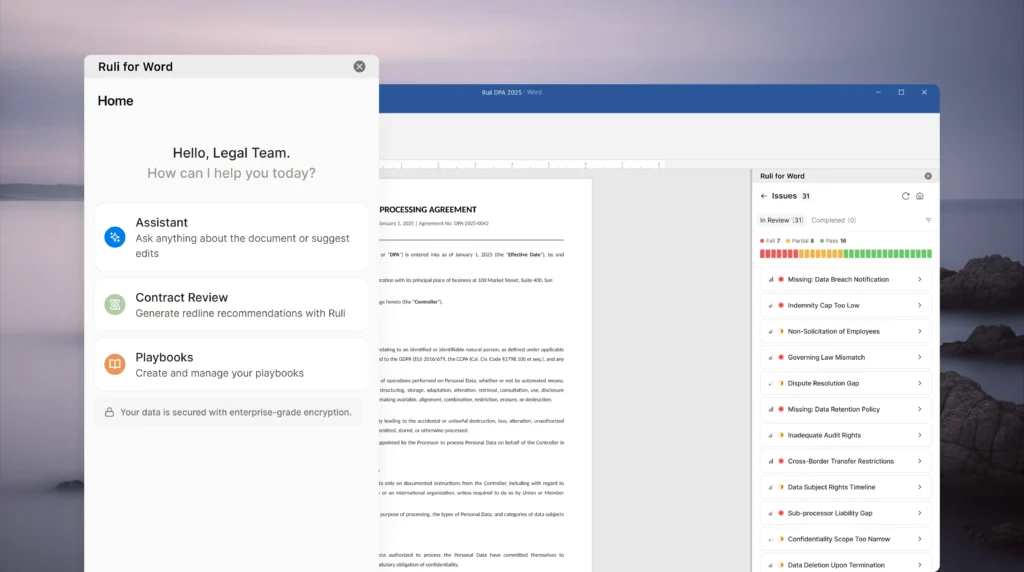
TLW: With the ability to analyse thousands of documents simultaneously, DataGrid seems to shift contract review from document-by-document analysis to pattern recognition across entire portfolios. How do you see that changing the way in-house teams think about risk and consistency in their contracts?
Bryan: “Most in-house teams have a standard position — they know what they’re supposed to accept on indemnification, or liability caps, or auto-renewal. What they rarely know is how consistently that position has actually been applied across their contract portfolio. The answer, almost universally, is: not as consistently as they think.
Where we’re taking DataGrid next is toward an intelligent repository – one where AI is working for you even when you’re not. You shouldn’t be limited to chat.
The vision is DataGrid integrated with your Playbook positions, so Ruli proactively tells you when your risk thresholds are shifting and what to do about it – whether that’s updating a Playbook position or managing exposure across your portfolio. And that intelligence extends into the Word plugin, so you’re seeing it in real time as you redline.
The goal is a legal team where the system is continuously monitoring, learning, and pushing insights to the surface before anyone has to think to ask.”
Continuous monitoring, not periodic checking
Regulatory monitoring is another area where Ruli leans into the idea of continuity. Legal teams are used to tracking changes manually through newsletters, alerts, external updates, and periodic reviews. It is a reactive process.
Ruli’s Monitor function attempts to make it proactive.
The platform continuously scans for regulatory updates across jurisdictions and practice areas, then maps those changes directly onto the company’s policies, contracts, and prior decisions. In other words, it does not just tell you that a regulation has changed. It attempts to show you what that change means for your organisation.
That distinction is easy to underestimate, because knowing that a law has changed is ‘useful’, but knowing which internal policies, contracts, or processes are affected is what really drives action.
There is also a timing element. Continuous monitoring means issues can be surfaced before they become urgent. Or, put differently: fewer last-minute scrambles.
TLW: Ruli’s monitoring capability focuses on mapping regulatory changes directly to a company’s internal policies and contracts. What were the biggest challenges in making that “last mile” connection between external regulation and internal impact actually work in practice?
Bryan: “The hardest part isn’t finding regulatory updates — there’s no shortage of those. The hardest part is making the output actually useful.
That comes down to fine-tuning three things: a deep understanding of the company itself – its products, markets, jurisdictions, and risk tolerances; smart filtration, so legal teams aren’t drowning in alerts that don’t apply to them. Then add the ability to connect external changes to internal reality – which contracts, policies, and processes are actually implicated.
When Ruli understands your risk tolerance and regulatory environment, it can make much smarter decisions about what to surface and how to frame it. It’s a focused report that tells you what changed over time, why it matters to you specifically, and what to do about it.”
Working where lawyers already work
One of the more practical design choices in Ruli is its integration into Microsoft Word.
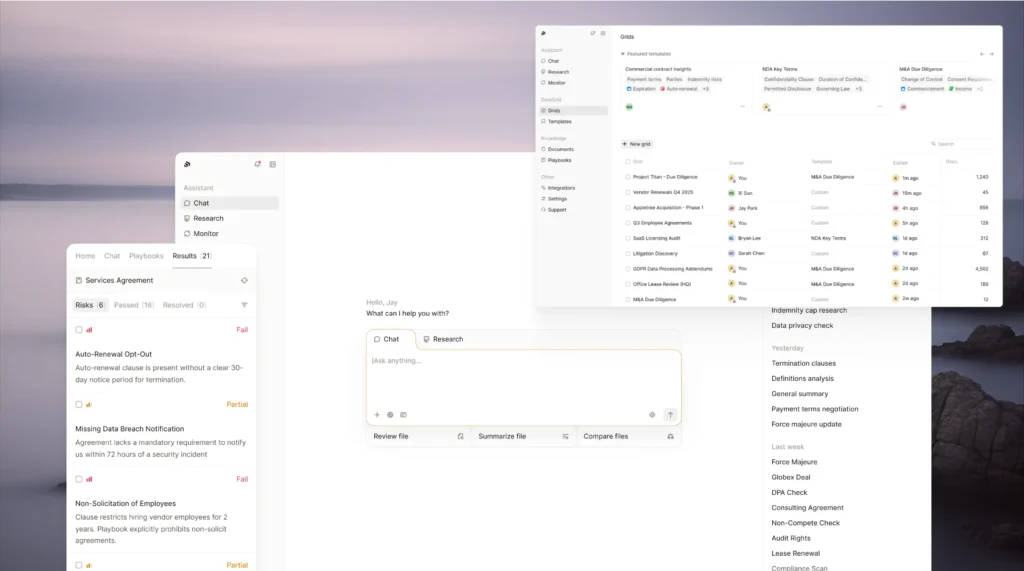
Legal technology is often highly capable, but nonetheless struggles with adoption because it requires lawyers to change how they work. Switching between tools, copying text back and forth, and managing multiple interfaces introduces friction. Ruli’s Word extension avoids much of that.
Lawyers can review, redline, and research within the same document, with suggestions grounded in their own playbooks and prior agreements. Redlines are not generic. They reflect how the organisation has negotiated similar clauses before.
There is also something slightly understated but important here: consistency. In-house teams often face variation in how different lawyers approach the same issues. Over time, that can lead to fragmentation in legal positions. By grounding redlines in shared playbooks and institutional precedent, Ruli introduces a degree of alignment that is difficult to achieve manually.
Scaling without adding headcount
Across its use cases, Ruli is clearly designed for a specific type of team: lean in-house legal functions operating under growing pressure.
The customer examples reflect this. At Matic, a legal and compliance team managing contract data across multiple spreadsheets moved to a system where those insights could be extracted and structured automatically.
At Newsweek, a US and EU team uses Ruli to reduce reliance on outside counsel spend and increase 754 hours of annual productivity gains. Transformative impact includes 100% compliance coverage across regulatory monitoring, and AI assisted drafting, contract review, and legal research.
At Groq, the legal team uses the platform to navigate large volumes of technical and legal documentation more efficiently.
None of these examples are particularly surprising on their own. What is more interesting what becomes clear across these examples, which is that Ruli is not solving a single, fixed problem. Its role shifts depending on the organisation. For some teams, it replaces lost capacity and preserves institutional knowledge. For others, it reduces reliance on outside counsel by bringing research and analysis in-house. In high-growth environments, it acts more as an accelerator, allowing legal teams to keep pace with the business. That flexibility is part of its appeal but also reflects where the market currently is: different teams are solving for different constraints, and they need tools that can meet them there.
A system that learns over time
Perhaps the most distinctive aspect of Ruli is its emphasis on evolving institutional knowledge. The platform does not treat documents as static inputs. It treats them as part of a growing system of relationships: contracts linked to amendments, emails linked to negotiations, decisions linked to outcomes.
Over time, that network becomes more valuable. Patterns emerge that would be difficult to detect manually, relationships between documents become visible, and past decisions inform future ones in a more structured way.
This is where the idea of “continuous intelligence” begins to make sense. It is less about any single feature and more about the accumulation of context.
TLW: Ruli emphasises “continuous intelligence” rather than one-off automation. How do you think about the long-term value of a system that learns from every contract, memo, and decision, compared to tools that focus on solving individual tasks?
Bryan: “The problem with much of AI tools today, is the work stops when you stop chatting. That’s not the vision of an AI future that we have in mind. AI should be working for you around the clock, and you should not be starting every session from zero memory.
The bet we’re making is that the real value isn’t in any single answer — it’s in the accumulation. Every contract reviewed, every memo added, every playbook position defined makes the system more attuned to how your organization actually operates. That compounds in a way that point solutions never can.”
Trust, security, and practical adoption
Of course, none of this matters if legal teams do not trust the system. Ruli’s focus on SOC 2 Type II compliance, data isolation, and privacy controls reflects an understanding that in-house teams operate under strict confidentiality requirements.
Equally important is usability.
The platform’s “zero implementation” approach, allowing teams to connect their existing data and begin using the system without lengthy setup, addresses a familiar friction point in legal tech adoption.
In practice, tools that require heavy implementation often struggle to gain traction, regardless of their capabilities.
Turning legal knowledge into something useful
Ruli does not present itself as a radical reinvention of legal work, and perhaps that is part of its appeal. The platform does not attempt to replace lawyers or redefine their role. Instead, it focuses on making the knowledge they already have accessible, structured, and usable in real time.
For in-house teams dealing with increasing complexity, that it is often exactly what is needed, because it’s not a lack of information that’s causing bottlenecks. Bottlenecks are arising because of how difficult it is to find, connect, and apply information when it matters.
And if that bottleneck can be reduced, even slightly, the impact compounds quickly.