](https://thelegalwire.ai/wp-content/uploads/2026/05/emmalegal-332x207.webp)
](https://thelegalwire.ai/wp-content/uploads/2026/05/emmalegal.webp)

There is a particular moment in most transactions where the volume of information goes from being theoretical to overwhelming. A data room opens, documents accumulate quickly, and what initially looked like a simple review exercise turns into a question of navigation: are all required documents provided, what matters, what doesn’t, and how quickly can you tell the difference?
Due diligence has always involved scale. What has changed is the expectation placed on that scale. Clients want answers faster, often before the full picture has even settled, and the gap between what is available and what is actionable becomes more visible with each deal.
Emma Legal sits directly in that aperture. It approaches due diligence in a unique way: not just as a document review exercise, but also as a structured workspace, that answers the question “how can we move from thousands of files to a usable legal view without losing context along the way?”
Channelling frustration into workflow design
Rick van Esch’s background offers a useful entry point into how the workspace has been shaped. Before founding Emma Legal, he worked across capital markets and AI, including time spent on large-scale acquisitions from the client side. That vantage point has translated well.
What stands out in those experiences is not the quality of legal advice, and Rick is quick to acknowledge that, but the time it took to arrive at relatively straightforward answers. Questions that appeared simple from a business perspective often required lawyers to navigate multiple documents, cross-reference clauses, and reconstruct context manually.
Emma Legal seems to be built around that observation. The workspace does not try to replace the diligence process. It gives lawyers a more structured way to execute it. This week, The Legal Wire had the pleasure of connecting with Rick, Emma Legal’s Co-founder and CEO, to explore how his experience shaped the Workspace’s approach to structuring due diligence workflows at scale.
TLW: You’ve experienced due diligence from the client side as well as from within the legal tech space. Was there a specific moment where you realised the problem was not legal reasoning, but the way information is accessed and structured? How did this filter into the creation of Emma Legal?
Rick: “ Two experiences stand out. The first: the time between the data room opening and receiving an initial legal analysis was typically weeks, not days. The second: much of the expert legal reasoning focused on clauses that were technically problematic but would not be dealbreakers.
Every LDD deal whether M&A, a funding round, or a restructuring runs under intense time pressure with limited legal capacity. There is no escaping the need to prioritize where expert reasoning goes but doing that across thousands of documents is extremely hard for humans. You tend to focus on what you read first. LLMs, when applied correctly, are very good at surfacing the clauses and documents where expert judgment matters most. Share those early with the client, go deeper from there, and the entire LDD becomes far more valuable.”
A workspace built around the data room
One of the visibly deliberate design choices is Emma’s relationship with the data room itself.
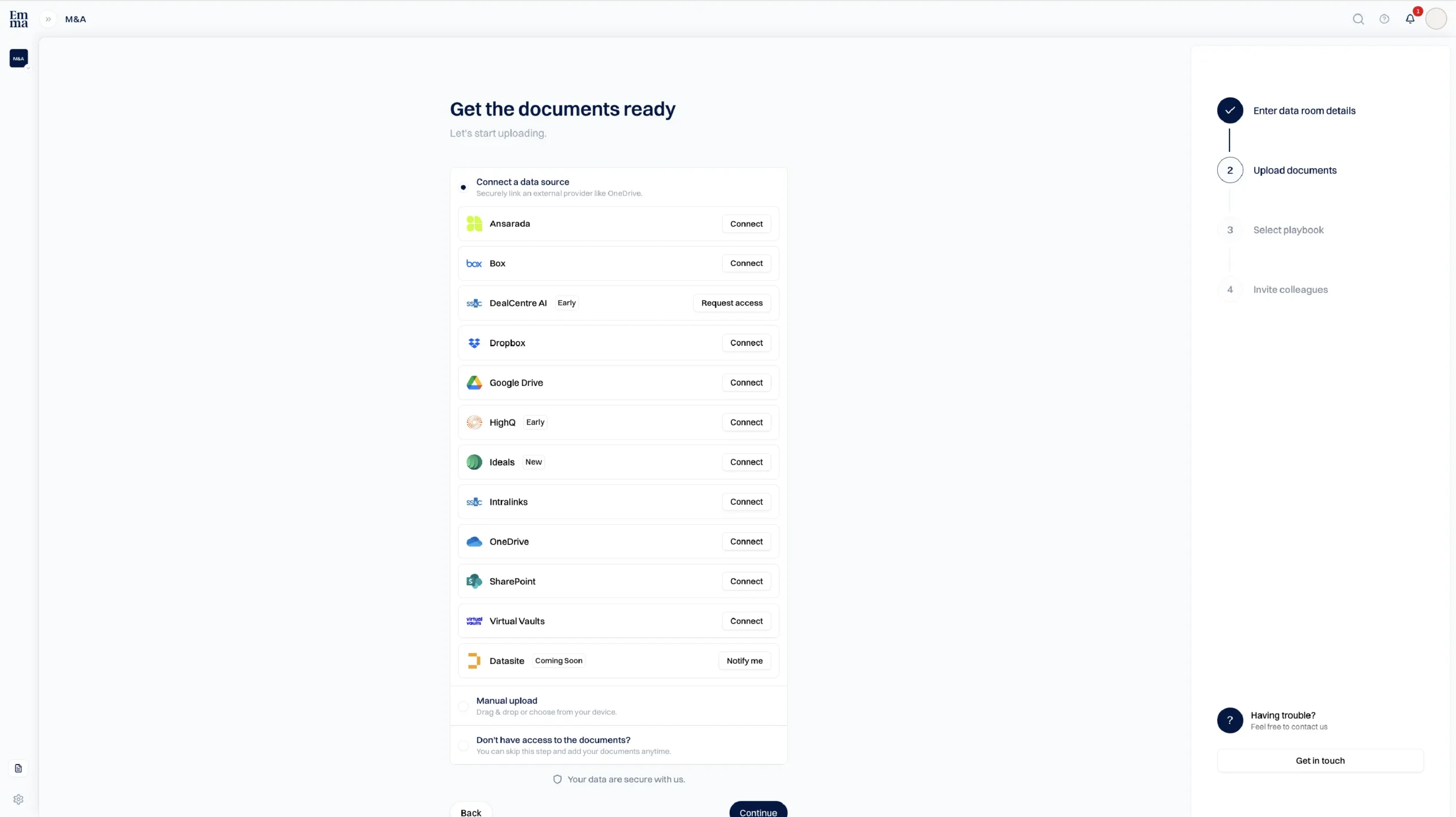
Rather than asking lawyers to move documents into a separate system, Emma connects directly to existing data room providers and cloud storage environments. The implication of this is straightforward: the analysis happens where the documents already live.
This may sound like a technical detail, but it has practical consequences. For those that work in this space, it’s clear that due diligence workflows are constrained by access, duplication, and version control. By integrating into that existing infrastructure and offering one secure environment, Emma positions itself as a working layer rather than an additional step.
The growing list of integrations, ranging from virtual data rooms to standard cloud storage, suggests that this is not incidental, but central to how the workspace is intended to be used.
Structuring the chaos
If the data room is the starting point, the next challenge is classification.
Emma begins by organising documents into defined types and mapping them against an Information Request List (IRL), also referred to as a DD checklist. Missing documents are identified instantly, and the system builds a view of what is present, what is absent, and what still needs attention.
From there, the analysis becomes more granular. Predefined and custom “checks” run across the dataset, identifying clauses, answering specific questions, and flagging potential risks. These checks aren’t abstract queries; they are tied to the types of issues that typically arise in transactions, such as change of control provisions, non-compete clauses, liabilities, and so on.
There is a certain logic to this layering. First organise, then interrogate, then prioritise.
It sounds simple when described like that. In practice, it is where most of the time is usually spent.
TLW: Emma relies heavily on structured checks and playbooks. How do you balance standardisation across deals with the reality that every transaction has its own nuances and risk profile?
Rick: “Before Emma, most LDDs ran on an individual lawyer’s heuristics rather than standard operating procedures. As a law firm, or as a client, you shouldn’t need a specific senior individual on the deal to guarantee quality. If you sign with an AmLaw 100 firm, the work should meet a minimum bar regardless of who staffs it. Emma ensures that baseline. The law firm then layers in the nuance and judgment specific to each deal’s risk profile.”
Risk as a working view, not an output
Where the workspace becomes really interesting is how it presents the results of that analysis.
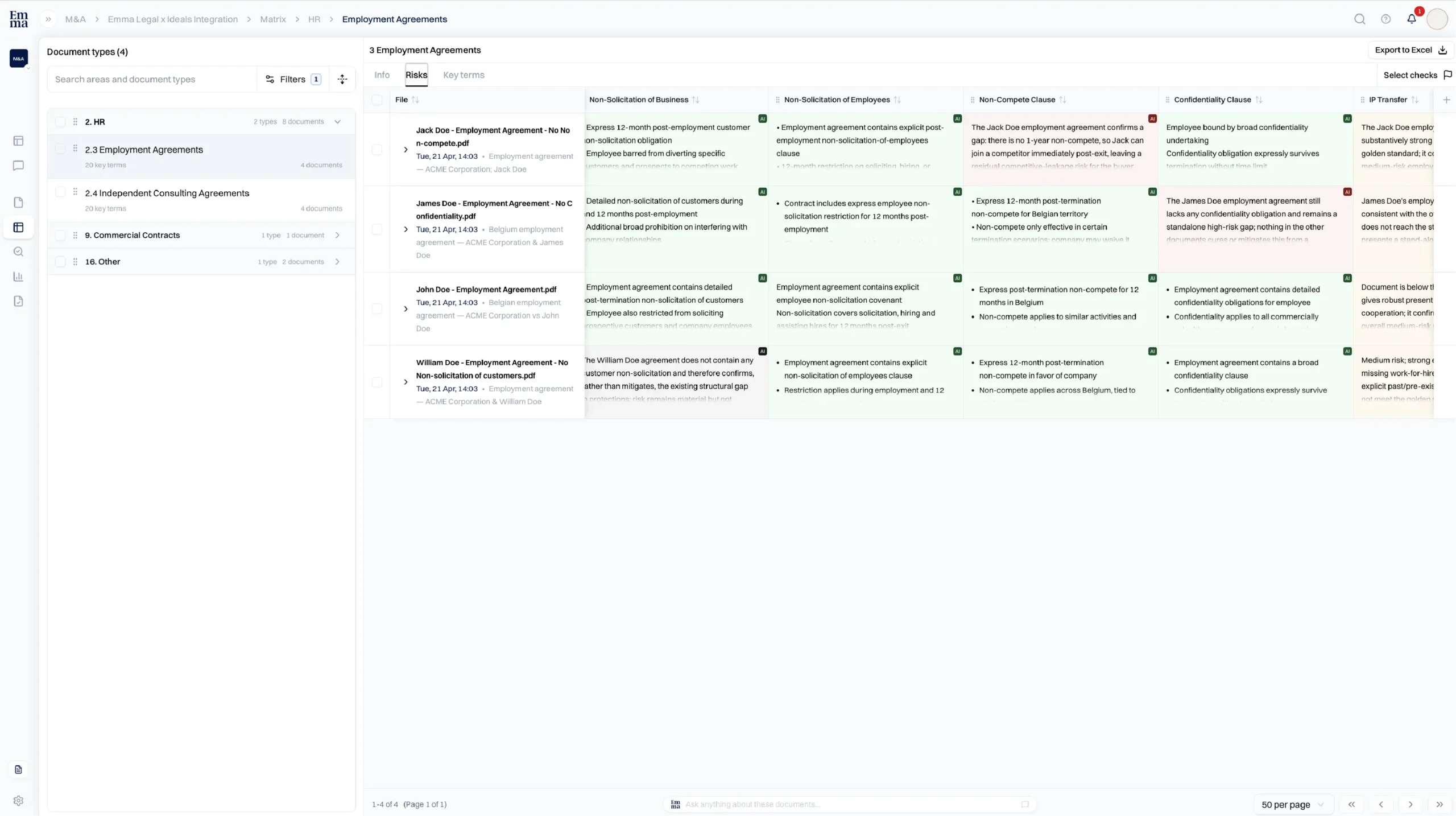
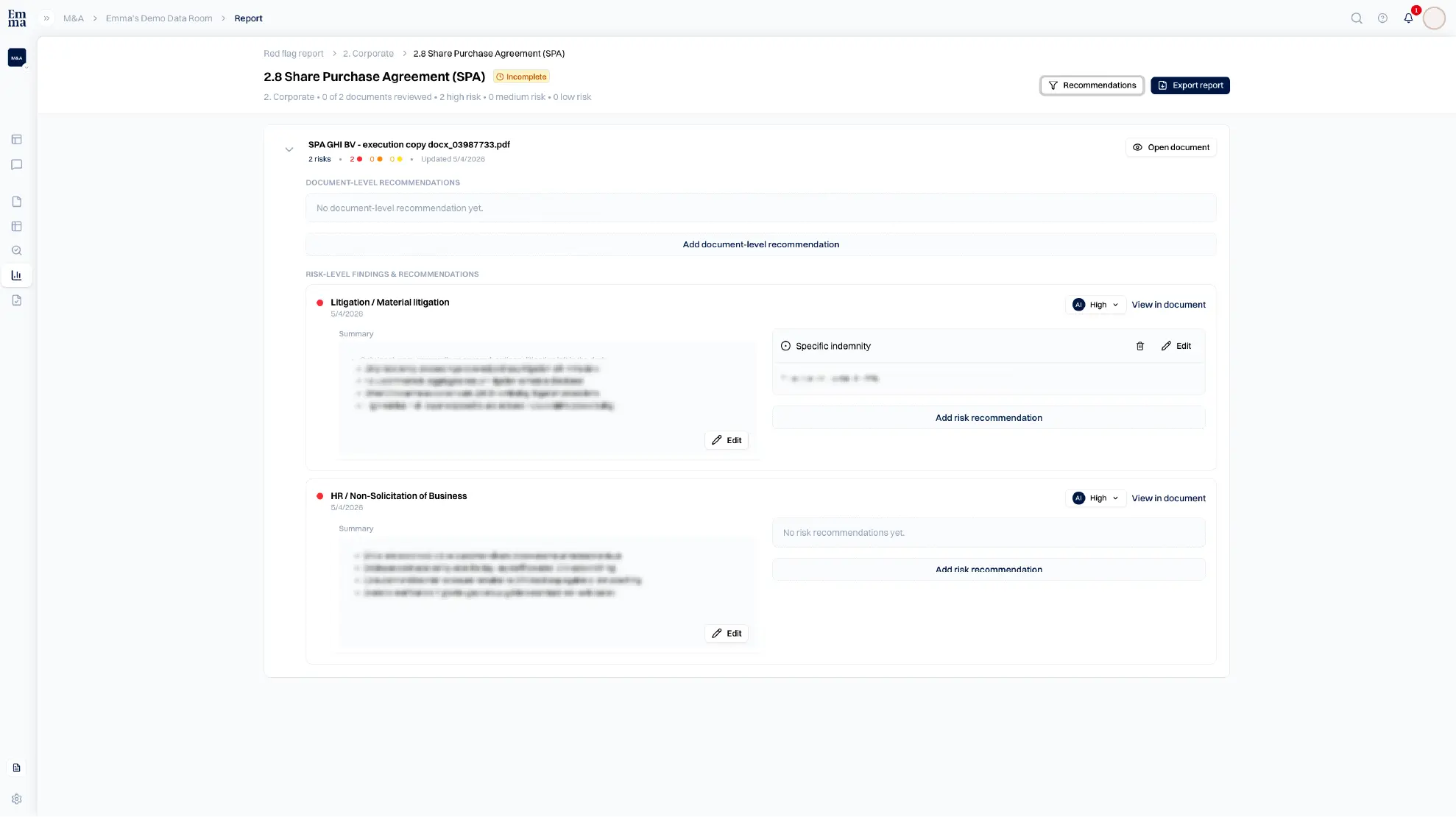
Instead of producing a static report at the end of the process, Emma surfaces risk continuously through dashboards, matrices, and colour-coded indicators directly in the documents themselves, providing full traceability. Lawyers can see where issues sit, how they relate to each other, and which areas require review.
The distinction is subtle but important. Due diligence is no longer a linear process that ends in a report. It becomes an evolving view of risk, shaped as the analysis progresses.
The “matrix” feature, for example, translates extracted information into a structured table, linking risks back to specific documents and clauses. That connection between summary and source is where much of the workspace’s utility lies.
Keeping the lawyer in the loop
A recurring theme in conversations around AI in legal work is the question of control: what is automated, what is reviewed, and where responsibility ultimately sits.
Emma Legal takes a relatively measured position which, in the current legal tech market, is important. The system generates suggestions, flags potential issues, and structures the output, but the lawyer remains the point of validation. AI-generated findings are clearly distinguished from those that have been reviewed and approved.
This choice is not just philosophical. It reflects a practical constraint. Accuracy in due diligence is cumulative, meaning that small errors, if left unchecked, can compound across multiple steps.
Rick describes this in terms of layered validation, an approach that reflects his experience of how small errors can compound across a transaction. Multiple models and checks operate within the system before outputs are surfaced, but final approval remains with the user.
TLW: There is increasing pressure in the market toward more autonomous AI workflows. You’ve chosen to keep the lawyer firmly in control, and this has worked well. Do you see that as a temporary position, or a structural feature of how due diligence should operate?
Rick: “This design addresses two distinct issues.
The first one is governance: ask any lawyer using AI today and you hear the same thing: impressive technology, but with non-deniable flaws for legal work. Answers aren’t traceable to a source, and it’s unclear who has reviewed what. Emma solves this through built-in collaboration and review approval workflows.
The second is technical: agentic AI workflows are typically a chain of sequential AI judgments. At 95% accuracy per step, seven steps drops overall accuracy to 70% (=0.95⁷). In LDD, that is not acceptable. Independent validation between steps is essential. Our workspace minimizes the approvals needed, but human review remains a core design principle. Quality in this work is non-negotiable. Here is where we differentiate compared to any other LegalTech provider whether it is Claude, Co-pilot, GPT or platforms like Legora and Harvey.”
Where specialised tools begin to matter
Emma’s positioning also reflects a broader trend within legal technology.
General-purpose AI platforms have become increasingly capable, but they do not always translate cleanly into highly specific workflows. Due diligence is one of those workflows. It requires not only document analysis, but sequencing, classification, and coordination across a large dataset.
Rick is fairly direct on this point. Horizontal tools can perform many tasks, but they tend to struggle with depth in specific use cases, particularly where cost, token usage, and workflow complexity intersect.
Emma’s response is to focus narrowly on that use case. The workspace is designed around due diligence as a process, rather than AI as a capability.
TLW: Due diligence seems to be one of the workflows where general-purpose AI can help, but may not go deep enough on its own. From your perspective, what makes due diligence difficult to generalise, and why does that create room for a purpose-built workspace like Emma?
Rick: “Most AI LegalTech companies have, at their core, been built around chat. Very few have focused on legal analysis from day one, which is exactly what LDD demands. LDD requires a fundamentally different LLM architecture with more token usage. Fortunately for LDD the token cost is justified: stakes are high, and clients in this space can defend the spend.
Going deep in LDD is structurally much harder than it initially looks. There are a number of reasons for this. Chat looks compelling at first, but it won’t take you far. To build something law firms will actually buy, you need to go very deep into the use case first. We’ve done that, and it gives us a real moat. LDD also runs on its own document ecosystem, data rooms like Intralinks, Datasite, iDeals, and Ansarada, rather than standard DMS players like iManage or NetDocuments. Lastly, LDD is transactional, so it is difficult to generate the recurring revenue investors prefer. This keeps many players at bay to go as deep as we did.”
Speed, but with a purpose
The efficiency gains are hard to ignore. Emma reports significant reductions in time spent on due diligence, with workflows that previously took days compressed into hours, and in some cases minutes. The more interesting question, however, is what that time is used for once it is freed up.
The workspace’s stated aim is to shift attention away from document handling and toward legal analysis, allowing lawyers to focus on judgment rather than retrieval.
Whether that shift is fully realised will depend, as always, on how teams adopt the tool. And this has been a major stumbling block for many platforms. Technology can restructure workflows, but it does not automatically change behaviour.
TLW: You’ve spoken about giving lawyers more time to focus on actual legal advice. In practice, have you seen teams change how they work once that time is freed up, or does it tend to get absorbed elsewhere in the deal process?
Rick: “Yes, and we’ve seen it clearly. Time savings go toward deeper, better legal advice like SPA or SHA negotiation. But there is also a commercial argument: we’ve heard from larger transactions that the deal team could not have won an LDD mandate at their quoted price without Emma. The traditional approach would have been too slow and expensive for the client to accept.”
Why due diligence may be the proving ground
Legal AI has moved through an initial phase of experimentation. Tools have been tested across a wide range of use cases, often with mixed results.
What is becoming clearer is that certain workflows lend themselves more naturally to structured automation. Due diligence appears to be one of them.
It combines high document volume, repeatable patterns, and a clear objective: identify and assess risk. That makes it a natural candidate for systems that can organise, analyse, and surface information at scale.
Emma Legal is one example of what happens when a workspace is built around that specific problem. It does not attempt to generalise across all legal work. Instead, it focuses on doing one thing well and building the surrounding workflow to support it.
For M&A lawyers and deal teams, the value of that approach is fairly direct: the faster risk can be surfaced, the earlier decisions can be made. In transactions, that’s important. Because strong legal advice is not only about identifying the right risks, but identifying them early enough to shape the deal.