

For much of its history, the in-house legal function has been defined by discretion. Its value was measured in problems avoided rather than opportunities created, its influence exercised quietly behind the scenes.
That model is no longer fit for purpose.
Across industries, corporate legal teams are being pulled into the centre of organisational life by forces they can neither ignore nor contain: accelerating technological change, intensifying regulatory scrutiny, geopolitical volatility, and growing expectations around ethical leadership. In response, the legal function is undergoing a fundamental reinvention, one that is reshaping how businesses govern risk, strategy, and culture.
From After-the-Fact Policing to Forward-Looking Governance
One of the most important, and least visible, changes taking place inside legal departments is the move away from reactive compliance models.
Rather than stepping in after a regulatory issue has surfaced, legal leaders are increasingly tasked with anticipating risk before it materialises. That means scrutinising incentives, monitoring behavioural risk, and embedding governance checkpoints directly into business operations.
This shift reflects a broader recognition that regulatory exposure is no longer confined to legal interpretation alone. Data governance, AI deployment, third-party relationships, and corporate culture all carry legal weight, and all require earlier legal involvement to manage effectively.
The result is a legal function that operates less as a control mechanism and more as part of the organisation’s decision-making architecture.
Legal’s Expanding Role in Commercial Strategy
As governance responsibilities grow, so too does legal’s influence across the enterprise.
Many in-house legal leaders now find themselves advising not just on regulatory compliance, but on product development, commercial strategy, and enterprise risk tolerance. Compliance is increasingly being “designed in” rather than bolted on, a development that requires legal teams to collaborate closely with finance, technology, procurement, and operational leadership.
At the same time, general counsel are being asked to play a broader cultural role. Internal ethics, accountability frameworks, and organisational trust have become central board-level concerns, and legal teams are often positioned as stewards of these initiatives.
This expansion of remit brings opportunity, but also tension. Expectations are rising faster than resources.
Technology: Progress Ahead of Policy
Few areas illustrate this tension more clearly than legal technology, particularly AI.
Across corporate legal teams, AI is already being used to review documents, accelerate research, and streamline routine workflows. The productivity gains are real, and increasingly difficult to ignore in an environment defined by budget constraints and workload pressure.
Yet governance has lagged behind adoption.
While many legal professionals are experimenting with AI tools, relatively few organisations have formalised frameworks governing how those tools should be used, trained, monitored, or audited. Concerns around confidentiality, data protection, and vendor risk remain unresolved, even as usage becomes routine.
The challenge for legal leaders is no longer whether to adopt AI, but how to do so responsibly, without introducing new categories of operational and reputational risk.
Doing More, Better With Less
Despite their growing strategic importance, most legal departments continue to operate with limited headcount and constrained budgets. Regulatory complexity, sanctions, and third-party oversight have expanded workloads, while expectations around speed and commercial alignment have also intensified.
In response, many teams are redefining how legal work gets done.
Routine tasks are being automated. High-volume workflows are increasingly outsourced to alternative legal service providers. Internal capability development now extends beyond legal expertise to include data literacy, technology fluency, and risk modelling.
The emerging legal function is leaner, more interdisciplinary, and more deeply embedded, but it is also under pressure to prove its value in tangible, enterprise-wide terms.
A Deeper Look at a Function in Transition
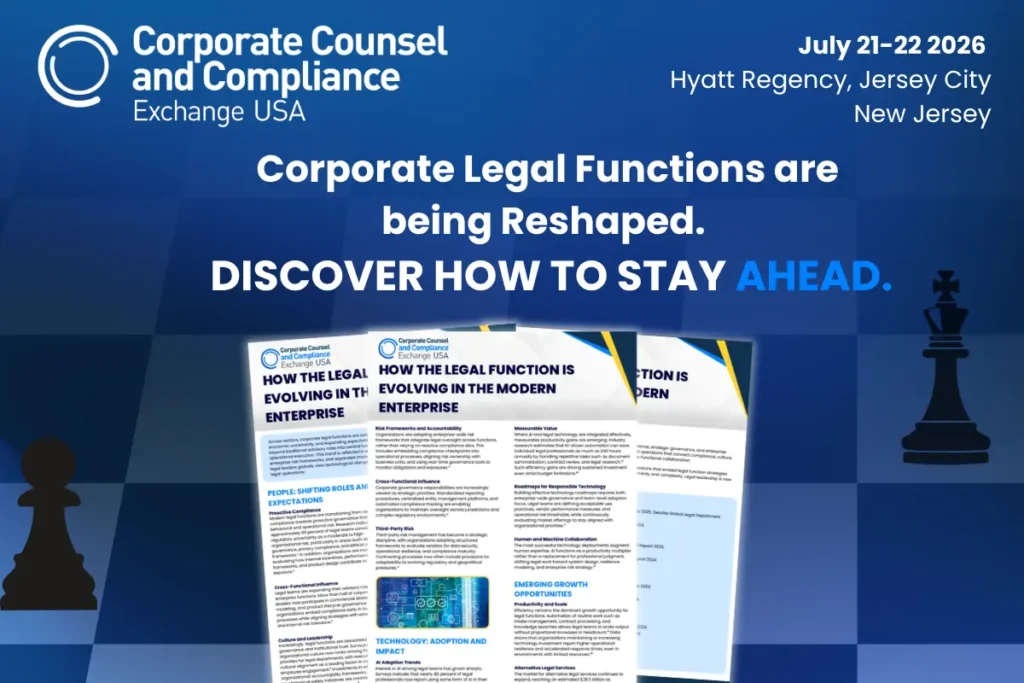
These shifts form part of a broader transformation examined in the research report ‘How the Legal Function Is Evolving in the Modern Enterprise.’
The report explores:
- How legal roles, skills, and expectations are changing
- The governance challenges created by rapid AI adoption
- The operational trade-offs facing legal leaders under resource constraints
- Why legal leadership is increasingly viewed as a strategic asset rather than a cost centre
Download the full report here to explore the data and insights behind the transformation.
Where the Conversation Continues: Corporate Counsel & Compliance Exchange USA
Many of the challenges highlighted in the research, from AI governance to proactive compliance and cross-functional leadership, are now shaping the agenda of senior in-house legal leaders globally.
They are also central themes at the upcoming Corporate Counsel & Compliance Exchange USA (July 21-22 2026, Hyatt Regency, Jersey City), an invitation-only forum bringing together Chief Legal Officers, General Counsel and Chief Compliance Officers to share experiences, debate emerging risks, and compare strategies in a closed-door, peer-led setting.
The Exchange offers:
- Practical case studies from enterprise legal teams
- Candid discussion on regulatory change, technology, and organisational influence
- Insight into how legal leaders are positioning their functions for long-term relevance
Download the full Report to find out more or Request Your Complimentary Invite* now.
*Subject to seniority and suitability