

Built with PelAIkan, Damien Charlotin’s citation checker, which Pilot5 does not own. Pilot5 verifies that a cited case exists; PelAIkan reads the source and verifies that it says what the memo claims.
November 4, 2026. Pilot5, adversarial intelligence for legal teams, today launches Adversarial Verification. From today, every citation in a Pilot5 legal memo faces an independent checker, PelAIkan, built by Damien Charlotin, before the lawyer signs. Two checks that do not trust each other: Pilot5 verifies that the cited case exists; PelAIkan reads the source in the official databases and verifies that it says what the memo claims.
For the lawyer, it changes the daily work in three ways. Every citation is read, or flagged as unresolved: the flags come to the lawyer, not the whole source list, and hours of manual cross-checking take minutes. The signature that certifies the authorities exist and are accurately cited now has two readers behind it, and the record of what was checked stays with the memo. And the recommendation itself is stronger: citation checks protect the sources, Pilot5’s deliberation protects the reasoning built on them. Verification is in Pilot5’s DNA for one reason: the quality of the recommendation the lawyer acts on.
A citation in an AI-drafted memo can fail in three ways: the case is invented; the case is real but does not say what the memo claims; or the quote has been altered. Invented cases draw the sanctions headlines. The other two pass any check that only asks whether the case exists.
- Pilot5 checks that a citation is real: it looks up each cited decision in public case-law records and confirms that the case exists and that its name matches the reference, and it re-reads each sourced statement of the memo against the text it retrieved.
- PelAIkan checks that a real citation says what the memo claims: it finds the source in official databases such as Légifrance, Judilibre, GovInfo and CourtListener, reads it, judges whether it supports the statement, and compares quotes word for word. Each verdict comes with the source excerpt, the reasoning and a calibration score.
- The two checks are independent. PelAIkan reads the source without seeing how Pilot5 reached its answer.
- Each result is shown to the lawyer at the end of the memo, in an annex headed “Independent check of the cited authorities (PelAIkan)”, with PelAIkan’s explanation. PelAIkan changes nothing in the memo. The lawyer makes the final call.
Adversarial Verification adds a reader that does not belong to Pilot5, and shows its reasoning next to the memo. The same checker is built for law firms, courts, arbitral tribunals and academic publishers.
In tests run on 13 October 2026 on memos with planted errors, Pilot5’s own check passed a real case cited for the opposite of what it held (Gideon v. Wainwright) and a real case with an altered quote (Schenck v. United States), because both cases exist. PelAIkan flagged both, with its reasoning. Both tools caught an invented case taken from Mata v. Avianca. In the same series, PelAIkan caught wrong statements of French, Romanian and Spanish law. Pilot5 publishes the full test in its announcement.
The test also ran on the public record. On 21 August 2026, Florida’s Second District Court of Appeal sanctioned a lawyer for 46 AI hallucinations across two briefs in Capital Standard v. U.S. Bank, No. 2D2024-1392 (fines totaling $1,500, appellate fees, referral to the Florida Bar); the opinion cites the AI Hallucination Cases database as “a database referenced by multiple courts”. On 3 November, Pilot5 submitted the opinion and four of the errors the court identified to PelAIkan. It resolved the opinion, flagged two real Florida decisions cited for rules they do not contain, found that a passage attributed to the Florida Supreme Court does not appear in the opinion, and did not locate the invented case. The same day, in production, a memo citing three Florida decisions went through the check: PelAIkan located all three opinions itself and confirmed the three propositions.
“Having catalogued hundreds of court decisions involving AI hallucinations, I can say the invented case is only the most visible failure. More often the case is real and the proposition is not, going beyond the usual stretch allowed to human advocacy. PelAIkan was built to catch that stretch and qualify it,” said Damien Charlotin, creator of PelAIkan and of the AI Hallucination Cases database.
“Since 15 June, a lawyer who signs a filing in a Florida court certifies two things: that every authority exists, and that it is accurately cited. An existence check covers the first half. The second half was the lawyer’s alone, source by source. Now both run before they sign,” said Wilfrid Rimbault, Co-CEO and Co-founder of Pilot5. “We published what our own check missed, then we added the check that catches it. That is what Anti-Hallucination Obsession means in practice.”
“On several aspects PelAIkan does better than what we had built ourselves, so we chose to use it in production rather than extend our own check,” said Thomas Wainstein, Co-CEO and Co-founder of Pilot5. “A second reader that starts from the record, not from our reasoning, is the kind that catches what we miss.”
For each cited authority, Pilot5 sends PelAIkan the authority’s official name and jurisdiction and the memo sentence that cites it, with client names replaced by tokens; never the client’s documents, the question or the brief. PelAIkan’s processing runs on Google Cloud Vertex AI in its EU region under zero-data-retention settings; nothing processed enters a training corpus, and only the relevant passage is sent for analysis, never the full document. Pilot5 applies its own zero-retention and EU-residency options to the memo itself.
The integration is available from today on Pilot5 legal memos, on legal.pilot5.ai and through the tools connected to Pilot5 (Claude, ChatGPT, Cursor), except where a customer has chosen to keep all processing inside Pilot5’s environment or on its own cloud, where nothing is passed to a third party. Lawyers can start at legal.pilot5.ai with free credits at signup. PelAIkan is also available on its own, as a web app, a desktop app and a Word add-in, at pelaikan.com.
About Pilot5
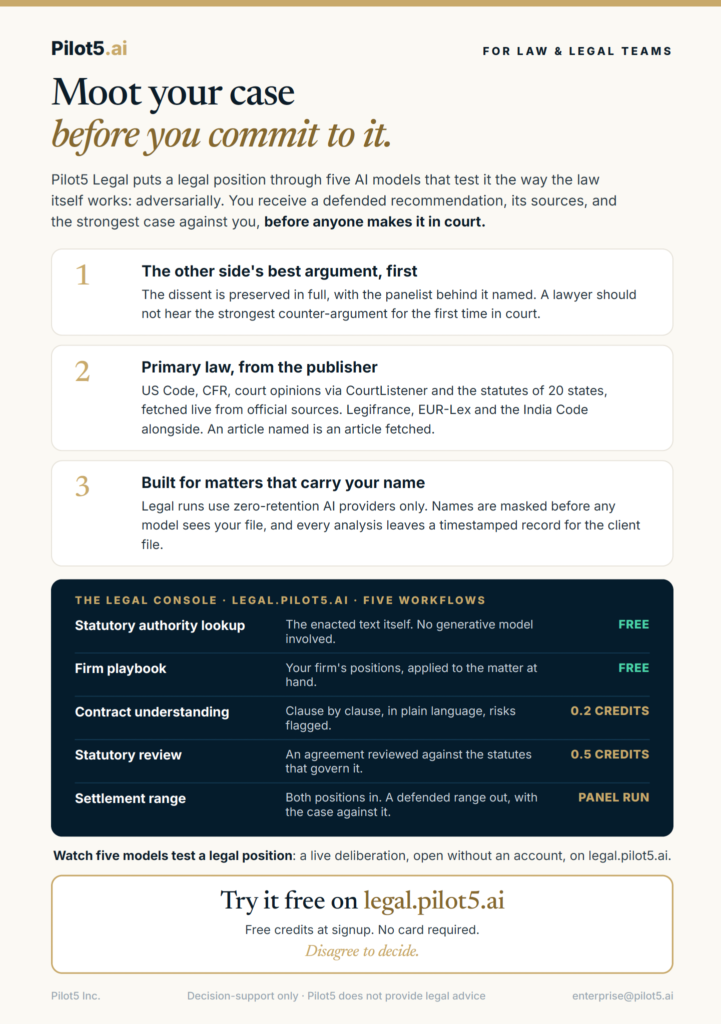
Pilot5 is a deliberative AI. Five independent AI models, never two from the same provider, analyze a question on their own, critique one another, and converge on one structured, sourced recommendation, with the dissent preserved. They do not merely answer; they answer one another. Pilot5 Legal, launched in October 2026, is adversarial intelligence for legal teams: work designed to be challenged, read where the law is published, with the record of the reasoning as the product. Pilot5 is available on the web, through MCP in Claude, ChatGPT, Cursor, Perplexity, Mistral and Microsoft Copilot Studio, and through a REST API. Pilot5 Inc. is a Delaware corporation led by its Co-CEOs and Co-founders Thomas Wainstein and Wilfrid Rimbault. pilot5.ai · legal.pilot5.ai
About PelAIkan and Damien Charlotin
Damien Charlotin is a Senior Research Fellow at HEC Paris and an Adjunct Professor at UC Law San Francisco. He created and maintains the AI Hallucination Cases database, which has tracked court decisions involving AI-generated errors worldwide since 2023. PelAIkan is his citation verification tool for legal professionals: it locates every cited authority in a brief, a submission or a judgment, reads the source and tests whether it supports the proposition for which it is cited, with a structured, auditable verdict for each citation. It is available as a web app, a desktop app for Windows and macOS, and a Microsoft Word add-in. pelaikan.com
Media contact
Wilfrid Rimbault, Co-CEO and Co-founder, wrimbault@pilot5.ai · Thomas Wainstein, Co-CEO and Co-founder, twainstein@pilot5.ai