

There is a specific pleasure a certain kind of lawyer gets from reading the same 500-page record for the fourth time. It is not the pleasure most people associate with the law. It is the moment somewhere on page 312 when a detail you missed on your first three readings suddenly changes the shape of the whole argument. That ‘aha’ moment is what Jackie Schafer, the founder and chief executive of Clearbrief, describes with contagious passion during our call.
Once you understand this about her, everything else about the company she has built begins to make sense.
Jackie spent the years before Clearbrief as an associate at Paul Weiss and an Assistant Attorney General for Alaska and Washington State, doing complex litigation and appellate work. She loved it. She loved the appellate writing schedule, albeit unusually predictable for a legal career. She loved that predictability specifically because it gave her the space to return to the record again and again. “Every time I went back through it, I’d find another nuance,” she says. “Sometimes one small detail could become the foundation of an argument I hadn’t even considered.”
This week, The Legal Wire sat down with Jackie for a conversation that ranged across cite-checking, Rule 11, generative AI, judicial workload, and what she thinks lawyers may lose if they let AI do too much of the thinking for them.
What follows is a piece about a founder whose company exists partly to protect the thing she loved most about being a litigator, and who is especially good at explaining why the rest of us should care.
So what is Clearbrief, really?
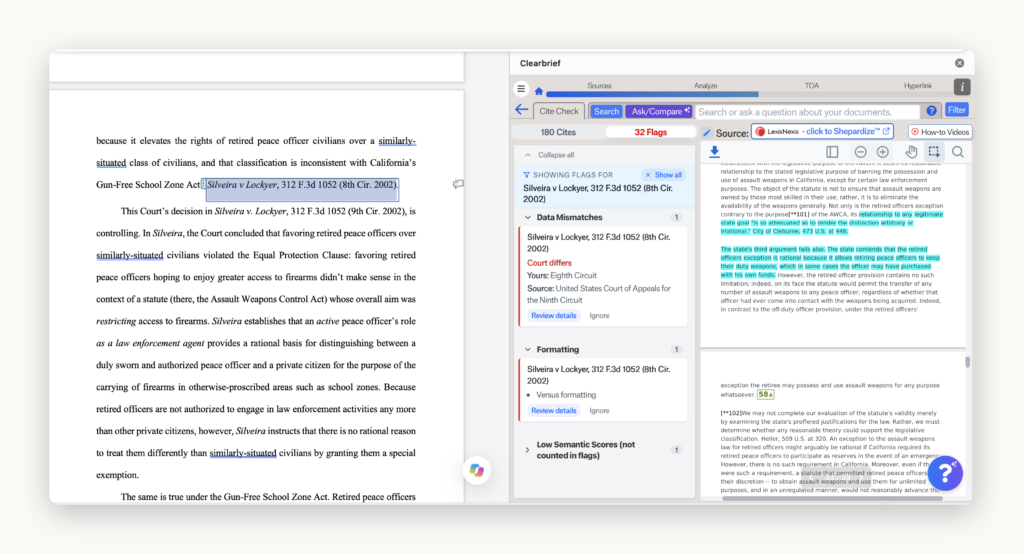
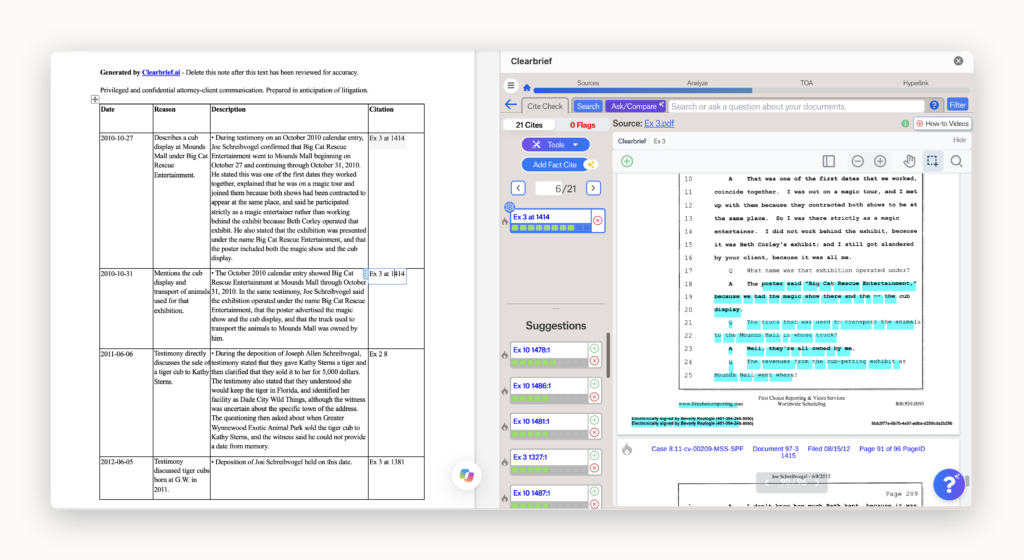
Clearbrief describes itself as the litigation safety layer and the last-mile tool for producing litigation-quality work product. In practice, that means two connected things. The first is a suite of generative AI drafting tools designed specifically for litigators, where every citation stays linked inside the Word document and the underlying source is displayed after every sentence. Create a timeline; you can see the source displayed in Word without extra clicks. Draft a fact section; the evidence is there beside it. The second, and what most firms come to Clearbrief for, is a set of deterministic cite-checking workflows that systematically check every reference in a brief, motion or pleading against the source it purports to cite.
The word deterministic is carrying a lot in this context. Clearbrief’s cite-checking cannot hallucinate. It’s rule-based and grounded, and it produces the same output every time. There are, as Jackie acknowledges, plenty of companies that can spin up a generative AI tool and say it can check your citations. The problem, in her view, is that you don’t know what decisions that tool made, what judgment calls it applied, or what it missed. “If the system isn’t showing you your full brief alongside the full source from a trusted database,” she says, “you are giving yourself a false sense of security.”
Based on the same rationale, Clearbrief also does something no other platform does, which is check citations to factual evidence rather than only to case law. The first part of a legal document is often not about the law yet, it’s the client’s story. But most firms don’t have a systematic way to check whether the witness said the exact thing the brief attributes to them. The process is more along the lines of someone logging into Relativity or iManage, searching for the material, and trying to find it manually. Clearbrief links all of that automatically, and, because the evidence is linked during the cite-checking stage, it is already linked for the judge by the time the pleading is filed. This is what Jackie means with the ‘last mile’ aspect of the tool.
Clearbrief has an impressive list of clients, including of course, lawyers, but also state and federal courts, global in-house teams and, in a partnership Jackie mentions proudly, the American Arbitration Association, whose thousands of arbitrators ask parties to file pleadings through Clearbrief so those filings arrive hyperlinked. The company is SOC 2 Type 2 certified, offers a bring-your-own-storage option, and does not use customer data for training LLMs.
TLW: For the legal tech founders and product leaders reading this, what have you learned about designing for a profession that has been trained to distrust anything it cannot verify itself?
Jackie: “I think the biggest challenge we face as product leaders is the pressure to turn every interface into ChatGPT, and have every product interaction be as frictionless as possible. Because being able to explain our work product is so important for litigators, I spend a lot of time reflecting on how using Clearbrief can leave the user with greater understanding and confidence in their writing, as opposed to a feeling that they don’t really know why or how the magic tech did something. It’s a terrible feeling to wake up in the middle of the night after a filing realizing they didn’t actually check that a cited page contains that info. One way we have addressed that dynamic in Clearbrief is by enabling the user to look efficiently at each citation and source with their own eyes, which is also what Rule 11 requires. We pull in the cited sources automatically via our partnerships with LexisNexis and Fastcase vLex (Clio), databases our users know and trust. The fact cites get linked and display automatically in Word so the team isn’t just relying on one person with the patience to log into Relativity and keep switching back and forth to check every fact.”
Why the same sanctions cases keep happening
The obvious question, which many people have asked Jackie before, is why lawyers keep getting sanctioned for the same category of mistake despite the story now being covered constantly in the legal press.
Punishment alone, she says, does not appear to be working particularly well. Sanctions will continue to have a deterrent effect, of course, but the profession also needs to work proactively to help lawyers understand how to do this correctly. It is not enough to punish people. We have to teach them.
Jackie’s prescription for the ongoing issue is premised on State bars, which already require CLE ethics credits, as well as law school training (see the press release here). Jackie envisages a solution comprising specific training on verifying AI output and checking citations, because both have become essential. Crucially, those trainings need to provide operational solutions, not just warnings. And firms need to think about cite-checking the way airlines think about pre-flight checklists, because nobody simply trusts the pilot to remember every step from memory. Law firms, in Jackie’s argument, need to think similarly and not treat cite-checking as something firm leadership has minimal control over.
A useful observation Jackie makes, in this regard, is that the problem is not primarily regulatory, but operational.
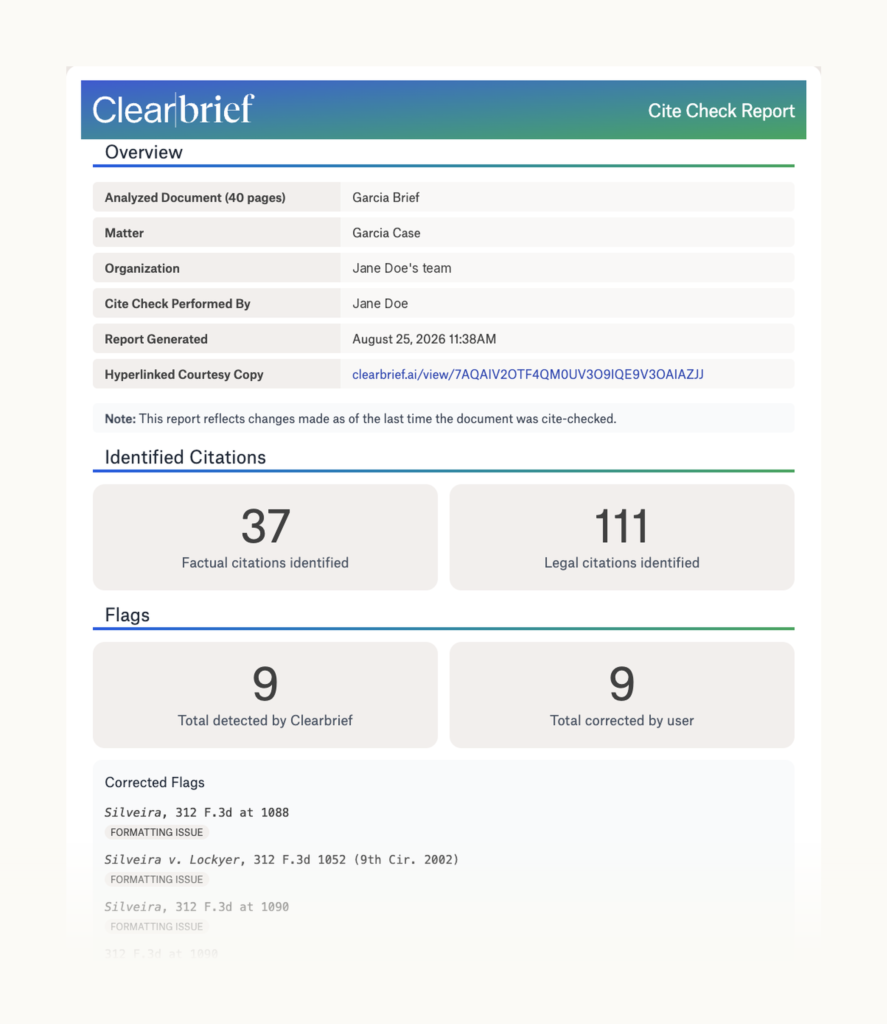
Big Law customers have come to Jackie and often say something along the lines of “We have an AI policy. We’ve trained our people. But how do we actually make sure nothing gets filed with a hallucination?” For Jackie, the truth is that firms have not yet focused on the operational infrastructure needed to close that gap. Every partner has developed their own individual, informal process for getting something filed. However, when something goes wrong, it affects the entire firm. Everyone at that firm is going to be asked about it by clients, colleagues, and probably even their grandmother. What is needed, she says, is not more policy but a proper checklist, run through a tool that can prove each step has been taken. Clearbrief’s cite-check report, co-developed with customers, is designed to do that.
TLW: Having spent time with many firms on these issues, what is still stopping firms from operationalising cite-checking the way you describe, and what has to change for the pattern to break?
Jackie: “My sense is that it’s a feeling of not wanting to tell partners how to do their jobs. But due to how quickly AI has permeated the profession, even partners who are incredibly experienced, brilliant attorneys are not always fully aware of the myriad ways generative AI can slightly and subtly change citations in a draft, creating hugely embarrassing situations for the attorneys who signed. And this can happen anytime others touch a draft, as there is no obvious way to know what tools others used when they made their edits.
Having clear guidelines that require filings to be run through a tool like Clearbrief and for that to be logged in the case file (we have a Cite Check[1] Report that does this while also hyperlinking the entire brief so it’s easy for partners to review) is a robust safety measure. And it’s something firm leadership can audit to control their risk.”
The friction question, and why Jackie is doesn’t think everything should be smoothed
Before interviewing Jackie, I’d read that she has a keen interest in the ‘art of legal writing’. Because of this, it came as no surprise when Jackie mentioned that some friction in legal writing is actually valuable. While not surprising from Jackie, this is not the argument most legal tech founders make. Most of the market is organised around removing friction as quickly and completely as possible, on the theory that friction is what lawyers hate and vendors are paid to eliminate. But Jackie doesn’t entirely share the sentiment.
She meets constantly with users because, as the product leader, she wants to see how Clearbrief is being used. What she notices is that the lawyers who are most fluent with tools like Claude Code, and who are almost engineers themselves, love the experience of chatting with a system, getting an answer, having everything packaged for them. In those conversations, she plants what she calls a small seed of doubt. “When are you pausing to form your own opinion on this?” she asks. “How are you building a process that still gives you time for deep thought about the writing? And when might some friction in the drafting process be desirable?”
Her answer comes from her own history. The joy of lawyering, for her, always came from the moments when she was thinking deeply about the facts of the case, which is not a moment technology should be trying to eliminate. Being forced, before a lawyer files, to look at everything they have written, compare it with the evidence, and think about whether the evidence truly supports the argument, is a discipline that shouldn’t be lost. That process can inspire the lawyer to rewrite, to sharpen, to put their own expression back into the writing. The friction, in other words, is the point.
This raises an argument that transcends product design: If the profession outsources too much of its thinking to systems that curate the answers for it, something specific about lawyering gets lost. What if there were not eight mistakes but twelve? What if there were not the three sources the AI surfaced but a fourth the AI ignored? Generative AI is unpredictable in what it includes in an answer, which is why Clearbrief designed its genAI tools for helping to write a facts section or timeline to also have a layer of deterministic logic. And its Cite-checking tools do not use generative AI at all.
A curated answer is not a checked answer, and for Jackie, this demonstrates the difference between using AI well and using it dangerously.
The importance beyond the sanctions data
The wider commercial argument Jackie makes is that hyperlinked filings do not only help lawyers avoid sanctions, they also help lawyers win cases. When a judge can look at every factual proposition alongside the evidence that supports it, the judge does not have to take the lawyer’s characterisation on faith.
Imagine an argument that an email establishes the plaintiff was aware of a particular issue. In a hyperlinked filing, the judge can see the email directly. “That’s incredibly powerful,” Jackie says. “In some ways, it allows you to say less and show more.”
The corollary is that a lawyer who cites a proposition to a source that does not quite support it damages their credibility with the judge from that point onward. If a brief says the car stopped at the stop sign and the judge finds the testimony reads “the car paused and slowed down near the curb,” the judge starts to mistrust the rest of the brief. Clearbrief’s solution is to flag this problem inside Word, showing lawyers how closely a source maps to the sentence they have written. It is also one of the strongest teaching tools in the product, which is why Clearbrief has begun partnering with law schools, including Boston University.
Jackie’s fascination with the judiciary is genuine. Clearbrief has had appellate court users from its earliest days, and watching judicial attitudes to technology change has been powerful, she says. Even some of the most conservative members of the profession are recognising the utility. Courts are under-resourced and struggling with enormous workloads that generative AI is in some cases making worse (pro se filings are up, and more voluminous than they used to be). If the profession gets this transition right, Jackie argues, the technology could genuinely improve the justice system. If it gets it wrong, courts will be dealing with the consequences for a generation.
Using AI for the boring stuff
According to Jackie, firm innovation leaders are missing something obvious. Firms have been very focused on using AI for the fun stuff. What about using it for the boring stuff?
Think about the work paralegals do around a filing: Exhibits, tables of authorities, hyperlinking, everything that has to happen after the writing is done and before the document leaves the building. That work is incredibly stressful. It is happening under a very tight deadline. It is causing burnout and, in her frank assessment, is responsible for a meaningful share of the profession’s terrible reputation for stress. Once cite-checking is finished, everything else on the pre-filing list has to be finalised. And as it happens, all of this might be transpiring around midnight.
Jackie sees a huge opportunity, but not in what one would expect (another drafting tool). It is a firm that decides to solve the last-mile problem for its paralegal and associate teams and gives them their evenings back. Nobody talks about this at the AI keynotes, perhaps because its not as ‘sexy’ as something that is advertised as your all-encompassing new paralegal that’s online 24/7. Nonetheless, it is where Jackie has seen the real quality-of-life improvements in legal teams. Fix that, and everything else about how the firm operates changes.
TLW: If you were advising a managing partner who wanted to be thoughtful about reducing the stress happening the days and hours before a filing is due for the benefit of associate and paralegal teams, what is the first specific step you would tell them to take before they even think about buying a tool?
Jackie: “The first thing i would recommend is to spend some time learning about what the partners are actually asking staff to do in the final hours of a filing. Most partners don’t have to deal with this part of the process and are not aware of the intense stress and opportunity for errors created by the last mile of a filing process. Many briefs contain hundreds of exhibits that need to be adjusted anytime a partner makes an edit; now Exhibit C is Exhibit N and all the cover pages need to be redone. We’ve put a lot of work into solving this type of problem. Meet with your paralegals; they know the friction points where the firm is losing money by spending hours on administrative manual tasks that get written off the bill, or the high cost of sending out a brief to be hyperlinked by a 3rd party.”
On Jackie, and her passion for the law
Former lawyers create specific types of legal tech founders, with years of hands-on experience and intimate knowledge of the industry, and Jackie is no doubt one of them.
Whether Clearbrief’s deterministic-cite-checking-plus-generative-AI-drafting model turns out to be the winning shape of legal-writing technology is yet to be seen, although what’s already indisputable is that the founder placing the bet is genuinely, visibly, in love with the craft of legal writing, in a profession that does not always encourage that kind of enthusiasm out loud. She is also clear about what she believes lawyers stand to lose if they let the current generation of tools do too much of the thinking for them. The combination of technical seriousness and unapologetic affection for the work itself makes for a great discussion regarding Clearbrief and the industry its operating in.
If passion for legal writing turns out to be contagious, Jackie is a good candidate for patient zero.
[1]Link to video