

Some problems in legal work are obvious, unglamorous, and quietly ruinous. Like the first pass of transcript review. The deposition slog. The 800-page PDF that lands on your desk just before lunch, with instructions to “flag anything useful.”
Rev, a veteran in the speech-to-text space, is reimagining this not as grunt work to be endured, but as a workflow to be engineered. Their platform sits at the intersection of transcription, AI summarization, and secure discovery review, and in doing so, it challenges how legal teams think about time, talent, and technology.
So what happens when you treat transcript review not as a rite of passage for junior lawyers, but as a systems problem that can be solved?
This week The Legal Wire had the opportunity to dig into this question and more in discussion with Rev Founder and CEO, Jason Chicola.
Tactical Intelligence From Transcripts
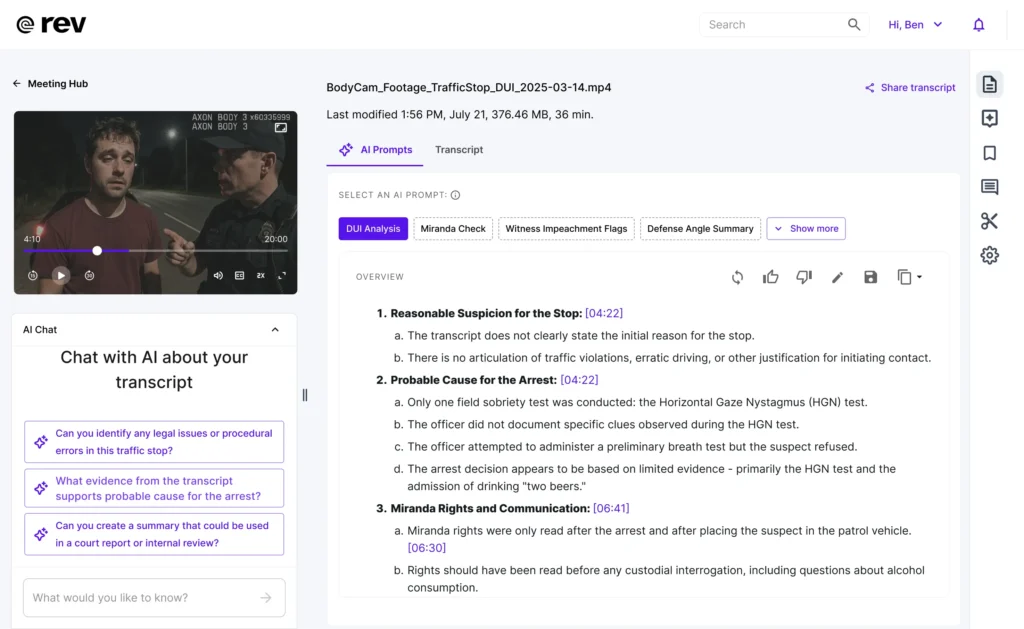
Rev doesn’t only produce transcripts, it delivers legal-grade outputs. Their AI-powered tools convert audio and video evidence into accurate, searchable transcripts with robust metadata, speaker separation, and contextual understanding. From there, legal professionals can jump straight into issue spotting; citation mapping; theme detection and key admissions extraction.
The goal? Eliminate manual triage. Speed up discovery. And empower legal teams to get to the strategic layer faster.
TLW: Rev’s approach to transcript review seems almost surgical. What inspired you to zero in on this layer of legal work, and how did you decide it was the right problem to solve at scale?
Jason: “Our path into legal AI was a natural progression of what we’d already been doing for years. Rev started as a trusted platform for journalists and researchers committed to uncovering the truth. Over time, lawyers and investigators began finding us on their own — using our transcripts to analyze body-came footage or jail calls, to identify contradictions, and ultimately to strengthen their cases.
We realized the pain point was universal: overwhelmed attorneys, paralegals, and investigators buried in evidence, whether it’s interviews, body-cam footage, or hours of recorded testimony. When critical facts get lost in volume, justice slows down. So we set out to engineer the discovery review process itself — not to replace human reasoning, but to accelerate how legal teams uncover the facts that matter most.”
Built for the Legal Battleground
It’s not enough to be fast. In legal, you also need to be correct. Rev’s platform is engineered for accuracy in complex, high-stakes environments: noisy courtrooms, multi-speaker depositions, and recordings where legal nuance matters. It supports a variety of file types including audio, video, PDFs, DOCX, and turns them into usable assets that can feed directly into motions, briefs, or trial prep.
With CJIS, HIPAA, and SOC2 compliance, and zero third-party AI training on customer data, Rev prioritizes control and security. This is legal intelligence built for the real world, not just demos.
TLW: In a world where “AI transcription” is now a checkbox feature, how does Rev continue to differentiate itself technically and where are you investing next to stay ahead of other (perhaps more general) providers?
Jason: “AI transcription is easy to claim and hard to trust. Error rates still hover between 5–15%, depending on the audio quality and provider — unacceptably high for the justice system, where every word counts and a single mistake can alter the meaning of a sentence. Rev delivers the most accurate speech recognition in the world, especially for challenging audio with multiple speakers.
Our foundation has always been accuracy and transparency — the qualities investigative work depends on. And because the integrity of evidence matters as much as its analysis, we pair that with best-in-class security. Every Rev output traces back to its original source, never trains a third-party model, and meets CJIS, HIPAA, and SOC 2 Type II standards.
We’re now investing in context-aware legal intelligence built on that same foundation. Our platform pinpoints key admissions, flags inconsistencies, and surfaces patterns that help lawyers and investigators move from raw evidence to actionable insights. We’re not chasing novelty — we’re deepening reliability.”
SmartDepo: The Next Generation of Deposition Review
Rev’s recent acquisition of SmartDepo is a signal and a solution. The platform now offers page-line summaries, thematic deposition memos, and key admissions with pinpoint citations. These aren’t summaries for the sake of it. These tools reflect how lawyers actually build cases.
SmartDepo’s output is comprehensive but human-centric. It doesn’t hide the raw record. Instead, it gives attorneys a structured map that can be used to trace themes, build arguments, and prep witnesses without spending hours mining data.
TLW: SmartDepo’s output is incredibly tailored to the legal workflow. What kind of feedback did you get from litigators during development, and how did it shape the product’s structure?
Jason: “SmartDepo was an exciting acquisition for us earlier this year because it embodied the same values we’ve held from day one — quality, precision, and respect for how legal teams actually work. Founded in 2023 by civil rights lawyer Isaac Manoff, SmartDepo built a purpose-driven solution to one of the most time-consuming parts of litigation: reviewing and organizing deposition testimony. Within two years, it became the trusted choice for top law firms and major court reporting agencies.
Its AI-generated summaries are rigorous — delivering 100% accurate page-line citations, hyperlinked tables of contents, key admissions analysis, and comprehensive deposition memos within minutes. What truly stood out was its human-in-the-loop approach, ensuring every summary undergoes expert quality checks. That philosophy mirrors Rev’s: AI should speed up the process, but humans safeguard the standard.
Bringing SmartDepo into Rev’s ecosystem allows us to offer legal professionals something no one else can — a single trusted partner for recording, transcribing, and summarizing depositions with unmatched accuracy and reliability.”
Real-World Use Cases: From Solo Counsel to AM Law
Whether you’re in a boutique defense firm or corporate legal department, the pain points are similar: too many files, not enough context, and limited time for review. Rev doesn’t claim to replace legal reasoning, it aims to scaffold it. By reducing transcript prep and discovery review time by up to 94%, it offers capacity without the need to compromise.
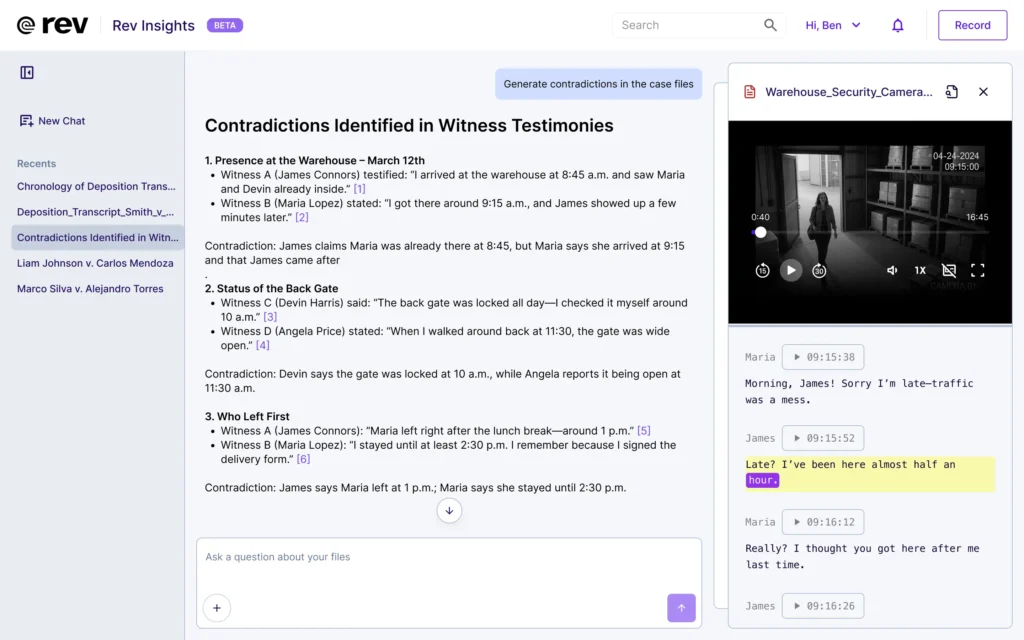
Imagine walking into a prep session with instant highlights from three depositions, contradictions flagged and exportable quotes ready for cross. Or reviewing expert witness testimony with AI-generated summaries that help you surface inconsistencies in seconds.
TLW: How are smaller or resource-constrained legal teams using Rev in ways that surprised you? Are there any unexpected workflows you’ve seen emerge?
Jason: “What’s been remarkable is how creative smaller legal teams have been with our tools. Public defenders, solo practitioners, and boutique firms are using Rev to review hours of evidence in a fraction of the time — sometimes upwards of 94% — without sacrificing accuracy or control.
We’ve seen investigators use Rev to cross-reference witness statements across multiple cases, journalists use it to trace patterns of misconduct, and attorneys use it to prepare for trial faster than ever. Those workflows remind us that Rev’s purpose hasn’t changed — we’re still helping people surface truth efficiently, whether they’re in a newsroom or a courtroom.”
A Platform That Respects the Lawyer’s Brain
Rev doesn’t push a “disruption” narrative. It offers something far more grounded: relief. Relief from the hours lost to manual labor. Relief from the dread of reviewing audio on deadline. And relief for junior associates who want to do actual legal thinking.
Legal work is often framed as an art, but there’s no shame in automating the carpentry. Rev makes the boring parts faster so that the creative parts can flourish.
TLW: What’s your perspective on the future of AI-human collaboration in law? Do you see Rev continuing to support lawyers in narrow ways, or expanding into broader legal research and analysis?
Jason: “I’ve never believed that AI replaces human expertise — especially in fields that rely on judgment, ethics, and context. Great attorneys manage relationships, drive case strategy, and lean on their intuition. What AI should do is clear the path for professionals to think critically and act decisively, eliminating much of the tedious work that lawyers and paralegals do today and freeing them to focus on the parts of the job they value most — like shaping strategy and advocacy.
The same principle that guided our work with journalists applies here: give legal teams faster access to verifiable facts so they can focus on interpretation and argument. Our platform will continue to evolve to support the full investigative workflow — from evidence intake and transcript review to case synthesis and analysis. Whether you’re a reporter building a story or a lawyer building a case, our mission remains the same: to make the pursuit of truth faster, fairer, and more accurate.”
Building Structure Where Legal Teams Need It Most
Rev’s offer is presented as scaffolding. Infrastructure. A way to organize one of the messiest, most time-consuming parts of legal work and turn it into something that runs with clarity and confidence.
The teams using Rev are not the ones trying to cut corners. They’re the ones that want to see clearly, prep faster, and spend less time piecing together transcripts and more time thinking critically. That’s exactly where Rev thrives, not in replacing judgment, but in accelerating how you get there. For legal professionals juggling deposition prep, discovery review, and evidentiary overload, Rev doesn’t pretend to be the whole answer. But it might be the piece that finally makes everything else click.