
Most founders can name the moment their company began. For Bork Morfaw, it began with a question he was glad to answer, asked often enough that answering it well became its own problem. He was a lawyer at Freshfields, and friends, and friends of friends, kept coming to him with legal questions they had nowhere sensible to take. He wanted to help, and did; what he lacked was a way of helping that scaled past his own evenings. Send me what you have, he would say, and I will at least point you to the right person. Over time, that improvised arrangement began to look like the outline of something.
The people asking were not short of intelligence or ambition. They were founders and operators building real things, and what stopped them was rarely a hard legal question; it was a basic bureaucratic hurdle keeping them from making progress. The realistic options were to pay a law firm several thousand euros for something routine, or to ask a general-purpose chatbot and hope, and the chatbot route has a particular failure mode: when it is wrong, it is wrong with total confidence. What was missing was a third option, and, on the other side of the same problem, a way for an expert to answer many people at once rather than one at a time.
nu:legal, the company he left Freshfields at the start of 2025 to build, is the attempt to construct exactly that. It is a vertically integrated legal platform aimed at small and medium-sized businesses in Germany and Europe, and it has spent its development in stealth, surfacing publicly for the first time with its launch today, 27 May.
The Legal Wire was given an early and exclusive look at the company ahead of that date, including an extended conversation with Bork, and what follows draws on both.
The platform opens with two practice areas, employment law and data privacy. According to nu:legal, resolutions arrive in hours rather than weeks, with internal figures putting the platform at up to six hundred times faster and fifteen times cheaper than the traditional route. The headline multiple will mean different things for different matters, but the more durable idea sits underneath it, and it is a genuinely thoughtful one.

A third option for the underserved middle
The legal technology market has a noticeable shape. Much of it is built for law firms, and a further share for the large in-house departments of major corporates; both can afford sophisticated infrastructure, and both are well supplied. The midsized company and the startup sit in an awkward gap, carrying the same employment and data-protection obligations as larger organisations, but with neither the budget for a standing relationship with a firm nor the appetite for the back-and-forth it involves.
His account of why the gap persists is grounded in his experience of how large firms are structured. A genuine efficiency gain in legal work runs into a business-model problem before it reaches the market: expertise billed by the hour does not survive software that removes a large share of the hours, and moving from billable time toward licences or fixed fees is a slow, structural decision for any established firm. nu:legal is partly a bet that the change is easier to build from scratch, for a different customer, than to retrofit inside a long-established institution
TLW: You watched a tool cut due diligence work by a significant amount at Freshfields, and understand how hard it is to take that to market without disrupting the underlying law firm model. For nu:legal, serving SMEs rather than firms, what becomes possible once you are not constrained by that model, and what new constraints replace it?
Bork: “At a traditional law firm, the technology can only move as fast as the billable-hour model allows. At nu:legal, we can redesign the entire experience around the business instead of around internal law firm incentives. That means instant workflows, transparent pricing, and legal support that operates at software speed. But new constraints replace the old ones. Once you serve SMEs directly, trust, product quality, and usability become everything. You are no longer optimizing for a few enterprise clients, you are building infrastructure people rely on operationally, every day.”
Selling knowledge instead of time
One of Bork’s perspectives that really sparked my interest is about where value sits in legal work, and who captures it. As Bork sees it, an experienced lawyer holds something genuinely valuable, and it lives in their head, their documents, and their notes, not in any public database and not in what a publisher sells. An employment contract template from a legal publisher may be perfectly correct in law and still unusable for a real corporate client, because it does not reflect the industry norms or client-specific nuances that determine what people will actually sign.
That tacit, current knowledge is what the traditional model monetises poorly, and what nu:legal wants lawyers to be able to sell. A specialist can deploy expertise by billing an hour or by training an associate, and that is more or less the list. nu:legal’s proposition is that they instead build what it calls agentic services: workflows, constructed with the specialist, that handle the routine portion of a matter up to the point where human judgment has to enter. The specialist writes down their process in natural language, the system runs it, the lawyer reviews the result, and each review feeds more detail back in. The aim is a system that has absorbed enough of an expert’s method to reproduce its reasoning, not merely its conclusions.
TLW: If a lawyer’s expertise can be turned into a service that runs without them, there is an obvious worry on the lawyer’s side about what they are giving away. How does nu:legal structure the relationship, commercially and in terms of control, so that a specialist sees a scalable asset rather than a one-off sale of their own replacement?
Bork: “We are not asking lawyers to give away their expertise. We are helping them turn it into scalable services. In the traditional model, a lawyer solves the same problem hundreds of times manually. With nu:legal, that expertise can become a product that repeatedly generates value, while the lawyer retains control over how the service works and evolves, and where human oversight remains necessary. We don’t just do this to make lawyers happy, we do it because our customers expect human oversight and continuous improvement and adjustment to changes in the law. That is the value lawyers provide continuously. We see lawyers on our platform as creators, building and maintaining long-term assets.”
Where the lawyer fits in
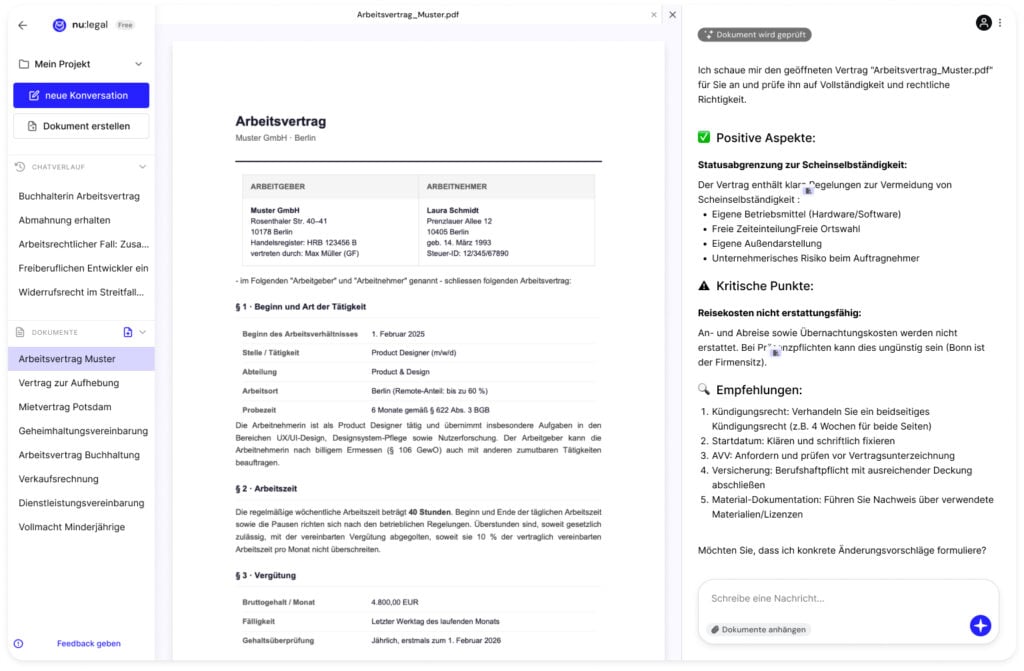
For a platform that automates much of a legal matter, nu:legal is careful about where it puts the human. The sequence begins with the client, not the lawyer: a business describes its situation, and the system’s agents respond with questions, request documents, analyse what comes back, and ask again, assembling what the company calls a digital case file, a structured record of the matter with a timeline of what happened and when.
Only then does a lawyer enter, and to an organised file rather than a cold instruction and a fortnight of chasing. If they ask a question the file does not answer, the agents go looking, and if the answer is genuinely absent, the system sends a fresh request to the client. Bork frames the benefit as attention rather than hours: the context-switching of conventional practice, the half-finished matter set aside while a document is awaited, drains a particular energy, and a lawyer with a complete file can sit with a matter and finish it.
He adds a candid qualification. The information-gathering stage tolerates error reasonably well, because a question missed early can be asked later and ninety percent is good enough to proceed; the closing stretch does not. The first eighty percent of legal work, in his telling, is comparatively easy and the next ten percent manageable, while the final few percent are the hardest and the part that matters most.
TLW: You have drawn a sharp distinction between the first eighty percent of a matter, where high error tolerance is acceptable, and the final few percent, where it is not. How does nu:legal make sure that distinction is reliably drawn and that the system itself knows which part of a matter it is in, and hands over before, rather than after, judgment is needed?
Bork: “One of the biggest mistakes in legal AI is pretending every task has the same risk profile. Most legal matters involve structured work that can be automated safely, but there is always a point at which legal judgment, accountability, or strategic nuance becomes critical. Our systems are designed specifically to recognize that transition, and we push forward the state of the art in this area. We deliberately optimize technology for repetitive and lower-risk work, while routing edge cases, ambiguity, and higher-stakes decisions to specialist lawyers before judgment becomes necessary, not after something goes wrong.”
The trust problem, and showing the working
Bork is direct that the central difficulty is not technical. Businesses know they have legal problems and already pay to solve them, so demand is not in question. The hard part is trust, and legal work is, as he puts it, a complete trust game: a client handing a sensitive matter to a partly automated system needs a reason to believe the result, and a reviewing lawyer needs a fast way to satisfy themselves it is sound.
nu:legal’s answer is to make the system’s working visible. Outputs are traced to their sources, information from a client’s documents, information from the client’s own answers, and, increasingly, the reasoning steps connecting the two. The company is prototyping a feature that exposes the decisions behind a recommendation and, where a document has been altered, the reason for the change. A reviewing lawyer need not take the system on faith, but can inspect its reasoning and citations and judge the quality directly. Whether that proves enough to win the trust of cautious practitioners is one of the open questions the launch will answer.
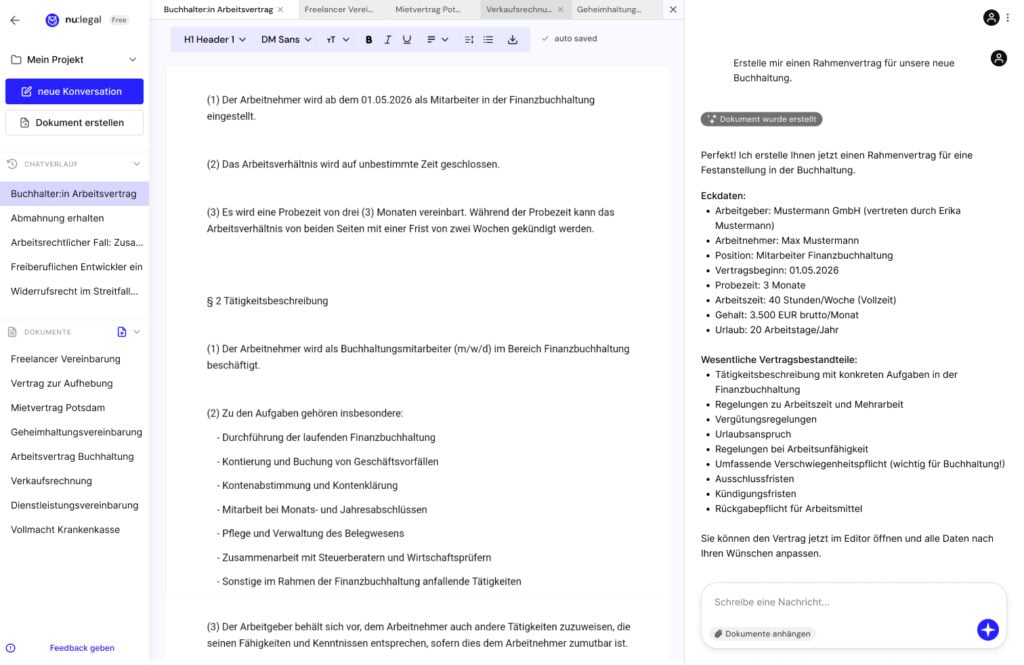
Underneath this sits an invaluable piece of design. Everything a client provides is assembled into an ontology, a structured, editable memory of the business that the agents draw on and the system keeps current as documents change. A company completing its first employment contract answers a long list of questions once; next time, nu:legal proposes answers, noting the assumptions drawn from prior matters and leaving the client to confirm or correct them. The benefit compounds in a way an hourly relationship structurally cannot.
TLW: The client-side ontology means nu:legal accumulates a detailed, living picture of each business it works with, which is what makes the second matter faster than the first, but also concentrates a great deal of sensitive information. How do you think about the security and governance of that memory, and about what a client is entitled to take with them if they ever leave?
Bork: “The reason the platform becomes dramatically better over time is that it develops context about how a business operates. But that also creates a huge responsibility. We treat that operational memory as highly sensitive infrastructure, not as data to exploit. Everything is designed around European privacy standards, legal confidentiality, and strict governance. Fundamentally, the client should remain in control of their business context and data. Trust only works if companies know the system is working for them, not trapping them.”
Why employment law and GDPR, and what comes after
The opening practice areas are not an accident. Employment law and data privacy are high-frequency, affect essentially every company, and generate work that businesses find tedious and are glad to hand off. They also sit at a lower price point per matter, which, counter-intuitively, is a feature. The logic runs through what Bork calls the innovation matrix: trust in automation falls as the stakes rise, so the more expensive and consequential the matter, the more a client wants a human carrying it. High-frequency, lower-value work is therefore the natural place for nu:legal to establish itself. It is where the trade nu:legal offers, speed and affordability in exchange for sensible reliance on automation, is most obviously worth making.
This prompts a fair question about the ceiling: does a model that begins with the routine eventually earn its way toward the genuinely complex, or is there a line past which clients will always want a human holding the pen?
TLW: Your innovation matrix suggests nu:legal is strongest in high-frequency, lower-value work, because trust in automation falls as stakes rise. Is that a starting position the platform eventually grows out of, or a deliberate and lasting boundary, and either way, where do you currently believe the line sits?
Bork: “I think trust in automation is contextual. Businesses are already comfortable using technology for high-frequency operational work because speed matters enormously there. As stakes rise, expectations around human judgment and accountability rise as well. We do not see that as a weakness of the model, but as a design principle. Our focus is not replacing human expertise and judgment. It is building the right balance between automation and expert oversight. Over time, the boundary will move as the technology improves and trust evolves. This allows experts to further scale their critical judgment and strategic insight.”
Where nu:legal sits
nu:legal enters the market with the familiar profile of an early-stage company: a pre-seed round of 1.3 million euros, more than fifty companies on a pre-launch waitlist, and a public debut still ahead of it. However, two details make it more interesting than that summary suggests. The first is LegalGPT, the proof-of-concept Bork built before raising any money, which drew more than 200,000 users and established fairly conclusively that the appetite for accessible legal help is real. The second is the unusually high proportion of practising lawyers among its angel investors, which suggests the profession reads the platform as something other than a threat.
That reading is consistent with what makes nu:legal worth watching. Its wager is that the value in legal work has been sitting in the wrong container, locked into a specialist’s hours when it could be packaged as knowledge and made to serve many clients at once. If the wager is right, the platform widens access for businesses currently priced out and gives lawyers a way to scale expertise they presently cannot. The questions that remain are demanding ones, about trust, about where automation should stop, and about how cleanly the model holds as matters grow complex, and they are not, on the evidence so far, questions Bork is inclined to dodge. He is unusually candid for a founder on the eve of a launch, quick to mark the parts of the problem that are genuinely hard, and clear that the goal is to solve a problem rather than replace anyone. For a company stepping out of stealth this month into the underserved middle of the European market, that combination of a serious idea and a builder honest about its limits is a promising place to begin.