
When Antoine R. Kanaan started receiving hundreds of calls from people around the world asking for help with legal services, he wasn’t a lawyer. But he was listening. What he heard, loud and clear, was a collective frustration with a legal system still operating on faxes, PDFs, and email chains.
From that friction came HAQQ. Pronounced like the Arabic word for “right” or “justice,” HAQQ set out to do more than add AI to a time-tracking tool. It aims to rewire the way legal teams think, work, and grow. The result is a practice management platform built from the ground up to be secure, compliant, and intuitive enough to feel like a digital legal twin.
HAQQ presents itself as buidling a new kind of infrastructure. A system that’s flexible, an agentic system that learns from your practice, adapts to your habits, and helps you draft faster, bill smarter, and scale more confidently.
An Operating System for Law Firms
Think of HAQQ as the lawyer’s operating system. It consolidates everything: matter management, CRM, calendaring, billing, document storage, team communication, even KYC and client intake. Rather than forcing legal professionals to juggle subscriptions, HAQQ proposes a unified workspace where all the tools speak to each other and share the same brain.
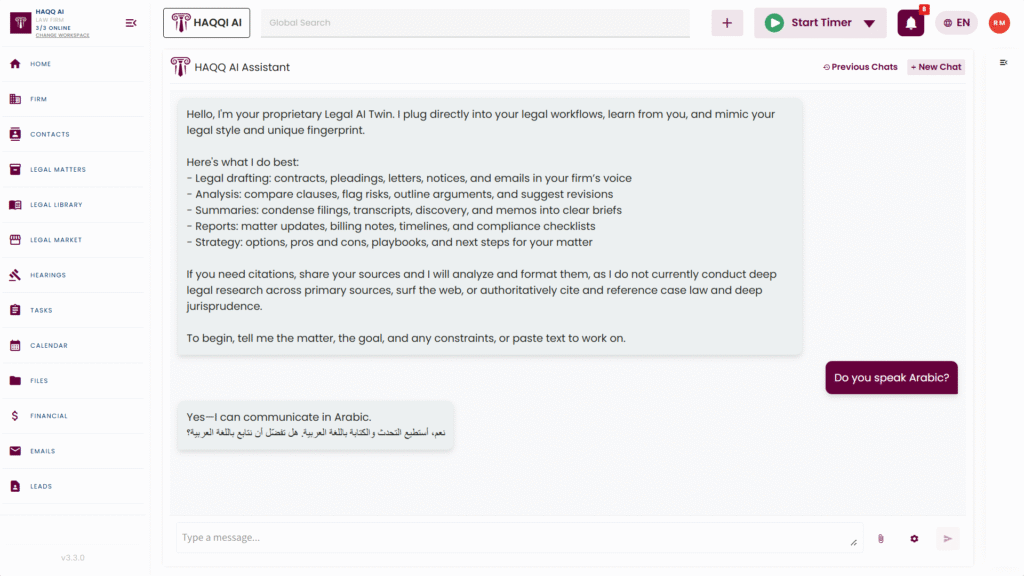
That brain is HAQQ AI: a layer of machine learning built to assist with drafting, summarizing cases, guiding procedural questions, and accelerating legal research. But instead of offering a generic “legal AI assistant,” HAQQ is trained on your firm’s data. This creates a tailored experience that gets smarter the more you use it.
This week, The Legal Wire got in touch with Antoine to find out a bit more about HAQQ.
Having interacted with HAQQ’s users for some time, we asked Antoine what he has observed about how users adapt to HAQQ’s AI over time, and what he would say is HAQQ’s biggest value add in practice.
Antoine noted “What we see again and again is that there is a very short distance between curiosity and dependence. A lawyer logs in, sends one or two prompts just to test the system, and by the time they hit the third prompt there is a real “click” moment. From that point on, they are no longer experimenting with a toy, they are reorganizing their workday around a new operating system.
On average, once a user crosses that 3-prompt threshold, they end up spending 4 to 5 hours per day inside HAQQ, and our power users sit in it for up to 14 hours because it becomes the place where cases, clients, documents, time, and tasks all live. It stops being “an AI feature” and becomes the default workspace where the practice runs.
The reason is that HAQQ is not just a chat box that drafts contracts. Under the hood, we built an AI operating system for the legal industry: one unified data platform with an application layer that connects clients, firms, and institutions. When the AI sits on top of structured, live operational data, it can do much more than answer questions. It can summarize the entire posture of a matter, prepare your next hearing day, surface the one document you forgot, and remind you which client has not paid.
So the biggest value add is not “faster drafting” even though we do that very well. The real value is cognitive offloading at scale. We take a huge amount of mental bookkeeping away from the lawyer. Instead of spending hours coordinating information across WhatsApp, Word, Excel, email, and a shared drive, the lawyer interacts with a Digital Twin that already knows the file, the client, the deadlines, the team, and the firm’s way of doing things. That is what turns a casual user into a daily user.
Over time, usage becomes more sophisticated. In month one, people use HAQQ for research and summarization. In month two, they start automating workflows. In month three and beyond, partners begin to think in terms of “What can I give entirely to the Twin so that my team can focus only on strategy and client relationships?” That shift in mindset is where the compounding value is created.”
Beyond the Dashboard: Real-World Intelligence
Behind the clean interface and powerful automation sits a robust commitment to privacy and security. HAQQ isn’t just ticking compliance boxes for the sake of optics. The platform is designed to exceed global standards: GDPR, PDPL, ISO 27001, ISO 42001, SOC 2. And it’s not just about certifications, HAQQ gives firms ownership over their data with AES 256-bit encryption and a preference for local hosting.
The result is a system where legal teams can finally move fast without breaking anything.
With security being such a major factor for many AI adopters, we asked Antoine, who has placed security and compliance at the centre of HAQQ’s value proposition, how HAQQ has balanced the speed of innovation with the regulatory demands of multiple jurisdictions.
According to Antoine “From day one we treated security and compliance as design constraints, not as an afterthought. If you want to serve ministries of justice, bar associations, and cross-border firms, you do not have the luxury of “move fast and break things.” You have to move fast and still be invited into the room.
Practically, that meant we built the platform from the ground up to align with the major global and regional frameworks: GDPR, SOC 2, HIPAA, CCPA, ISO 27001 / 42001, and the different PDPL regimes in the GCC. We then mapped this into the architecture. Every workspace can be hosted in the relevant jurisdiction, on local infrastructure, so that a Saudi firm can confidently say its data is in KSA, a UAE institution knows it is in the UAE, and so on. That single choice removes a massive amount of friction in procurement and regulatory review.
On the innovation side, we made a clear trade: we accepted more work and more cost early in order to move faster later. For example, we invested in a unified data model, strict permissioning, and detailed audit trails so that every AI action is explainable and traceable. That is harder to do in the beginning, but once you have it, you can ship new AI capabilities quickly without renegotiating security each time. The legal AI engine can evolve while the compliance perimeter remains stable.
We also work with regulators and institutions, not against them. Our eBar and eCourt projects force us to sit with bar councils, ministries, and their IT teams and design within their rules. That collaborative pressure makes the product stronger. Every new jurisdiction we enter raises the bar on compliance, and those improvements cascade back to all our customers. In other words, regulation is not slowing us down, it is deepening our moat.”
Task Tracking, Timekeeping, and the Business of Law
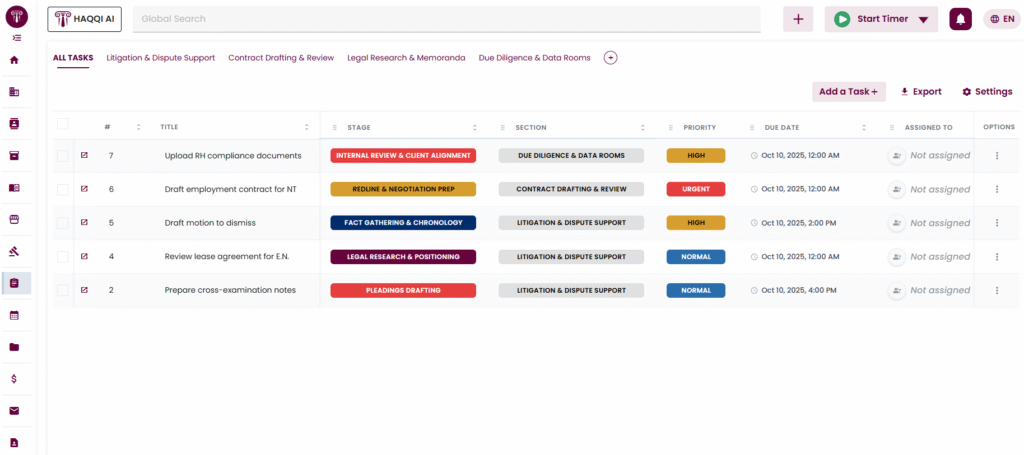
From a functionality perspective, HAQQ hits all the expected marks: task assignment, Kanban-style workflows, time tracking, automated invoicing. But it’s the way these features interconnect that makes the difference. With billing and accounting integrated directly into the matter pipeline, teams get instant visibility into their financials, work-in-progress, and outstanding tasks.
More importantly, lawyers don’t need to be system architects to set it up. The platform adapts to boutique firms and larger teams alike, with minimal configuration.
With such a diverse potential client base, we asked Antoine how he sees smaller firms and solo practitioners benefiting from HAQQ differently than larger institutional players, and how HAQQ manages to work for firms of all sizes
Antoince explained that “The way we think about HAQQ is as an ecosystem with three main faces: eClient for the client, eFirm for the law firm, and eBar for the institution.” He added that “Different segments plug into different parts of that ecosystem, but the underlying platform is the same.
For solo practitioners and smaller firms, HAQQ is essentially a fully digital law office in a box. They get case management, document management, billing, CRM, and a powerful legal AI that works in their language and jurisdiction, all under one login. Instead of juggling six or seven generic tools, they run their entire practice on a single system and let the AI handle drafting, summarization, scheduling, and a lot of the client communication. It levels the playing field so a two-lawyer shop can look and operate like a 20-lawyer firm.
For large institutional players, the value is of a different magnitude. There, the problem is not just productivity, it is orchestration. You have tens or hundreds of lawyers across multiple offices, multiple practice areas, often several countries, and a very complex compliance environment. In that context HAQQ becomes a management and governance layer. Partners can see matters across teams, leadership can enforce workflows and data policies, and AI can be used to standardize quality while still respecting each jurisdiction’s rules. The same AI that drafts a motion for a solo lawyer can, at scale, become a risk-management tool and a knowledge-sharing fabric for a regional firm.
The way we make this work for all sizes is by making the product deeply configurable but on a single core. A solo practitioner can be live in a day, using a default configuration. A 300-lawyer firm can spend time with our team defining custom roles, approval flows, and integrations, all without forking the product. So the platform feels personal and local, yet we keep the efficiencies of one global codebase. That combination is rare in LegalTech and it is a big part of why we can grow across segments without diluting focus.”
Where AI Makes It Real
Many legal tech tools today aim to save time or reduce admin overhead. HAQQ’s premise goes even further: that by giving lawyers an AI twin that understands the context of their matters, the platform can fundamentally change how work gets done.
HAQQ doesn’t just summarize documents. It tracks legal citations. It helps prep witnesses. It logs time as you go. It nudges you on next steps. And with built-in CRM, client intake, and communication tools, it replaces the piecemeal, patchwork toolkit many firms are still stuck with.
With so many capabilities, we wanted to find out from Antoine how HAQQ draws the line between automation that helps and automation that overwhelms, and where he sees human oversight playing the most critical role.
Antoine’s response reminded us why we find these interviews so valuable: “I like to borrow Rick Rubin’s word here: taste. Automation should never replace taste. It should never replace judgment, ethics, or responsibility. It should replace chores.
Our philosophy is simple. Execution is automatable, direction is not. So we deliberately aim the AI at the work that is mechanical, repetitive, or purely procedural: reading large bundles of documents, extracting facts, organizing files, generating first drafts, routing tasks, checking deadlines. Those are things machines can do tirelessly, and when they do, they give lawyers something incredibly valuable back, which is time and attention.
The red line is anything that touches final legal judgment, client consent, or rights. There, the human has to stay in the loop. In HAQQ the AI proposes but the lawyer disposes. It might suggest a strategy, draft a clause, or highlight a risk, but a human lawyer validates it, edits it, and signs off. We also log and surface AI activity so that a firm can always answer the question “What did the AI touch in this case?” which is essential for professional responsibility.
Human oversight is most critical at three layers. First, at the strategic layer, where you decide what you are trying to achieve in a negotiation or a litigation. Second, at the ethical layer, where you decide what is acceptable for this client and this matter. Third, at the institutional layer, where bar associations and courts set the rules of the game. Our job is to give these humans better instruments, not to perform in their place.
So the way we draw the line is by constantly asking: “Is this feature making the lawyer more present with the decision that matters, or less?” If the answer is “less,” we do not ship it. If the answer is “more,” we double down. That is how you get the upside of automation without drowning people in it.”
The Price of Multipurpose Simplicity
One of HAQQ’s most compelling promises is economic: by replacing fragmented subscriptions, it claims to save up to $25,000 per lawyer per year. For smaller firms and growth-stage teams, that’s not just a marginal benefit.
And it’s free to start. HAQQ’s forever-free tier is tailored to solo lawyers and small teams who want to try before they commit. Larger firms can explore competitively priced plans that match their specific needs, with the option for custom integrations.
From Friction to Fluidity
Legal tech isn’t new. But the best tools feel more and more like relief, and less like complicated tech. HAQQ is aiming for that kind of seamlessness, not by simplifying legal work, but by removing the overhead that gets in its way.
So, what would it look like if your entire legal team had a digital twin? One that could draft, organize, remember, and protect the work that matters, without needing an onboarding guide and a half dozen logins? That’s the question HAQQ wants lawyers to ask themselves. And maybe, just maybe, the answer isn’t about what the platform does. It’s how it helps you get back to the part of the job that makes it worth doing.