
When Troy Doucet founded AI.Law, his goal was simple yet ambitious: help litigation teams draft faster, smarter, and safer. Now, that vision has been codified into a U.S. patent. Issued under U.S. Patent No. 12,461,932 B1, AI.Law’s newly protected method covers how unstructured data is transformed into structured legal documents using a large language model and context-aware feedback loop, a process that enables the creation of lengthy, high-quality drafts without human intervention.
The patent’s scope extends beyond litigation support, and touches on the mechanics that major AI systems use to generate complex documents. For Troy, the recognition underscores how far ahead AI.Law has been since its inception. As he puts it, “virtually all the big AI players now use our process.”
The Legal Wire recently interviewed Troy to discuss the patent’s implications, its impact on LegalTech, and what this milestone means for the future of AI-assisted litigation.
TLW: Congratulations on the new patent. Can you walk us through what this patent actually protects and why it’s such a milestone for AI.Law?
Troy: “Thank you. One of the core challenges in AI-driven document drafting has been overcoming the limitations related to length and depth. Typically, achieving a high-quality response requires detailed input and often results in short responses. This poses a challenge for legal drafting, where documents can range from 20 to 90 pages. Recognizing this need, we developed an innovative process to ensure AI-generated outputs are both useful and practical for extensive legal documents.
Our patented method involves a unique approach to problem-solving. We deconstruct the legal issue into manageable components, allowing each segment to be independently analyzed by the AI. Instead of processing one extensive request, we efficiently handle multiple smaller tasks, enabling the AI to generate high-quality responses without being overwhelmed.
For enhanced processing speed, we simultaneously send each segment for analysis, eliminating sequential delays. This parallel approach empowers us to compile a comprehensive document swiftly, within seconds to a few minutes, depending on the complexity.
To ensure coherence and consistency, we then utilize an AI-driven review process that integrates the individual segments into a cohesive whole before delivering the final output. While there are extensive technical specifics detailed in our patent (spanning 100 pages with 20 claims), this method provides us with a competitive edge in producing complex, nuanced legal documents quickly.”
TLW: From a technical standpoint, what’s unique about your approach to generating long, structured legal documents that warranted a patent?
Troy: “Our approach is distinguished by its ability to dramatically reduce the time required to draft complex legal documents. For instance, we successfully filed a multi-count federal lawsuit in March 2024, drafted by our AI in under 3 minutes. This is a task that traditionally takes around 8 hours when done manually. This achievement highlights our unique method of leveraging AI to achieve unprecedented speed while maintaining depth and complexity. Our innovation lies in the way we utilize AI technology to enhance efficiency and accuracy in legal document drafting, setting us apart from other AI companies.”
TLW: Many in LegalTech build on existing LLM infrastructure, but you went further by securing intellectual property around how it’s used. Why was that important to you?
Troy: “Securing intellectual property was crucial because we developed a unique process through extensive trial and error and creative innovation. This approach goes beyond simply using a large language model (AI). It builds a strategic moat that adds value and distinguishes us from competitors. By securing IP rights, we protect this core competitive advantage, ensuring that our innovation is both preserved and leveraged effectively in the market.”
TLW: Do you see this patent as defensive (protecting your innovation) or offensive (positioning AI.Law to lead the next phase of AI-driven drafting)?
Troy: “We are excited to explore collaborative opportunities that leverage our unique technology to drive industry-wide advancements. We are still evaluating what that looks like on a case-by-case basis, and are looking for experts to help us chart that path forward.”
TLW: Flowing from this, will other companies using similar document-generation methods need to license this technology from AI.Law, or do you see more collaboration opportunities ahead?
Troy: “We see a wealth of win-win opportunities within the broader market to collaborate using our technology. We are open to partnerships and do not intend to monopolize the technology. We anticipate having licensing discussions with other companies, and recognize our legal obligation to protect our intellectual property.”
TLW: Your platform already drafts lawsuits, analyzes depositions, and generates discovery responses. How does this patent push AI.Law closer to your long-term vision? What’s next for AI.Law? Are there more patents in the pipeline?
Troy: “Document drafting is a key part of what we do, so this patent is important to our overall business process and competitive advantage. We do have other patents in the works as we remain on the cutting edge of AI development.
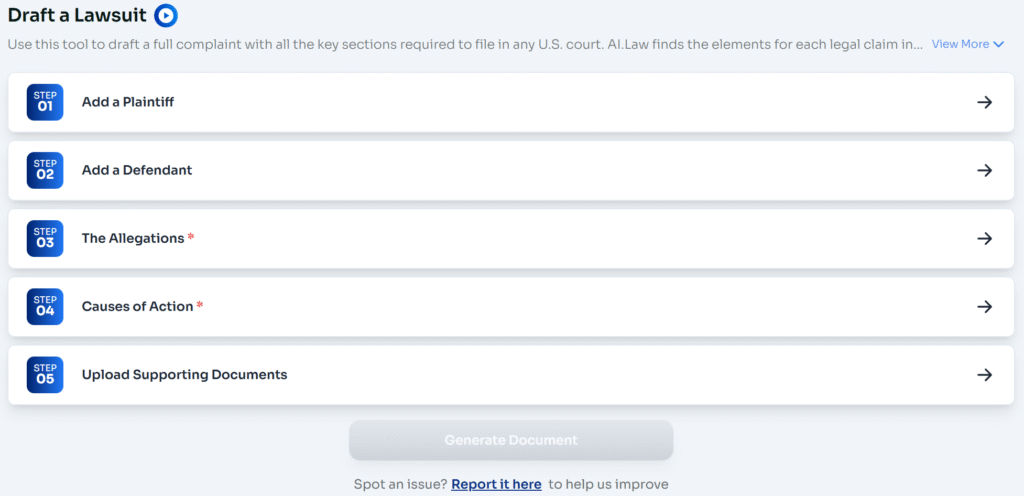
Our goal is to build on our IP to offer more tools to the industry that can be used to effectively manage cases and push them forward. We remain very optimistic about AI and its ability to help not just the legal community and access to justice, but society as a whole.” For those wanting to keep track of Troy and AI.Law’s developments, visit https://www.ai.law/ or connect with Troy on LinkedIn https://www.linkedin.com/in/tdoucet/.