
Ahead of their session, ‘Building a Fortress – How the Legal and Data Teams Can Work Together on Management, Privacy and Protection,’ at the Corporate Counsel & Compliance Exchange USA, Kristiyan Assouri, Executive Vice President, Chief Legal Officer & Corporate Compliance Officer, and Michael Stefanini, Chief Data Officer & Director of AI at Tutor Perini shared their views.
Operating within the increasingly complex and fragmented US privacy landscape, they share insights into how closer alignment between legal and data teams is helping organisations strengthen governance, navigate regulatory demands, and drive more confident, data-led decision-making.
Tell us about yours and Michael’s roles and where do you sit according to each other?
Kristiyan Assouri: I am the Executive Vice President, Chief Legal Officer & Corporate Compliance Officer. Mike is the company’s Chief Data Officer and Director of AI. We work very closely on the company’s initiatives involving AI and data strategy.
Our partnership is built around a shared responsibility: making sure the company uses data and AI in a way that is innovative, practical, and trustworthy. Since Michael joined, we have focused on building a close working rhythm early: regular check-ins, shared priorities, and open discussion around both opportunities and risks.
What does your current partnership look like? Michael has just joined; how have you developed this relationship?
Kristiyan Assouri: Rather than treating legal as a final checkpoint, we are working together from the beginning so that strategy, governance, and execution stay aligned. We both appreciate understand that Tutor Perini is a construction company and not a technology company.
What does a good legal-data partnership actually look like in practice?
Kristiyan Assouri: A strong legal-data partnership works best when both sides are involved early and understand each other’s goals. In practice, that means legal is not just identifying risk, and data is not just delivering technical solutions.
Together, we are shaping frameworks for responsible use, defining guardrails, and making sure the business can move forward confidently. The best partnerships are collaborative, practical, and focused on enabling good decisions rather than slowing them down.
Where do your paths tend to cross more often?
Kristiyan Assouri: Our paths most often cross where data, regulation, and business strategy intersect. That includes AI governance, privacy, compliance, data usage decisions, and risk management.
Any time the company is asking how to use data more effectively while maintaining trust and accountability, that is where our teams naturally come together.
How naturally do your teams collaborate, is it structured or more informed?
Kristiyan Assouri: It is both structured and organic. We have formal touchpoints around major initiatives, governance processes, and decision-making, but the relationship also depends on people being comfortable reaching across functions day to day.
The most effective collaboration happens when teams do not wait for an issue to escalate – they engage early, ask questions, and solve problems together in real time.
Where has working closely with data most tangibly improved legal decision-making?
Kristiyan Assouri: The biggest improvement is that legal decision-making becomes more grounded in evidence and operational reality. Instead of relying only on assumptions or broad policy concerns, we can look at actual patterns, usage, impact, and risk signals.
That helps us prioritize what matters most, respond faster, and design solutions that are both legally sound and workable for the business.
What does ‘data driven compliance’ actually look like beyond dashboards?
Kristiyan Assouri: Data-driven compliance means using data not just to report on what happened, but to actively identify trends, detect issues earlier, and improve controls over time.
Beyond dashboards, it is about creating feedback loops; understanding where risks are emerging, testing whether policies are working, and adjusting processes based on real outcomes. It makes compliance more proactive, more targeted, and ultimately more effective.
What are the biggest misconceptions legal teams have about data, and vice versa?
Kristiyan Assouri: One misconception legal teams sometimes have is that data is purely a technical function, when in reality it shapes business strategy, operations, and customer trust.
On the other side, data teams may sometimes see legal as primarily a constraint, when legal’s role is really to help the business move forward responsibly. The strongest relationships happen when both sides understand that they are solving the same problem from different perspectives.
What should legal leaders understand about data governance before adopting AI tools?
Kristiyan Assouri: Legal leaders should understand that AI governance starts with data governance. If you do not have clarity around data quality, ownership, access, lineage, and permissible use, it becomes much harder to adopt AI responsibly.
Strong governance creates the foundation for trust, accountability, and scalability. In other words, before focusing on the AI tool itself, leaders need confidence in the data ecosystem that supports it.
What’s one practical step a GC or CLO can take tomorrow to strengthen this relationship?
Kristiyan Assouri: One practical step is to establish a regular working session with the data leader focused on shared priorities rather than only issue escalation.
Even a short, recurring conversation can change the relationship from reactive to strategic. It creates mutual understanding, surfaces risks earlier, and helps both functions align around how to support the business.
Why is this relationship becoming critical now?
Kristiyan Assouri: This relationship is becoming critical because companies are making bigger, faster decisions about AI, data use, and digital transformation than ever before.
Those decisions carry strategic upside, but they also raise complex questions around governance, accountability, compliance, and trust. Legal and data leaders need to work side by side so the organization can innovate with confidence and do so responsibly.
Download the full interview to find out more.
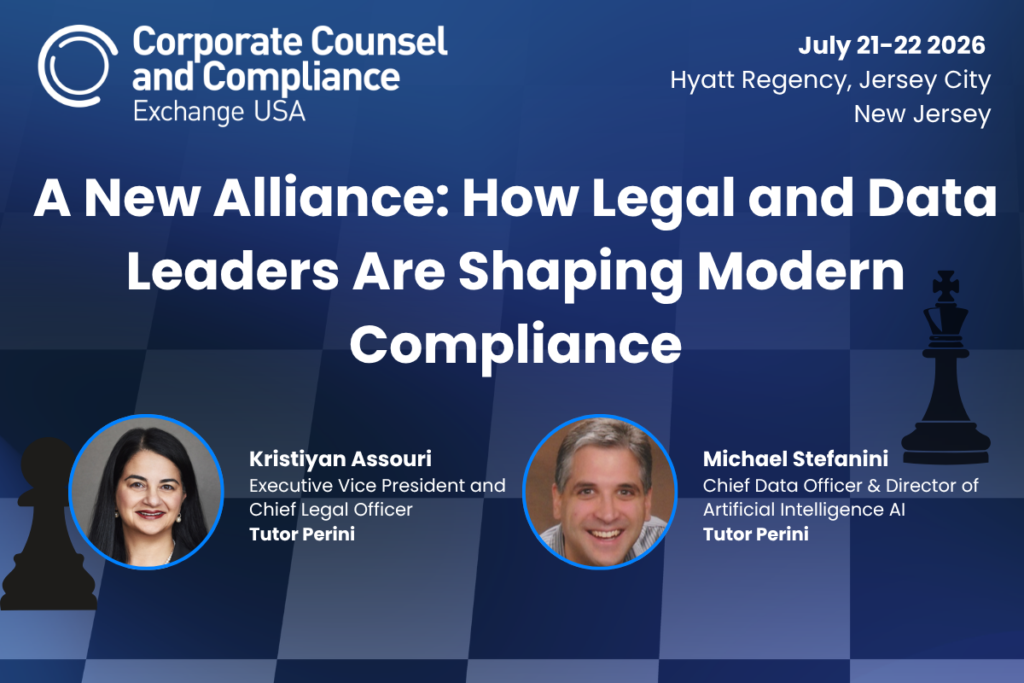
Where the Conversation Continues: Corporate Counsel & Compliance Exchange USA
Kristiyan Assouri and Michael Stefanini will be exploring these themes in more depth at the Corporate Counsel & Compliance Exchange USA (July 21-22, 2026 | Hyatt Regency, Jersey City), an invitation-only forum bringing together Chief Legal Officers, General Counsel, and Chief Compliance Officers for candid, peer-led discussion.
If you’re looking to:
- Build stronger alignment between legal and data
- Embed AI governance in practice
- Move from reactive compliance to proactive decision-making
The Exchange offers practical case studies, open discussion on regulatory change, AI and data governance, and insight into how legal leaders are strengthening influence and driving strategy.
Request your complimentary invite or get in touch to learn more.*
Subject to seniority and suitability