

Karnov Group has published Inside the Legal Mind 2026, a survey of 3,129 legal professionals in Denmark, Spain, France, Norway and Sweden. It launched at the IBA Annual Conference in Copenhagen and is the group’s first report at this scale. It covers four themes: pressure on the rule of law, AI in legal work, motivation and careers, and where respondents under 30 differ from older colleagues.
First, a note on method. Results are not weighted by country, and Sweden supplied 1,058 responses (about a third of the sample) against 395 from France. Karnov notes that Sweden and Denmark may be overrepresented and Spain and France underrepresented. No formal significance testing was carried out. The country and segment breakdowns are, therefore, more informative than the headline averages.
AI use is routine but confidence in it is not.
59% of respondents use AI at least weekly, and 31% use it daily. Norway is the outlier at 48% daily use, compared with 25% in Denmark and Sweden.
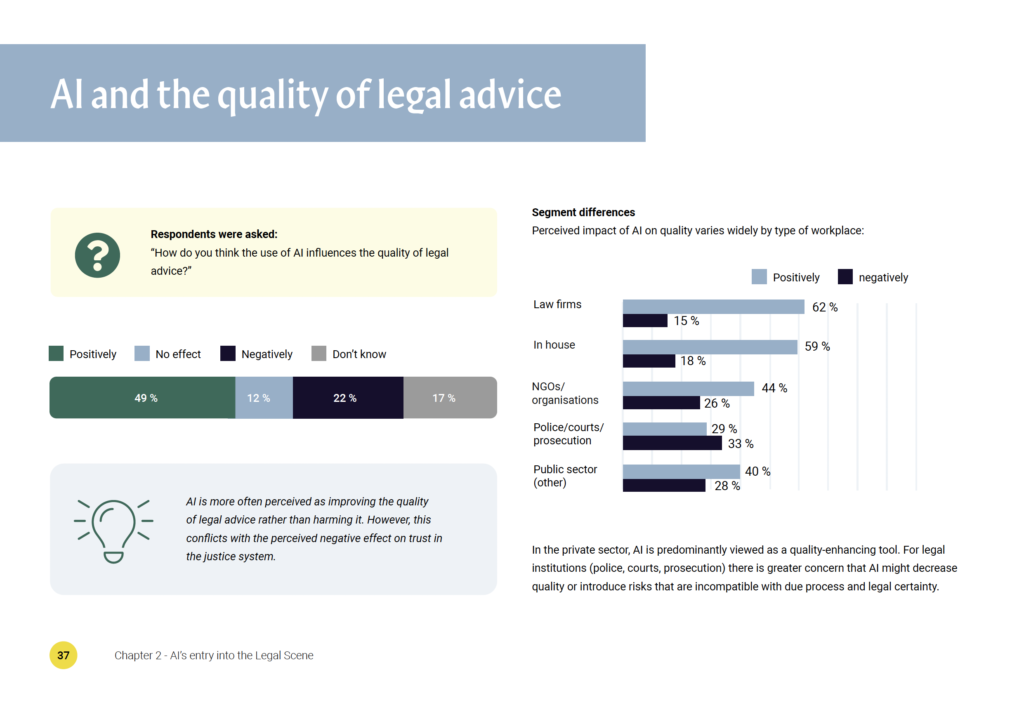
On quality, the profession leans positive: 49% say AI improves legal advice and 22% say it makes it worse. On trust in the justice system, the picture reverses. 40% expect AI to have a negative effect, 18% expect a positive one, and 28% don’t know. Spain is the only country where positive expectations lead (38%).
Where respondents work matters a great deal. 62% of law firm respondents see quality gains, compared with 29% in police, courts and prosecution services. The report’s cross-tabulation suggests that views on quality and trust move together. Of those who expect AI to improve trust, 87% also see quality gains. Among those who expect it to damage trust, only 33% do.
Governance trails usage. 53% say they or their employer have AI guidelines in place and 39% say they do not. In-house teams report the highest share with guidelines, at around 61%.
Client use of AI is a sore point. 34% see clients’ easier access to legal information through tools like ChatGPT as a disadvantage, against 19% who see an advantage. The free-text answers explain why: invented case law, clients who trust a chatbot over their lawyer, and courts processing longer AI-drafted submissions from self-represented parties.
The competence question
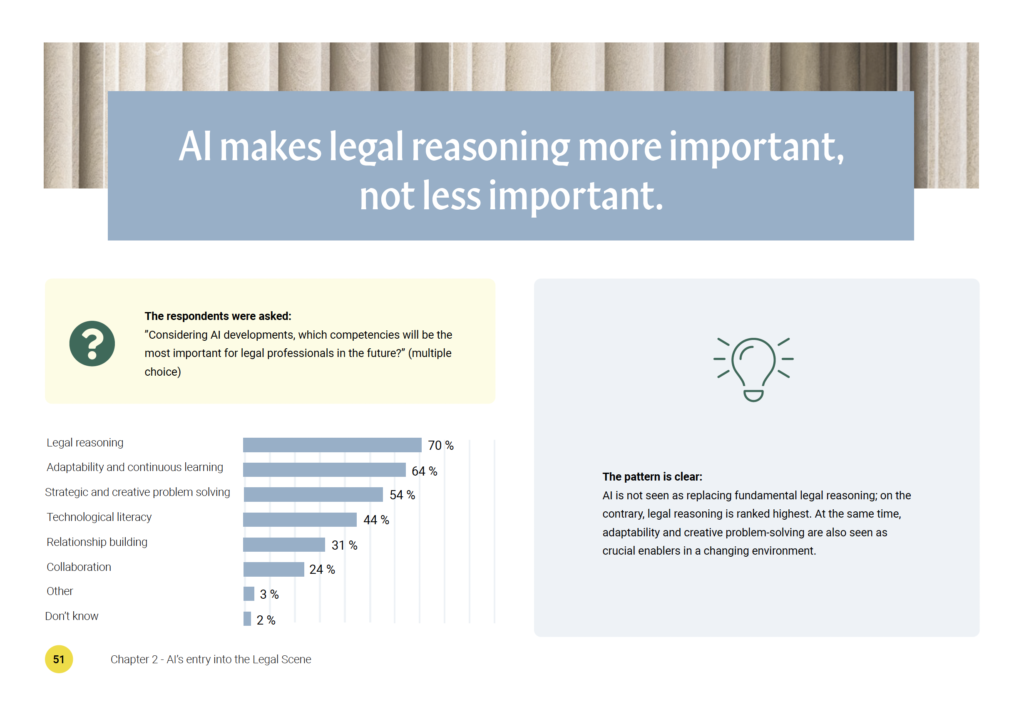
64% see a great or very great risk that AI will leave younger lawyers with insufficient legal competence. The figure is 74% in Spain and 73% in France, but 51% in Norway. Only 9% think legal education is keeping pace with AI, while 59% say they don’t know. Asked which skills will matter most, 70% chose legal reasoning and 44% chose technological literacy.
Under-30s, who make up 9% of the sample, are the heaviest users: 67% use AI weekly and 38% daily. They are also more sceptical than average about client access to AI (45% see it as a disadvantage, against 34% overall).
Norway presents a contrast. It has the highest daily use, yet 53% of Norwegians who believe the rule of law is under pressure name AI as a cause, compared with 11% in Spain. That figure comes from a subset, since only 36% of Norwegian respondents think the rule of law is under pressure at all.
Rule of law, access to justice and retention
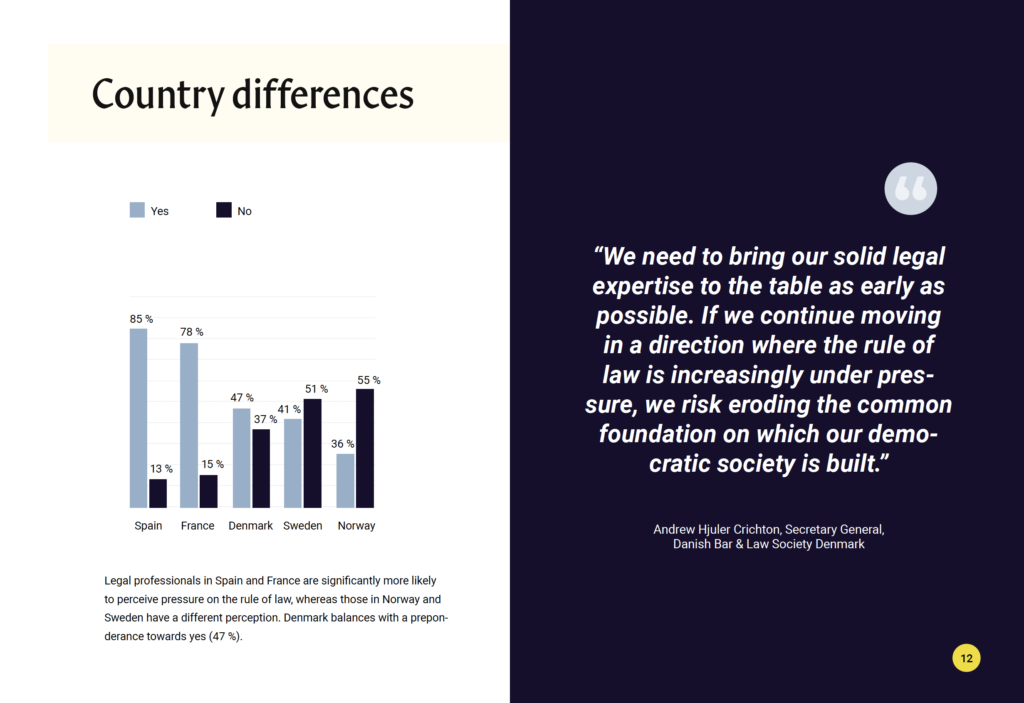
53% believe the rule of law is under pressure in their country. The figure ranges from 85% in Spain and 78% in France to 36% in Norway. 72% say pressure has increased over the past three years, and political decisions are the most cited driver. On access to justice, 49% of law firm respondents say equal access exists only to a small or very small extent, compared with 18% in police, courts and prosecution services.
37% have considered leaving their workplace in the past six months, rising to 50% among 30 to 39 year olds. On gender, 63% of women see substantial barriers to women reaching top positions, compared with 23% of men.
Taken together, the data shows a profession that has adopted AI faster than it has built the guidelines, training or shared view on trust to support it.
Click here for the full report