


Chamelio, the AI-native platform for in-house legal teams, has raised a $26 million Series A led by Entrée Capital, with existing investors Work-Bench and Emerge Ventures back on the cap table alongside new participation from Bright Pixel Capital. The company announced the round on 22 September from New York, five months after closing its seed. In that window, according to Chamelio, annual recurring revenue has grown fourfold. The customer list now runs to more than a hundred organisations, including Wiz, monday.com, Socure, AppsFlyer and Wonderful.ai.
The thesis Chamelio is pitching to its investors and to those customers is that the contract lifecycle management software in-house legal teams have been buying for the last decade was designed to store contracts, not to do work, and that a new category is now needed to replace it.
This week, The Legal Wire spoke to CEO and co-founder Alex Zilberman shortly after the funding announcement about how he got here, why he thinks CLM’s moment has passed, and how an ideal AI-native operating system for in-house legal should look.
From facial recognition to the in-house lawyer
Alex is not a lawyer, which he mentions early. He is a second-time founder whose first company, started in 2015, was in the computer vision space and built a facial recognition system that at the time ranked among the top three globally for accuracy. That company raised hundreds of millions of dollars and reached tens of millions, in ARR, before an exit. “We were using what was then the latest and greatest technology, which was called deep learning,” he says. “It was really when GPUs started becoming cool and the ability to perform calculations on them emerged. It seems obvious now, but it wasn’t obvious then.”
Chamelio’s other two co-founders come from that world too. Gil Banyas, Chamelio’s COO, was Alex’s general counsel at the computer vision company and spent his earlier career in in-house roles and at law firms. Gal Lellouche, the CTO, previously sold his own data-extraction company to Sage, the accounting software group, where he stayed on as senior director of AI.
Regarding this specific combination, Alex says “I think we bring some of the most relevant experience you could bring together in this space. There’s Gil’s legal background, my experience scaling companies and working in sales leadership, and Gal’s applied AI and research experience.”
The three of them began speaking to legal professionals in 2023, after ChatGPT’s public release. They weren’t really motivated by the fact that lawyers were using generative AI because, as Alex recalls, lawyers weren’t really using it at that stage, but they were inspired by the fact that lawyers were discussing this potentially disruptive technology and seemed intruiged by it. “It was practically taboo. It would make more mistakes than it would provide correct answers,” Alex says. “But the curiosity was there. The level of emotion it generated among potential users was so high that we understood the world was about to change. People were going to pay attention. We wouldn’t have to convince them to look at this new technology.”
They started with a prototype at the end of 2023 and brought on ten design partners at the start of 2024. The first product was a very simple AI redlining tool that worked over email. “They’d send an email, the system would perform the redlining and send it back,” Alex explains. “We didn’t know it at the time, but we’d built our first agent, we just didn’t know that’s what it was called.”
The next developments shaped the company. Design partners started asking whether the same email interface could do more, including things they had already bought other software to do. “You’ve paid $100,000 or $200,000 for something that promises to do exactly what you’re asking us to do,” Alex recalls telling them. “One after another, we understood that those solutions weren’t living up to their expectations.” That is the moment he cites as the origin of Chamelio in its current form: not incremental improvement on redlining, but an attempt to build what CLM was supposed to have been.
Alex is particular about how he describes the product-market fit conversation. Asked whether Chamelio evolved organically in response to customer feedback, he pushes back. “No, I wouldn’t put it that way. We built everything guided by customer feedback, but led by our vision.” He formulates the distinction as such: “You shouldn’t really ask a customer, ‘What do you want?’ You should ask, ‘Why do you want it? What are you trying to do?’ When you understand why they want it, you can start thinking of a great solution that can help them and others.”
TLW: You have said Chamelio’s growth has depended on knowing when to say no to customer requests as much as knowing when to say yes. Can you give a specific example of a customer request you’d turn down, and why saying no in that case matters for your vision for Chamelio?
Alex: “A common example is when a customer asks us to reproduce a very specific workflow from their legacy system exactly as it exists today. We’ll always understand why they need it, but we won’t automatically rebuild a twenty-step process just because that is how the old software worked. Often, once you understand the actual objective, an agent can achieve the same outcome with a fraction of those steps, or remove the need for the process entirely. That distinction matters a lot to us. If you say yes to every feature request, eventually you rebuild the legacy platform you were trying to replace. Our job is to listen very carefully to the problem, but still have a strong point of view about the solution.”
What replaces CLM?
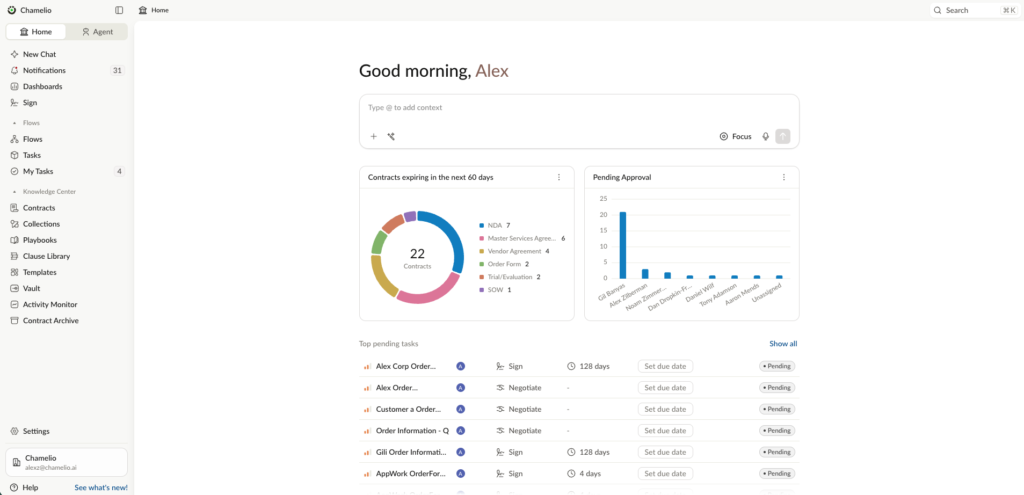
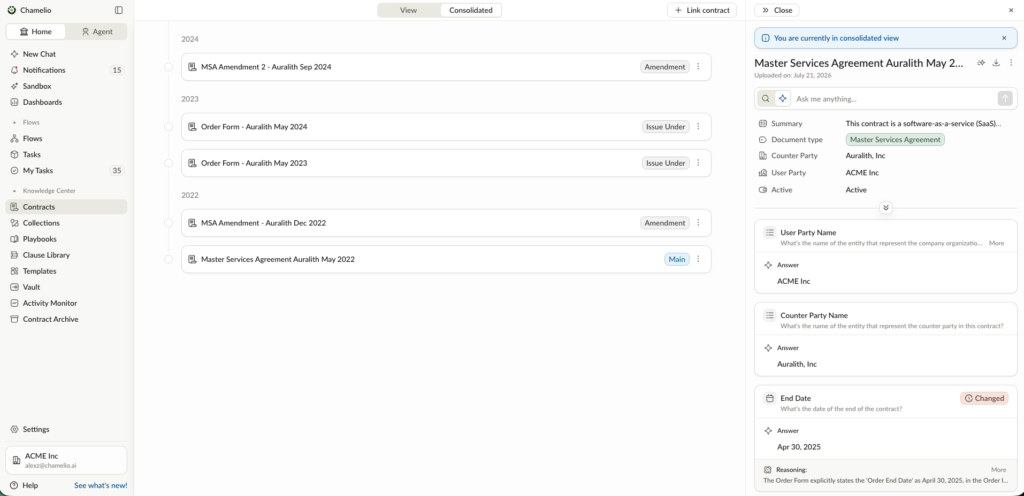
Chamelio calls itself a legal intelligence platform. What that means in practice is that it takes on the full contract lifecycle, from drafting through negotiation, approvals, obligations and ongoing management, and connects that work into the systems the rest of the business already lives in. Native integrations run to Salesforce, HubSpot, NetSuite, Zip, Slack, Teams, Microsoft Word and email, with more added on an ongoing basis. Customers can deploy the platform autonomously for routine work, or keep a lawyer involved where oversight is required.
To Alex, that combination is vital. Legal, for him, is not a function that produces value in isolation. It produces value by being present, quickly and in context, everywhere else in the business. “The way legal operates is by providing value to all the other departments in the organisation. For us to do something meaningful for legal teams, we need to help them put all their context, all their guardrails and all their decision-making into the platform, and allow them to be present in all the other places where their internal customers work. Instead of a legal user going through five or seven different tabs, searching for someone who tagged them and jumping between different Word files, they can have everything organised in one place. They can even have agents that respond on their behalf, with or without their approval, depending on the topic.”
He provides some examples of what customers are doing with the platform: an agent looks at every contract signed in the last three days and checks it was signed by someone with the correct signing authority; an agent flags negotiation tasks pending for more than three days; and an agent reassigns work automatically when the person it was assigned to is out of the office. “It’s all these small things that normally require a human to push them forward,” he says. “An agent can do them and keep the business moving without people wasting brain energy on simple manual tasks.”
TLW: Chamelio has more than a hundred customers already, and many of them will have been paying six-figure sums for the CLM you are aiming to replace. How does the displacement conversation usually evolve and how long does it typically take a customer to switch off the legacy system entirely?
Alex: “Honestly, the switch is usually easier than people expect. By the time a legal team is talking to us, they’ve often had enough of the limitations of their existing CLM and are actively looking for a different way of working. The bigger challenge historically was that replacing a CLM sounded like another long, painful implementation project.
We’ve invested heavily in removing that friction. We built an AI-based onboarding and migration agent that can help customers move data and structure from many of the most widely used CLM platforms into Chamelio. That means we can automate a meaningful part of the migration work that would traditionally require a large services project.
In practice, customers can start proving value quickly, migrate progressively, and retire the legacy system as Chamelio takes over more of the work. So the conversation is usually much less about ‘can we survive another CLM implementation?’ and much more about ‘how quickly can we move?”
The legal engineer and human in the loop
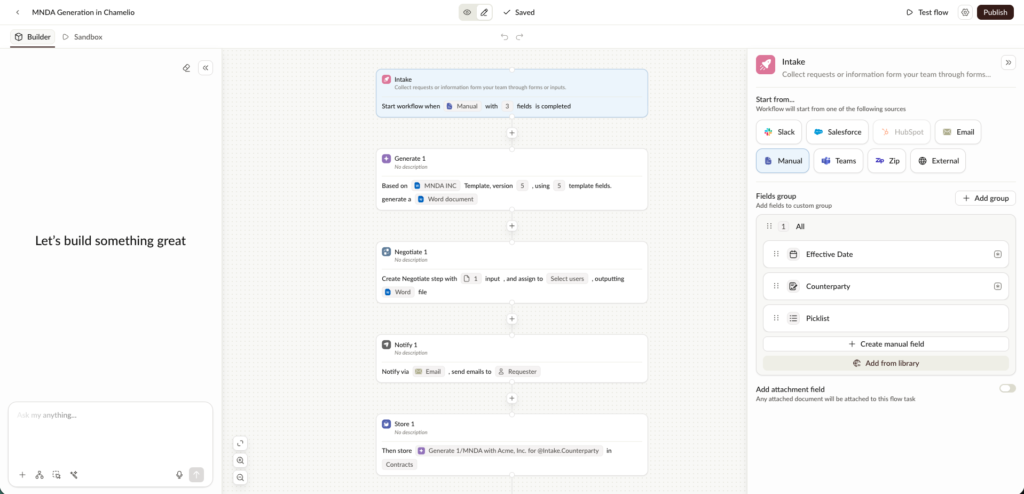
Chamelio’s model is quite unique in that every account gets a dedicated legal engineer during onboarding. Setting up the software and the agents is not the hard part, Alex says. That’s why, he says, Chamelio even has agents that set up agents: you describe what you want and the system prefills the settings.
Where the legal engineer earns their keep is in the human bit that surrounds all of that. “We want to be there with our customers, advising them on best practices. Making them aware of what the best practices are in the market, what others are doing, why they’re doing it and how to think about it. That’s a big, big value that we still provide.”
Chamelio treats autonomy as a live conversation with customers. Technically, Alex says, a customer can set up any piece of the engagement to run autonomously. But in practice, they usually want Chamelio’s input on where to set the parameters. “What’s nice and interesting is that customers are looking for our input.”
TLW: The legal engineer role is central to how Chamelio deploys. As you scale from 100 customers towards multiples of that, do you envisage any changes to the legal engineering team at, say, 500 customers, and what part of that role do you eventually expect an agent to do?
Alex: “At 500 customers, I expect legal engineering to be even more important, but the work will be different. We already have agents helping customers configure agents and workflows, and more of the mechanical setup will continue to disappear into the product. I don’t want highly capable legal engineers spending their time moving fields around or configuring software. Their value is understanding how a sophisticated legal department operates, showing customers what is possible, sharing what we are learning across the market and helping teams redesign processes around AI. The software should increasingly do the setup. The humans should provide the judgment, creativity and change management.”
An updated view at twenty months in
Chamelio’s own founding coincides with a piece Alex wrote for The Legal Wire back in December 2024, in which he set out five criteria for a good legal tech vendor: software that works right away, is customisable, sets up quickly, offers ongoing support, and has experience working with legal teams. Asked, twenty months on, whether he would change the list, he would keep all five. He would add one more, and sharpen a second.
“I would add one that has become much more important: how quickly the vendor itself can evolve. The pace of change in AI over the last 20 months has been extraordinary. You’re no longer just buying a piece of software based on what it can do today. You’re effectively choosing a technology partner that needs to keep adapting as the underlying models improve, new capabilities become possible, and the way legal teams work changes.”
The sharpening is on the first criterion. “I’d sharpen ‘works right away’ to ‘proves value right away in your actual environment.’ A great demo is no longer enough. Can it work with your contracts, your playbooks, your workflows and your business systems? Can your lawyers start using it without a six-month transformation project?”
His summary of what has changed in his own thinking is that “the technology has become dramatically more capable, but successful adoption still comes down to solving real problems, integrating into how people already work, and continuously improving after deployment.”
What the raise is a bet on
Asked what single message he would want the legal tech audience to take away from our discussion, Alex returned to the vendor-choice theme. “Don’t make a technology decision based only on what AI can do today. When I wrote the original piece, much of the conversation was still about whether legal teams should build their own AI tools or buy them. Twenty months later, I think the more important question is whether the platform you choose can grow with you.”
On the meaning of the $26 million raise amongst all this, Alex says “our recent funding round is really a bet on that transition. We believe the opportunity is much bigger than making individual legal tasks faster. It is about building the operating layer through which an in-house legal department can run a meaningful part of its work.”
TLW: The in-house legal tech category is competitive, with incumbent CLM providers, big legal AI platforms and other agentic contract startups all describing themselves in similar language. When a prospective customer asks why Chamelio rather than the alternative that pitched them last week, what is your one-sentence answer?
Akex: “Most alternatives help legal teams manage or accelerate individual pieces of work; Chamelio brings the team’s context, workflows and agents together in one system that can actually execute the work.”