
A useful way to think about a market is to notice what it has stopped arguing about. Two years ago, the legal AI conversation was mostly about whether the technology could do the work at all. Today, in the pieces we have published, the interviews we have done, and the reports circulating in the profession, that question has largely gone quiet. Something more consequential has replaced it.
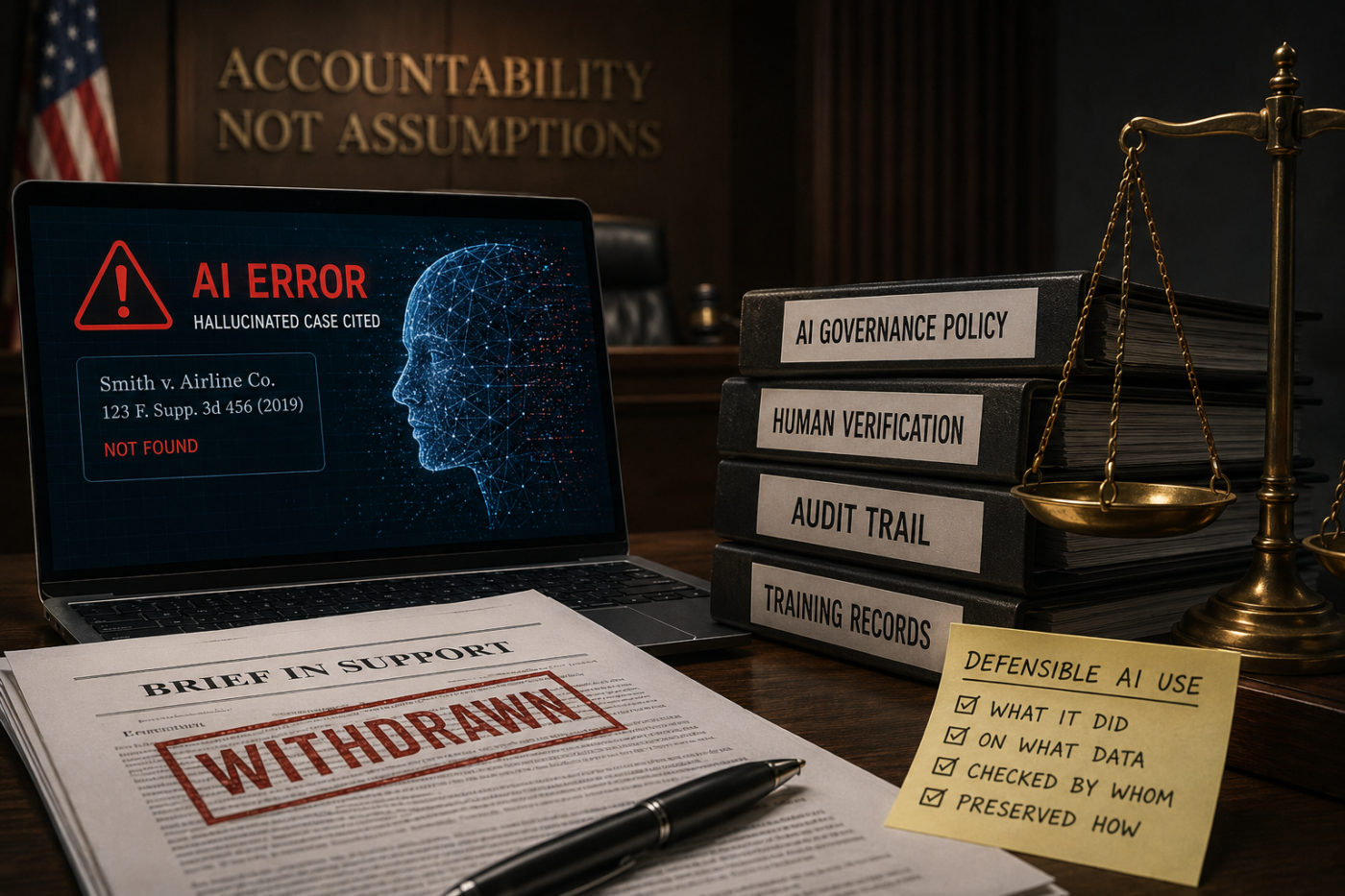
The new question is whether AI-assisted legal work is defensible. Not defensible in the marketing sense, where a product is claimed to be trustworthy, but defensible in the operational sense: whether an organisation can show a court, a regulator, an opposing counsel or its own audit committee exactly what the AI did, on what data, checked by whom, and preserved how. That shift is happening across every layer of the profession at once, and the industry has not fully caught up with itself.
The evidence has stopped being anecdotal
Consider the sanctions data. A public database maintained by Damien Charlotin, a research fellow at HEC Paris, tracks court decisions worldwide where a party relied on AI-hallucinated material and a judge responded. When the database launched in the aftermath of Mata v. Avianca, it was a novelty. As of June 2026, the tracker has identified more than 1,590 cases globally, more than 1,000 of them in the United States, with penalties running from four-figure fines to combined sanctions of over $109,000 in a single Oregon matter and the first attorney suspensions tied to AI-generated filings. Bloomberg Law’s editorial board has argued for mandatory nationwide reporting.
But what the tracker documents doesn’t come down to just a training problem. Firms of every size are now represented, including household names. Take Sullivan and Cromwell, for example, which had comprehensive AI governance policies, mandatory training modules and explicit verification requirements in place, but still filed an inaccurate brief that had to be publicly withdrawn. Gordon Rees has been named in the tracker more than once.
The pattern indicates more than individual carelessness. It’s somewhat of a systemic mismatch between how the tools are used and how the profession is currently organised to catch mistakes.
The underlying rates help explain why. Stanford’s RegLab, in the first peer-reviewed empirical study of commercial legal AI tools, found that Lexis+ AI, Westlaw AI-Assisted Research and Ask Practical Law AI each hallucinate between 17% and 33% of the time, despite vendor claims of being hallucination-free. That is meaningfully better than a general-purpose chatbot, which Stanford’s earlier study found could hallucinate on legal queries at rates between 58% and 88%. But it is not remotely close to a system a court would recognise as reliable without human verification.
A tool that is wrong roughly one time in four, used by thousands of time-pressed lawyers each day, produces exactly the database the profession is now looking at. The important observation is that this is no longer speculative territory. There is data, there is a public tracker, and there are courts responding.
Courts have started building the accountability layer themselves
In 2023, roughly a dozen federal judges had standing orders on AI use. As of April 2026, more than 300 federal judges have adopted some form of AI disclosure or verification requirement, and at the time of writing this article, a public tracker maintained by Legal AI Governance identifies at least 113 active court orders binding attorney filings, with more than 50 published bar opinions on the same question. Some require affirmative disclosure. Others require certification that a human verified all AI-generated content. A small number prohibit AI use in filings altogether. The result, as most practitioners can attest, is a patchwork the profession is now expected to navigate one jurisdiction at a time.
The District of Kansas moved the model in January 2026, adopting a district-wide standing order that applies to every case, every filing, every attorney, rather than judge-by-judge. New York’s Unified Court System introduced a system-wide AI policy that took effect on 1 June 2026. The direction of travel is clear enough. Even where formal rules have not yet arrived, the working expectation in most courts is now that lawyers can explain, when asked, exactly what AI did on their behalf.
That expectation is beginning to reach the profession from other directions as well. The EU AI Act’s obligations for general-purpose AI providers took effect on 2 August 2026, and organisations are being asked to demonstrate, not merely claim, that the systems they deploy are governed. In-house counsel who a year ago were being told by clients not to use AI are now being asked, per multiple practitioner reports, to show that they are using it. The direction of pressure has reversed, but the accountability question underneath both instructions is the same.
Practitioners are already saying what the market has not
A new practitioner report from Casepoint, From AI Hype to AI Accountability, based on qualitative conversations conducted between January and April 2026 with legal, FOIA, records, IT and compliance leaders across corporate legal departments, federal agencies and law firms, arrives at a picture consistent with the sanctions and standing-order data.
Legal teams, in the report’s account, are not waiting for AI to arrive. They are already using it, governing it, testing it through vendors and outside counsel, or responding to pressure to deploy it faster. The more complicated question is how to benefit from AI while maintaining control over records, risk, cost, defensibility and human accountability. One user at a large federal agency summarised the new operating standard in three words: ‘trust but verify’.
The report’s five recommendations for legal and FOIA leaders read as a considered synthesis of what practitioners on the ground are doing. Start with workflows where AI can be verified, meaning bounded tasks with known source material and reviewable output. Treat AI risk as an operational issue and build controls around it, rather than treating hallucinations as a technology problem to be waited out. Update policies, particularly litigation hold, records schedules and FOIA workflows, before AI-generated material becomes discoverable inside them. For federal agencies, align AI deployment with authorisation, records and oversight obligations from the outset. And invest in training, ownership and vendor scrutiny as much as in the technology itself.
A useful line from the report captures a category of risk the wider legal AI conversation is still working out how to describe. AI-generated material, whether that is a prompt, a summary, a draft analysis or a chat history, is now sitting in Microsoft 365 environments, collaboration platforms, document repositories, legal hold systems and agency records systems. Retention schedules, litigation hold policies and FOIA workflows were, in most cases, not designed with any of it in mind. Heather Harmann, Lead Discovery Analyst at Starbucks Coffee Company, is quoted in the report on the practical shape of the problem: how many prompts are you saving, what does that snapshot look like, and in what format could you produce them if required. Those are not future questions.
Matthew Gray, Manager of Litigation Services at McInnes Cooper and one of the report’s named contributors, told The Legal Wire that the accountability shift is one he is watching rather than racing to lead. “I’m quite happy to wait to see how this unfolds,” he said. “I don’t think the risk of being first in this area is worth it.” He would prefer, he added, to work with vendors who adopt the same posture. On the question of how AI adoption actually takes hold inside a firm, his view is that the current market often gets the sequencing wrong: “I’ve heard at other firms how senior lawyers will make key decisions and dictate changes after seeing snappy sales pitches. It’s the support staff who then must make sense of new tools and integrate them into workflows, which is no small effort.”
What this means for the wider legal AI market
If the accountability shift is real, and the evidence suggests it is, the strategic implication for legal AI is quite significant.
The products best positioned for the next phase of adoption are not the ones with the most impressive-looking capability, but the ones that can be audited: that can show what the model did, what data it relied on, who reviewed the output, and how the process would be defended if challenged. The parts of the market that were built for the earlier question, whether AI can do the work, are slowly reorganising around the newer one.
This is a pattern The Legal Wire has been tracking through founder interviews across the year. Bayshore, in Munich, encodes legal rules into deterministic logic so that compliance decisions can be traced end-to-end and defended to a regulator. Casepoint itself, in the interview we ran with CPO Pete Feinberg, articulated a careful position on the distinction between assistive AI, where the human stays in control, and autonomous AI, where the system reasons and acts. Sapphire Legal has bet its architecture on per-client data isolation precisely because a shared context leak between two clients of a fractional GC is not a risk that can be managed with policy alone. None of these companies are chasing the loudest capability claim. All of them are betting on the same underlying shift.
What is worth naming plainly is that the accountability question is not one legal AI can answer on its own. Model performance is part of it. So is workflow design, records handling, verification protocol, procurement discipline and, crucially, the willingness of a firm or agency to maintain a working answer to the question of what its people did with the tools they were given. The market and the practitioners are pointing at the same thing. The next twelve to eighteen months will show whether the profession has organised itself to answer it.