


Ask a marketing team how their content gets approved and you will hear a familiar sequence. A draft is written. It goes to legal. The team waits, sometimes for days, and then the cycle repeats with whatever comes back. For most enterprises this is simply how marketing compliance works, and it has held up reasonably well for as long as content moved at roughly human speed.
But that speed has changed.
With generative tools now embedded in marketing functions, the volume of content an enterprise can produce has risen sharply, while the review process sitting between a draft and publication has stayed broadly where it was. Haast, a US-based compliance software company that recently closed a twelve million dollar Series A led by Peak XV Partners, has built its product around the consequences of that mismatch. The company has a name for the result: compliance debt, the quiet accumulation of risk that builds every time content ships faster than anyone has the capacity to review it properly. You do not feel it, on Haast’s account, until something fails in public.
It is a tidy piece of framing, and like all tidy framing it deserves some scrutiny. But the underlying observation is hard to argue with. If a marketing team’s output has tripled and its review pipeline has not, the gap between the two has to go somewhere. Haast’s wager is that the gap is now large enough, and costly enough, to justify rethinking the review process rather than simply staffing it harder.
This week, The Legal Wire sat down with Kunal Vankadara, Haast’s CEO and co-founder, to examine how the company is approaching that rebuild, and what it reveals about where compliance work is heading.
Compliance as an execution layer
Haast describes itself as an AI operating system for compliance, beginning with marketing and regulated content. The premise is that legal review should not function as a gate that finished content queues behind, but as a set of checks embedded into the end-to-end content workflow itself.
Marketing teams receive compliance feedback while they are still writing. Legal sees the work only once it is already compliant and ready. Live websites, social channels, and third-party partner content are then monitored continuously, so that a claim which drifts out of compliance after publication is caught early rather than discovered by a regulator.

The company reports review-time reductions in the range of 80 – 90%, and time-to-market improvements of two to three times, with a client base that includes heavily regulated names such as Zurich and Aviva. Those figures are Haast’s own, and worth treating as the company’s account of its results rather than independent findings. The harder claim to assess from the outside is the qualitative one: that compliance quality itself improves when checks are applied consistently and early, rather than at the end of a process where a missed disclaimer is expensive to fix and easy to overlook.
Two structural choices distinguish the product. The first is that Haast monitors content beyond an organisation’s own walls. In sectors such as insurance, gambling, and FMCG, marketing material is routinely adapted by brokers, affiliates, franchisees, and distributors, and a co-branded asset that drops a responsible-gambling message or carries an outdated rate is still, in regulatory terms, the brand’s problem. The second is configurability by jurisdiction and product line. An operator running poker in Nevada, sports betting in Australia, and casino in the United Kingdom is subject to three different rulebooks, and Haast allows rules to be set per brand, per jurisdiction, and per product so that each asset is checked against the right one.
TLW: Haast describes itself as an execution layer rather than a copilot. In practice, where does that distinction matter most for a legal or compliance team, and what does it change about how responsibility and final sign-off are handled once the AI is doing the first-line review?
Kunal: “A copilot sits beside you and offers suggestions; you’re still doing the same job, just with a faster research assistant. An execution layer changes what the job actually is. When Haast is running the first-line review, legal teams aren’t reading every asset before it’s compliant – they’re seeing work that has already passed automated checks, flagged with the specific issues that require human judgment. That shifts their role from reviewing everything to applying judgement on the high-priority decisions that genuinely need it.
Responsibility doesn’t move – final sign-off stays with the lawyer, and it should. What changes is the surface area they’re working across. But there’s something deeper happening too. The platform is continuously learning a lawyer’s internal, subjective risk tolerance and scaling it across the organisation, effectively creating a digital twin of how that team thinks about compliance. Every check, every flag, every correction is logged, so when something does require sign-off, the lawyer has full visibility of what the system assessed and why. That’s not a copilot handing you a draft. That’s an execution layer that’s already done the work.”
The judgment that isn’t written down
The most substantive argument Haast makes is about the limits of generic AI, and it is here that the company’s thinking is most worth drawing out. According to Haast, a foundation model with access to every regulatory database, every internal playbook, and every past precedent still cannot capture the part of compliance that is never formally written down anywhere.
Consider a rule of the kind that appears across financial services regulation: that risks and benefits must be presented in a balanced manner. The rule is clear enough as a sentence. Whether a particular piece of marketing actually breaches it is not a matter of reading the rule. It is a judgment, made by a particular lawyer, shaped by an organisation’s clients, its products, its history with a regulator, and its appetite for risk. That judgment is not in a database. It is learned over time, through feedback, through context specific to one institution. Two equally competent compliance teams at two different firms might reasonably reach different conclusions on the same asset, and both might be right for their own organisation.
Haast frames this as the gap between a capable assistant and a genuine automated process, and Kunal’s own background lends the point some authority. He came to the company with a legal foundation, followed by a period as a policy adviser to the Australian Government and consulting work at BCG. That is a combination which tends to produce a particular kind of literacy: not only how rules are written, but how they behave once they meet an actual organisation with deadlines, commercial pressure, and a finite number of experienced people. Compliance, on this view, is not a checklist. It is hundreds of judgment calls a day, most of them resting on institutional knowledge that exists only in the heads of a firm’s most senior practitioners.
Haast’s answer is a feedback loop. The platform ingests rule-level corrections from a client’s own lawyers and uses them to tailor its reviews to that organisation’s specific risk tolerance, refining its judgment with each correction it receives.
The company’s framing is that the system should learn what a given legal team means, not merely what a regulation says. If that works as described, the value compounds: every review makes the next one more closely calibrated to the firm. It is also, quietly, a defensibility argument, since a model of one organisation’s accumulated judgment is not something a competitor can easily replicate.
TLW: You’ve argued that the real gap is risk tolerance – the judgment that exists only in experienced people’s heads. How do you actually capture something that subjective in a way a system can apply consistently, and how do you know when it has genuinely learned a team’s judgment rather than just approximating the average of its past decisions?
Kunal: “The honest answer is that you don’t capture it all at once – you build toward it through feedback. When a lawyer corrects a Haast decision, that correction carries information: not just that this particular flag was wrong, but why it was wrong in this context, for this organisation, at this risk threshold. Over time, those corrections form a pattern that is specific to that team’s judgment, not an average across the industry.
The important nuance is what we’re actually trying to teach the system. We’re not saying ‘this is the exception’ or ‘this isn’t the exception.’ We’re trying to teach it principles, and how to think. The goal is a system that reasons the way a senior lawyer at that firm reasons, not one that has memorised a list of past decisions. As for knowing when it’s genuinely learned versus approximating an average – the signal is in the edge cases. When it has genuinely internalised a team’s risk tolerance, it handles ambiguous cases the way that team would: not flagging a promotional claim that another firm’s lawyers would pull, because it knows this organisation’s regulator, this product’s history, this brand’s appetite. The honest test isn’t whether the system agrees with lawyers, it’s whether it surprises them less.”
TLW: There is an obvious tension in automating judgment: the more the system absorbs a team’s past calls, the more it may entrench them, including the cautious or inconsistent ones. How does Haast handle the risk that a feedback loop hardens a firm’s existing habits rather than improving them – and is there a role for the system to challenge a reviewer, not just learn from them?
Kunal: “It’s a real risk, and the way we’ve built Haast is designed specifically to address it. The first thing is full transparency: the AI always surfaces its answer first, without any feedback applied, and then shows the modified position once feedback is taken into account. The lawyer can see both. That means the reasoning is never hidden, and it becomes visible when a pattern is forming that doesn’t reflect current intent.
But the second thing is actually one of the more important problems we see in practice: inconsistent positions within the same organisation. Different lawyers making different calls on the same issue is more common than most compliance teams want to admit. Our platform can surface that inconsistency directly, flag where positions diverge, and help the organisation reach a consistent view on the issues that matter. So the feedback loop isn’t just about learning from the past – it’s also a mechanism for getting alignment on what the right answer actually is going forward.”
Built for lawyers who are not ‘AI-forward’
Haast is direct about a problem that defeats a great deal of legal technology in the background: adoption. The company’s stated view is that most lawyers in large organisations are not especially interested in AI for its own sake. They are not, in Haast’s phrasing, AI-forward. They want a marketing review finished so they can move on to more demanding work, or go home. A tool that asks them to open a separate tab, think carefully about how to prompt an assistant, and check whatever it produces is, for that audience, simply a new source of work. Sooner or later it falls out of use.
The design response is to embed the AI inside the workflow that already exists, so that the review arrives faster rather than arriving as an additional task. It is a sharper position than it first appears, because it concedes something many vendors prefer to leave unsaid: that the obstacle in enterprise legal tech is rarely the capability of the model and usually the last mile into a working process.
Haast’s Chief of Staff has made a related point about implementation, observing that speeding up one step in a compliance workflow can create bottlenecks elsewhere, and that the conversation has to start with the system rather than the software. A faster review stage is of limited use if the approval that follows it was never redesigned to absorb the new pace.
This is also where the competitive logic of the product becomes clearer. If the difficult part is genuinely the last mile, then a better foundation model, welcome as it is, does not close the gap on its own. Kunal has written approvingly of Claude for Legal as a real step forward for the profession, while maintaining that improved access to case law and regulatory databases still leaves the risk tolerance problem untouched. A rising tide of model quality lifts every legal tech product. It does not, by itself, decide which marketing asset a particular bank is comfortable publishing.
TLW: You’ve said the real return on AI is not in a chatbot but in embedding it invisibly in existing workflows. For a legal team evaluating tools right now, what should they be pressure-testing to tell the difference between software that genuinely disappears into their process and software that just adds a faster tab – and what does a failed implementation usually have in common?
Kunal: “The question I’d push teams to ask is: what happens when someone is busy? A tool that requires a lawyer to open a new interface, construct a prompt, and evaluate a response will be used when people have time and skipped when they don’t. That’s not AI adoption. Real embedding means the review arrives inside the workflow the person is already in, without a decision about whether to use it.
This is also fundamentally a question of cultural change. Chatbots require people to change how they work; to remember to use them, learn how to prompt them, and consistently seek out the tool to get the benefit. That’s a significant ask, and most organisations underestimate it. The common thread in failed implementations is an absence of cultural change. When you embed the AI into the existing workflow, you sidestep that problem entirely. The second test is what happens downstream: speeding up the review step exposes bottlenecks that were hidden before. If the approval process after legal sign-off wasn’t designed for faster throughput, the gain disappears into the next queue. Ask vendors: have you mapped the full workflow, or just the step your software touches?“
From content review to a broader compliance system
Haast has been explicit that marketing and regulated content compliance is a starting point rather than the whole ambition. The company has pointed to new modules in regulatory horizon scanning, product compliance, and audit, and frames its longer-term aim in expansive terms, comparing its intended role in compliance to the role Salesforce played in the shift to cloud software. That is a considerable claim, and the sort of statement an interview is well placed to test rather than simply relay.
The reasoning behind the expansion is coherent. Marketing content is a sensible wedge because the volume problem there is acute and immediate, which makes the value of automation easy to demonstrate. But the underlying capability Haast is building, a system that captures an organisation’s risk tolerance and applies it consistently, is not specific to marketing. The same feedback loop that learns whether a financial promotion is balanced could, in principle, be pointed at product disclosures, regulatory change assessment, or audit preparation. Whether the judgment captured in one domain transfers cleanly to another is a genuine open question, and one that Kunal would be well-placed to answer.
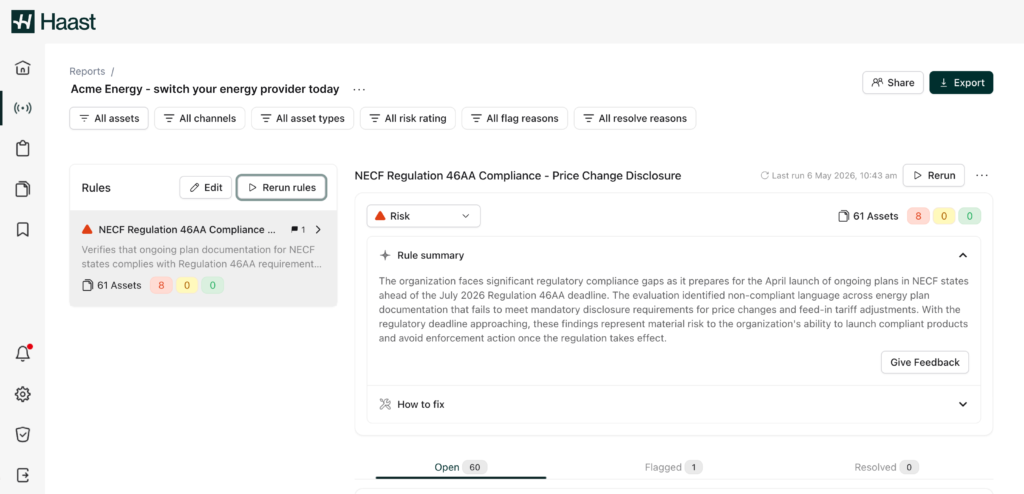
TLW: Haast started in marketing compliance and is now moving into horizon scanning, product compliance, and audit. How much of what the system learns about a client’s risk tolerance in one domain actually carries over to another – and how do you decide which adjacent area is a natural extension of the platform rather than a different product wearing the same name?
Kunal: “Whether it’s content compliance, product compliance, or horizon scanning – learning the risk tolerance is really important to actually delivering value. The rules don’t transfer automatically between domains, but that organisational understanding does. What Haast builds is a model of how a specific organisation thinks about risk: what it flags, what it tolerates, where it draws lines that differ from a competitor in the same regulatory environment. That fingerprint is genuinely portable.
Horizon scanning is a good example of why it matters. The biggest problem with those tools today is the ‘so what’ gap. Most of them tell you what has changed and when. None of them tell you what it actually means for your business, or what you need to do to become compliant. They deliver information without operationalising it. Because we’ve built a deep understanding of a client’s policies and risk tolerance through content compliance work, we’re not just able to tell them what has changed and how it impacts them – we can actually operationalise the change. We know what their content needs to look like on the other side of it.”
Where Haast fits
Stripped of the framing, Haast is making a focused bet about where the difficulty in compliance actually sits. Not in finding the rules, which are public, and not in reading them, which a capable model now does well. The difficulty lies in the layer of judgment that determines how a specific organisation applies those rules to its own content, and that layer has stayed manual precisely because it has never been written down in a form software could use.
For a legal or compliance team weighing the product, the useful questions are practical ones. Does the embedded-workflow approach genuinely hold up against the adoption problem it identifies so clearly? Does the feedback loop capture judgment, or does it mostly average out a team’s past decisions? And can a capability proven on marketing content carry into the heavier compliance work the company is now building toward? For the wider legal tech market, Haast is a clean example of a thesis worth watching: that as foundation models close the gap on knowledge and drafting, the durable value moves toward the parts of legal work that were never written down at all.