
Legal teams have spent the better part of a decade refining how work moves through their department. Intake tools, contract lifecycle management platforms, and more recently AI copilots have all attempted to make that process more efficient.
But the structure itself has largely remained intact. Work arrives. A lawyer picks it up. Technology assists along the way.
Flank takes aim at that structure directly.
The company’s proposition is that enterprise legal teams can insource routine work to AI agents rather than sending it to outside counsel or contract lawyers. It is built on a specific assumption: that a meaningful portion of legal work does not need to be assisted, it can be executed. That distinction changes where the primary bottleneck arises, and by extension, what the lawyer’s role looks like.
From assistance to execution
Much of the current generation of legal AI sits alongside the lawyer. It drafts faster, searches more broadly, and surfaces risks more efficiently. But the lawyer remains the operator.
Flank shifts that role.
Its agents sit inside the tools the business uses from day to day, most notably email, and pick up inbound legal requests directly. The process is essentially this: a commercial team sends an NDA or a question to a shared inbox. The agent reads it, determines what is required, and executes the task, be it drafting, reviewing, redlining, or responding. Only once the work is complete does it reach legal, where it is reviewed through a supervision layer before being sent back.
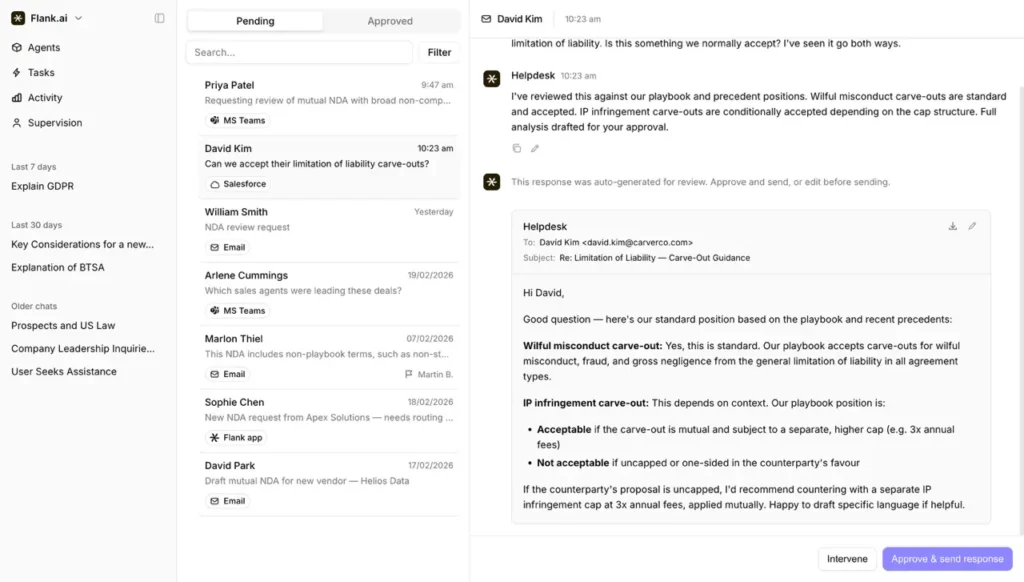
The implication is straightforward. Legal is no longer processing every request from the beginning. It reviews completed outputs and intervenes where necessary. The function shifts from execution toward oversight.
What “agentic” actually means here
The term “agentic AI” has been used broadly over the past year, often to describe systems that can perform more than one step at a time. Flank takes a more structured view.
Their internal definition rests on four conditions: the system must execute tasks end-to-end; operate within the customer’s own legal logic; handle multiple task types within a workflow; and embed supervision as a core feature rather than a safeguard added later.
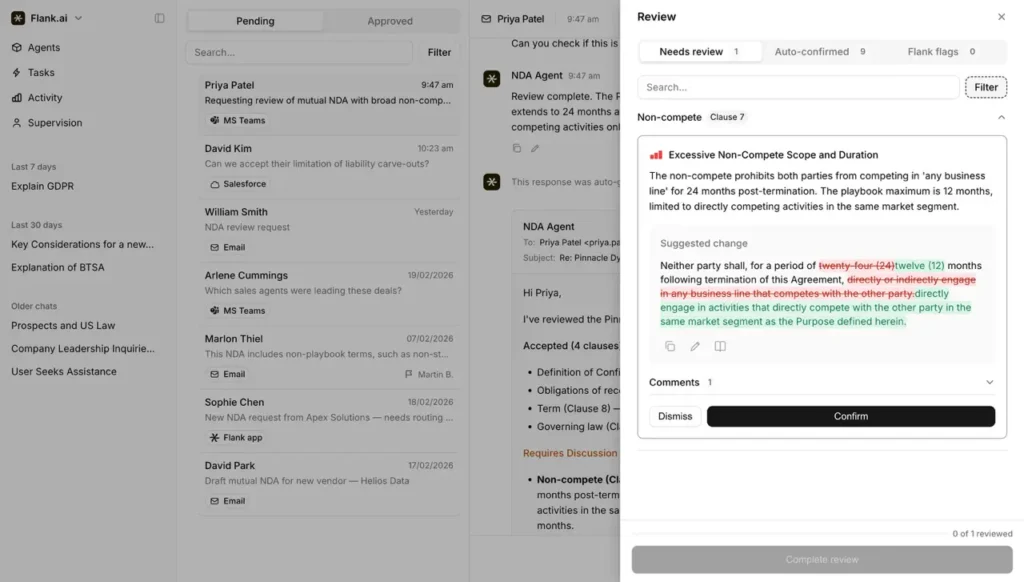
In practical terms, this means an agent does not stop at identifying issues in a contract. It applies playbook-aligned redlines, prepares outputs, and routes them appropriately, all within guardrails set by the legal team.
This week, we spoke with Jake Jones, Co-founder and COO of Flank, to find out how the company is pushing legal AI beyond workflow support and into supervised execution.
TLW: The market is full of products claiming to be “agentic.” From your perspective, what actually separates a system that executes legal work end-to-end from one that is simply automating multiple steps and where do most products fall short of that distinction in practice?
Jake: “The test I’d apply is simple: can you give the system a task and walk away? Not ‘walk away and hope’, walk away because there is a supervision layer that catches anything the agent isn’t confident about. Most products that call themselves agentic are really multi-step copilots. They still need a lawyer in the loop at every stage. The difference is whether the system is doing the work or whether it’s helping someone else do the work. We built Flank so that legal teams can insource their routine volume to agents – NDAs, vendor DPAs, standard amendment – and get it back fully executed, reviewed, and ready. If the lawyer still has to read every output and make every call, you haven’t removed the bottleneck. You’ve just moved it.”
The inbox as the legal front door
One of the well-considered design decisions in Flank is its choice to operate through email.
Legal tech often introduces new interfaces: portals, dashboards, intake forms. But adoption often stalls, because the more behavioural change a tool requires, the slower uptake becomes.
With its email integration, Flank avoids this. From the business user’s perspective, nothing changes. They send an email, attach a document, and describe what they need. The response arrives minutes later. There is no login, no training, no visible system.
Internally, however, the structure is different. The inbox is no longer a queue waiting to be processed. It becomes a channel through which work is resolved.
Supervision as a product layer
Execution introduces a predictable concern: control.
Flank addresses this through a supervision model built into the product rather than layered on top. Legal teams can choose how and when to review outputs, from full approval on every task to escalation-based review where only uncertain or high-risk outputs are surfaced. There is also a managed supervision option, where experienced legal professionals oversee outputs during deployment or at scale.
The effect is that the system does not require an immediate leap to full autonomy. It can be introduced gradually, with legal retaining visibility and control throughout. As confidence builds, the level of intervention can decrease.
TLW: You built supervision into the product as a core design principle. Where do you think human oversight remains non-negotiable, even as agent capability improves and legal teams grow more confident in autonomous execution?
Jake: “Supervision isn’t a concession to caution — it’s the reason the system works. The question isn’t whether AI will eventually be capable enough to operate without oversight. It’s that legal teams need to trust the output today, and trust is earned through a process, not a benchmark. There are categories where I think human review stays non-negotiable for a long time: anything involving novel counterparty risk, bespoke commercial terms that sit outside the playbook, or matters where the regulatory environment is shifting underneath you. But the bigger point is that the work never leaves your building. The agents operate inside your infrastructure, applying your playbook, with your lawyers reviewing the output. That’s a fundamentally different proposition from sending a stack of NDAs to an outside provider and hoping the quality holds.”
Operating on a company’s legal logic
A recurring limitation in legal AI tools is their reliance on generalised knowledge. They can explain what is typical in the market, or what the law allows, but they struggle to reflect how a specific organisation chooses to operate.
Flank addresses this problem by grounding agents in the company’s own materials: templates, playbooks, fallback positions, and prior negotiations. This is not simply a matter of retrieval; it is behavioural. Agents apply the organisation’s negotiation style, its thresholds for risk, and its preferred language automatically.
Over time, that creates consistency across outputs that is difficult to maintain manually, particularly in large or distributed teams. It also reduces a familiar friction point: the variation in how different lawyers approach similar issues.
A different approach to scale
Legal teams are, almost by definition, capacity-constrained. Demand scales with the business, but headcount rarely keeps up.
Most technology has attempted to address this by making individual lawyers faster. The gains are real, but incremental.
Flank’s approach is different. If routine work can be executed autonomously, capacity becomes less tied to headcount. One lawyer can supervise the output of multiple agents. The constraint shifts from time spent executing tasks to time spent reviewing exceptions.
This has implications beyond efficiency. It affects cost structure, turnaround time, and the extent to which legal can operate as an on-demand function within the business. Flank positions itself within what it describes as the “legal services displacement” market — a deliberate choice that puts the company in competition not with other legal tech tools, but with the work currently flowing to outside counsel and contract resource providers.
TLW: Flank frames itself as operating in the “legal services displacement” market rather than traditional legal tech. How do you see that playing out commercially, specifically in terms of how legal teams are making the case internally for shifting spend away from outside counsel?
Jake: “The budget question is the thing that clarifies everything. Legal software typically competes for a line item of a few hundred thousand pounds. The budget we’re displacing — outside counsel, secondments, ALSPs — is ten to fifty times that size, and it’s controlled by the GC and the CFO, not the legal ops team. That’s a different commercial conversation entirely. What we’re seeing is that the teams who adopt Flank often aren’t making a technology purchasing decision. They’re making a resourcing decision: do I keep sending this volume of work out, or do I insource it to agents that operate inside my own environment, on my own playbook, supervised by my own lawyers? The internal business case almost writes itself once you frame it that way, because you’re not asking for new budget — you’re redirecting spend that’s already approved.”
Where Flank fits in the broader market
The emergence of agent-based systems comes at a moment when expectations around AI in law are shifting.
Early enthusiasm focused on productivity gains: faster drafting, quicker research, improved document review. Those capabilities are now becoming table stakes. The next question is whether technology can change the operating model of a legal team, not just the pace at which individual tasks are completed.
Flank is positioned within that shift.
It does not attempt to replace legal teams, nor does it position itself as a system of record. It focuses on a specific layer: the volume of repeatable, time-consuming legal work that sits between the business and the lawyer.
By addressing that layer through execution rather than assistance, it offers a different way of thinking about how legal work can be delivered.
TLW: In practice, where do agentic systems still struggle today? Are there specific types of legal work or edge cases where human intervention remains essential, even with well-defined playbooks and strong supervision tooling?
Jake: “The honest answer is that agents struggle most with work that requires genuine novelty, the counterparty who sends a completely non-standard document structure, the negotiation where the commercial relationship is more important than the legal position, or the regulatory question where the law itself is unsettled. Those are the cases where experienced judgement matters and where supervision earns its keep. But that’s perhaps fifteen to twenty percent of the volume most legal teams handle. The other eighty percent is patterned, repeated, and well-understood work where the playbook is clear and the risk is low. That’s the layer agents should be executing, and it’s the layer that currently absorbs the majority of a legal team’s time and outside spend. The goal is not to eliminate the need for lawyers. It’s to make sure lawyers are spending their time on work that actually requires them.”