We’ve written about SettleIndex before at The Legal Wire, but a new update has us taking a fresh look. The platform, known for applying mathematical rigor to litigation risk, has recently introduced AI-powered automation that promises to make modeling faster, smarter, and more accessible to lawyers. CEO Robert Hogarth shared a sample report with us that shows how their latest evolution is reshaping litigation strategy in real-world cases.
Custom Models to Click-and-Go Risk Analysis
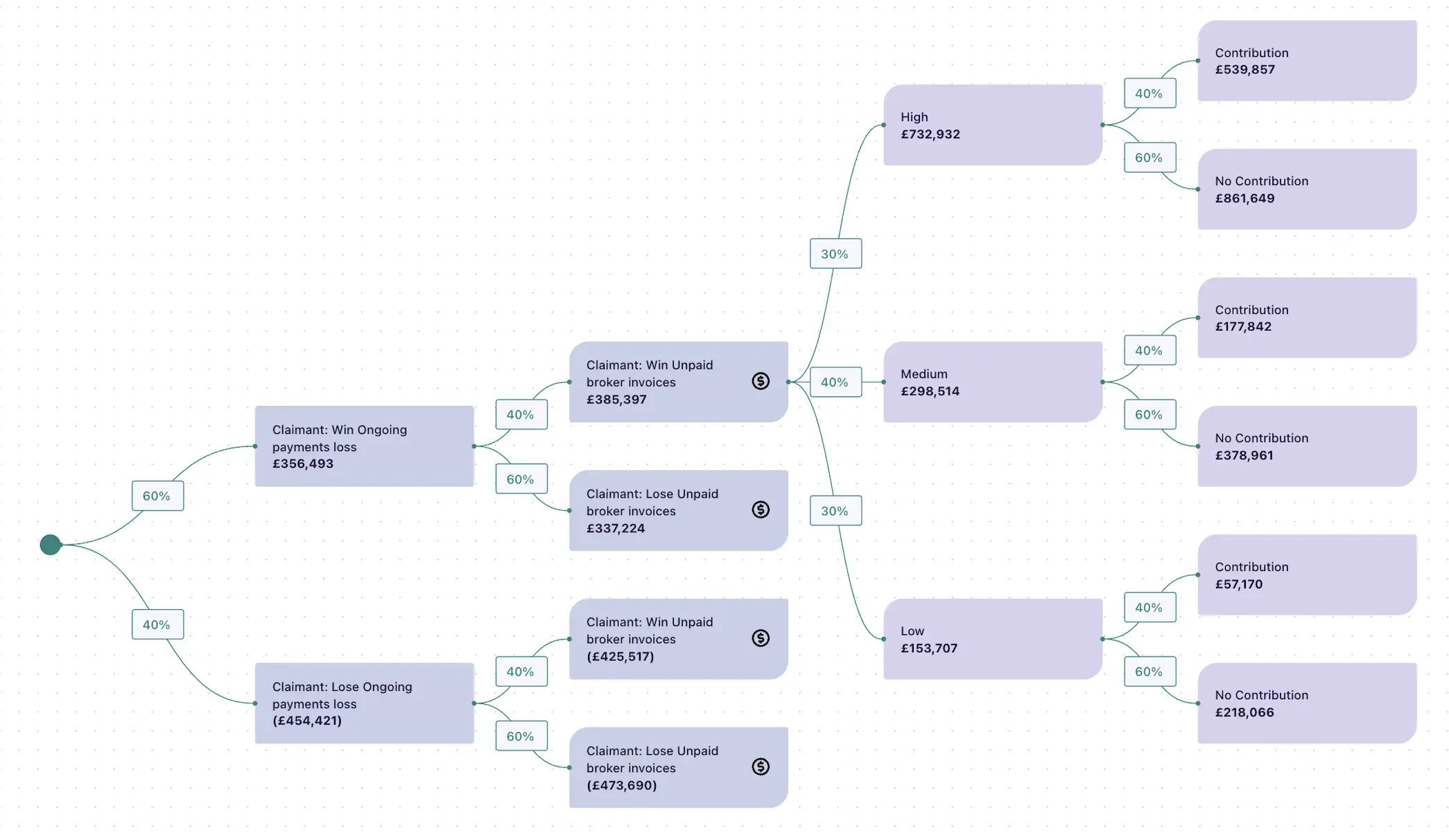
SettleIndex has moved beyond manual inputs to a streamlined, AI-enhanced workflow. Instead of building models from scratch, users now upload claim documents: letters or pleadings, and the system handles the rest. Within a minute (yes, a minute!), SettleIndex extracts the amounts claimed and the key legal issues. It then generates a dual-perspective litigation risk model using decision tree theory.
We recently spoke with Robert to dig a little deeper into what’s new at SettleIndex.
TLW: The new dual-party modeling shows both claimant and defendant positions, what is the benefit of this for clients such as law firms and insurers?
Robert: “One of the problems in litigation risk modelling is that it takes two to tango. It doesn’t help one party to create a scientific risk model, if they are negotiating with an opponent who takes an irrational view of their chances. A brilliant aspect of SettleIndex is that it produces a neutral valuation of the dispute, which both parties can share. The parties can adjust any parameters, but they will be starting from a fair settlement figure. This has the power to change behaviour, which is necessary for clients to see the benefits.”
In the sample report that Robert recently shared with us, the outcome of this AI-enhanced workflow is clearly demonstrated. From the Herbco report (video also available here), the model outputs key insights and figures, including case targets, KPIs, estimated positions, the settlement strategy that each party is following, the range of possible outcomes, a summary of the case facts, as well as a Model Settlement Value, the point where both parties benefit more from settling than from going to trial. A shaded visualization highlights mutual gain zones, sunk costs, and areas of mutual loss. It’s an efficient, visual way to grasp the negotiation landscape, but more importantly, it’s a major strategic asset for a litigator.
TLW: Your sample report clearly visualizes mutual gain zones. How important is visualization in getting lawyers and clients to rethink settlement strategy?
Robert: “Most lawyers have never seen our Settlement Chart. Once understood, it becomes a potent way of visualising claims at the highest level. In fact, the whole SettleIndex report follows an identical format for every case, so the process of quickly assimilating or comparing many cases becomes a simple task.”
It allows teams to assess not just what their client wants, but what the other side likely considers rational. That makes for better planning and fewer surprises.
A Competitive Edge in an Evolving Market
Unlike broader litigation analytics platforms that focus on historical court data or document review tools optimized for discovery, SettleIndex is purpose-built for settlement forecasting. It combines fast document extraction, dual-party analysis, and mathematical modeling in one tool. The result is something distinct: an interface where both legal intuition and economic logic work in tandem.
Robert also mentioned that SettleIndex has been accepted into Guidewire’s Insurtech Vanguard programme, the dominant claims platform for insurers. This strategic positioning could open a path to widespread adoption in the insurance industry, where reserve accuracy and quantifiable risk are critical. For corporate legal departments and insurers alike, SettleIndex offers something few platforms can: a way to measure, model, and manage litigation exposure proactively.
TLW: Acceptance into the Guidewire programme seems like a major step forward. What does that unlock for you in terms of scaling adoption or embedding into existing legal/insurance workflows?
Robert: “This should lead to integration once Guidewire customers start to use our software. One of the major difficulties faced by new legal tech companies is distribution, so obviously we are very excited by the prospect that our software could become available to all users of Guidewire.”
Building Confidence Through Calibration
Another interesting aspect of SettleIndex’s development is how it’s validating its models. The team is currently uploading cases that have already been settled to benchmark the tool’s predictive accuracy. The goal is to achieve predictions within ±10% of actual outcomes, an ambitious target, but one that, if met, would provide much-needed confidence for risk-averse industries.
This calibration process not only improves the forecasts, but creates a feedback loop for continuous improvement. It’s a grounded way to build credibility, especially in a field where accuracy can influence multi-million-pound decisions.
What’s Next for SettleIndex?
With this level of automation, SettleIndex is positioning itself as a standard-bearer for AI in litigation strategy. With momentum building around SettleIndex’s AI-driven evolution, we had a final question for Robert: since SettleIndex has moved from manual modeling to a fully AI-powered workflow, what hurdles did you and your team have to overcome in building trust in their system?
Robert: “Although we are using AI to extract and supply inputs, models are builtdeterministically using our own software. All of its structure and the inputs that go into creating reports can be inspected in detail. We are testing with Claimant and Defendant lawyers, but the early results show a high correlation between our forecast and the actual eventual settlement. The striking revelation is that in over 95% of cases studied both parties would have done better by settling for our ‘Model Settlement Value’ early on. Our ability to demonstrate that SettleIndex can give very good estimates on past cases gives users the confidence to trust it on live cases. We anticipate that when users make their own adjustments to the model on live cases the results would get even better.”
As legal teams face mounting pressure to predict outcomes, control costs, and guide clients toward strategic settlements, tools like SettleIndex may become less of a luxury and more of a necessity. We’ll be watching closely as it moves from model to mainstay.