
What does the future of legal research and drafting look like? According to LexisNexis, it’s a single, secure interface where authoritative legal content, your own firm’s documents, and the open web can all talk to each other. This powerful combination is exactly what the new generation of Protégé General AI promises to deliver.
Unveiled on 10 December 2025, the revamped Protégé General AI, which is now available within Lexis+ AI, introduces a unified, multi-source workflow that blends legal precision with real-world context. With it, lawyers can draft, research, and iterate on complex matters using both trusted LexisNexis content and new generative models, with Shepard’s® Citations built directly into the engine.
As always, we’re intruiged to know what sets Protégé apart in a crowded AI race. We shot a few questions over to Serena Wellen, Vice President, Product Management to find out. For starters, it’s the first platform to actively orchestrate interactions between multiple agents: one coordinating tasks, another handling legal research, one fetching web insights, and another navigating your own documents. Together, these agents do more than summarize – they plan, reason, and build strategy alongside you.

TLW: How do you define the boundary between assistance and autonomy in an agentic system that collaborates across sources?
Serena: “Great question. In practice, the boundary between assistance and autonomy in an agentic system isn’t a single line—it’s a set of guardrails that define who decides, who acts, and who is accountable, especially when the system is reasoning across heterogeneous, high-trust sources like LexisNexis, customer documents, and the open Web. I would say that a core distinction involves decision authority vs. execution support. In the case of Protege General AI, the system supports human judgment. It retrieves, synthesizes, explains, and proposes. However, final decisions, interpretations, and actions remain human-owned.
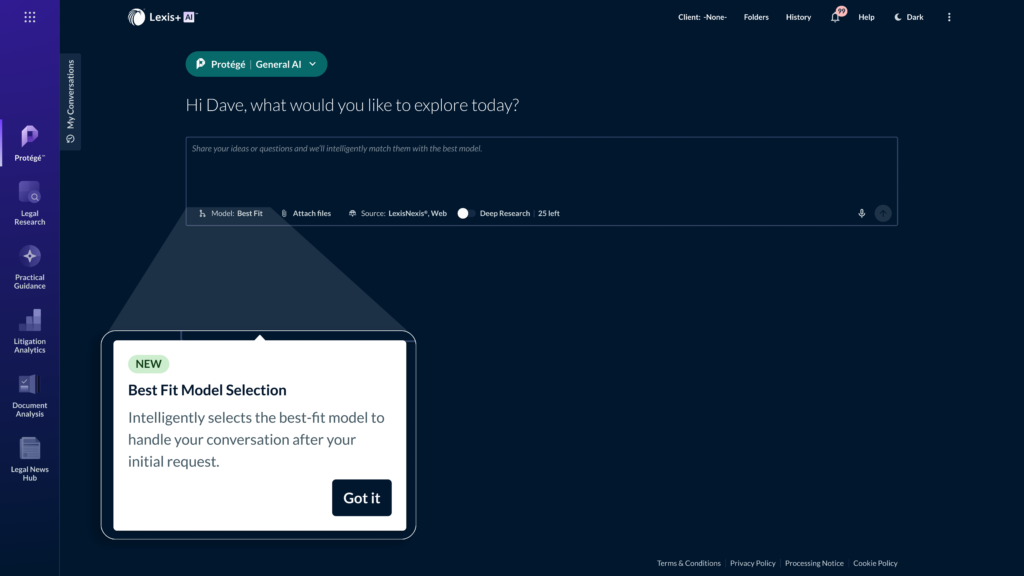
For instance, Protégé General AI introduces a “Best Fit” mode that automatically selects the optimal model for each task. Still, lawyers retain control as they can toggle between Claude Sonnet 4.5, GPT-5.1, and other recent models depending on the nuance required. All of it takes place in a secure, fully encrypted environment that supports firm-specific privacy needs.”
There’s also a new depth to research. The updated platform enables advanced reasoning on complex matters, from multi-party disputes and M&A workflows to emerging crypto regulation. In addition, it arms lawyers with a toolkit to benchmark, validate, and iterate faster than ever.
TLW: With “Deep Research” and open web integration now part of the platform, how does LexisNexis ensure responses remain authoritative and risk-managed?
Serena: “LexisNexis pairs expanded retrieval (Deep Research + open web) with layered controls that prioritize provenance, verification, and accountability, so the system gets broader without getting riskier. Protégé is designed so answers are grounded in identifiable sources, not just fluent text. Responses are tied to retrieved documents, with linked citations verified by our Shepard’s citator service and open web source references. This makes outputs auditable—users can trace, review and verify the underlying source material for the model’s response.”
The power here isn’t just in the AI itself, it’s in how it’s being tailored. Protégé knows when to guide users toward a deeper legal analysis and when broader context is helpful. It also keeps citation integrity front and center through Shepard’s® checks and source labeling. That balance between speed and trust isn’t easy to achieve, but LexisNexis seems committed to threading the needle.
Another standout? Flexible source control. Users can determine whether a prompt pulls from LexisNexis content, customer uploads, the web, or all three. That kind of transparency is quite rare in general AI tools.
TLW: How are enterprise clients using custom document ingestion to personalize Protégé for their own practice areas or client needs?
Serena: “Enterprise clients ingest their own precedent and know-how into Protégé, so that it reasons the way their lawyers do. Commonly ingested materials include firm-approved templates, like contracts, pleadings, and briefs, as well as prior deal documents or litigation filings. The resulting personalization allows drafts to mirror the firm’s document structure, language, and style.”
The timing of this update, just months after the October 2025 launch, signals an aggressive iteration cycle and a clear signal to the market: LexisNexis intends to lead not just on content, but on capability.
TLW: What does rapid iteration mean for users? Should firms expect monthly updates, major quarterly rollouts, or more user-driven features through 2026?
Serena: “We are constantly experimenting with the latest emerging generative AI technologies, assessing how we might use them to meet more of our customers’ needs and transform their workflows. Our partnerships with all of the major model providers allow us early access to the latest models, tools and frameworks. And our deeply experienced AI team closely watches the trends in AI research globally to see what is emerging and where we should experiment. We then bring those innovations directly into the product as soon as the quality and performance meets our high standards. At the same time, we are constantly obtaining feedback and data from our customers on where to improve and where our product needs to transform.”
The goal? To make AI less of a bolt-on tool and more of an embedded, everyday ally. Protégé General AI is aiming to work like their best-prepared, best-read research partner, one that’s always available, always up to date, and now, more versatile than ever.